Contact Us
Table of contents
Introduction
Managing IT hardware used to be simple.
A company would buy computers, assign them to employees, and replace them when they stopped working. Most businesses tracked everything in spreadsheets or basic inventory lists, and for smaller environments, that worked well enough.
But modern IT environments are much more complex.
Platforms like Asset Vue help organizations gain real-time visibility into hardware assets while reducing manual tracking and inventory errors.
Let’s understand how hardware asset management works and why it has become essential for modern businesses.
What Is Hardware Asset Management (HAM)?
Hardware Asset Management (HAM) is the process of tracking and managing physical IT assets throughout their entire lifecycle.
These assets can include:
- Laptops
- Desktop computers
- Servers
- Networking equipment
- Mobile devices
- Monitors
- Printers
- Scanners
- And other Enterprise Hardware
The goal of hardware asset management is simple:
Organizations need to know:
- What hardware they own
- Where it is located
- Who is using it
- What condition it is in
- When it needs maintenance, replacement, or disposal.
Without a structured system, managing IT hardware becomes difficult very quickly, especially for large organizations with multiple locations or remote employees.
This is why many businesses use hardware inventory management software or a centralized asset management system to automate asset tracking and maintain accurate inventory records.
Instead of relying on spreadsheets and manual updates, companies can track assets in real time using technologies such as:
- RFID tags
- Barcode labels
- Mobile scanning
- Automated discovery tools
- Cloud-based asset management platforms.
Some organizations also combine hardware tracking with broader IT asset management strategies to improve visibility across both physical devices and software environments.
Why Hardware Asset Management Matters in Modern Enterprises
Modern businesses rely heavily on technology to operate efficiently.
Employees use laptops and mobile devices daily. Data centers depend on servers and networking hardware. Warehouses use scanners and connected equipment to manage operations. Healthcare organizations track critical medical devices and IT infrastructure across multiple facilities.
As organizations grow, managing all of these assets manually becomes nearly impossible.
Without proper computer hardware inventory management, businesses often face problems such as:
- Duplicate hardware purchases
- Lost or stolen devices
- Inaccurate inventory data
- Compliance issues
- Delayed audits
- Increased security risks
One of the biggest challenges is the existence of "ghost assets."
Ghost assets are devices that appear in records but no longer exist physically, or devices that exist physically but are missing from inventory systems. Both situations create financial and operational problems.
For IT and security teams, unmanaged devices can also become serious cybersecurity risks. If a company does not know a device exists, it cannot properly monitor, update, or secure it.
The Complete Hardware Asset Lifecycle
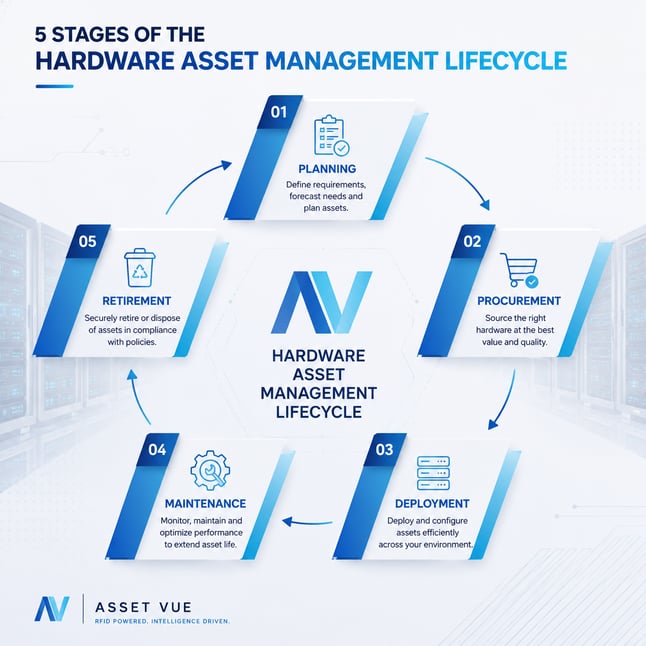
Managing hardware assets is not only about knowing where devices are located. A strong hardware asset management strategy also focuses on the entire lifecycle of every asset.
From the moment a company plans to purchase equipment until the day that equipment is retired, every stage affects costs, security, productivity, and operational efficiency.
Organizations that manage the full lifecycle properly often reduce unnecessary spending, improve inventory accuracy, and avoid compliance issues.
Let’s break down the five main stages of the hardware asset lifecycle.
1. Planning & Procurement
Everything starts with planning.
Before purchasing hardware, organizations need to understand:
- What equipment is required?
- How many devices are needed
- Who will use them
- And how long those assets are expected to last.
Without proper planning, businesses often overspend on unnecessary hardware or purchase equipment that does not match operational requirements.
During procurement, IT and finance teams usually focus on:
- Budgeting
- Vendor selection
- Warranty coverage
- Lease or purchase decisions
- And standardizing hardware models across the organization.
Modern hardware asset management software helps centralize procurement records so companies can track purchase dates, serial numbers, warranties, and asset ownership from day one.
This creates a reliable source of truth for future inventory management and audits.
2. Asset Deployment & Assignment
Once hardware is purchased, the next step is deployment.
This stage includes:
- Configuring devices
- Assigning assets to employees or departments
- Tagging equipment
- Updating inventory systems
For many organizations, this is where tracking problems begin.
If assets are not properly recorded during deployment, companies quickly lose visibility into who has what equipment and where devices are located.
For example, enterprise organizations using RFID-based asset tracking systems can quickly scan multiple assets at once instead of manually checking every device individually.
This improves efficiency while reducing human error.
3. Maintenance & Asset Optimization
Once assets are actively being used, organizations need to maintain and optimize them throughout their operational life.
This stage focuses on keeping hardware functional, secure, and cost-effective.
Typical maintenance activities include:
- Repairs
- Software updates
- Hardware upgrades
- Warranty management
- Performance monitoring
A good asset management system helps IT teams monitor hardware condition and identify assets that may need replacement before failures happen.
4. Asset Retirement & Secure Disposal
Every hardware asset eventually reaches the end of its lifecycle.
Devices may become outdated, damaged, unsupported, or too expensive to maintain.
At this stage, organizations need a structured retirement process to ensure assets are removed securely and responsibly.
This usually includes:
- Data wiping
- Device decommissioning
- Recycling
- Disposal documentation
- Inventory updates
Proper disposal is especially important for security and compliance.
Old devices may still contain sensitive company or customer data. Without secure data removal procedures, organizations risk data breaches and regulatory issues.
A strong computer hardware inventory management process ensures retired assets are fully removed from active inventory systems, preventing ghost assets and inaccurate reporting.
Key Features of Hardware Asset Management Software
Not all hardware asset management solutions offer the same capabilities.
Some platforms only provide basic inventory tracking, while more advanced systems include automation, RFID tracking, real-time visibility, reporting tools, and lifecycle management features.
Below are the most important features businesses should look for when evaluating hardware asset management software.
Automated Asset Discovery
One of the biggest problems with manual inventory tracking is incomplete or outdated records.
Devices are constantly being added, moved, replaced, or removed from networks. When updates rely on spreadsheets or manual entry, inventory accuracy quickly declines.
Automated asset discovery solves this problem.
Modern hardware inventory management software can automatically detect devices connected to a network and add them to the inventory system. This gives IT teams better visibility into all active hardware across the organization.
Real-Time Asset Tracking
Real-time visibility has become one of the most valuable features in modern asset management systems.
Instead of relying on periodic manual audits, organizations can continuously track the location and movement of hardware assets.
This is commonly done using technologies such as:
- RFID tags
- Barcode labels
- Mobile scanning tools
- Wireless asset tracking systems
RFID-based tracking is especially valuable for organizations managing large volumes of equipment because it allows multiple assets to be scanned simultaneously without direct line-of-sight scanning.
For example, enterprise environments like:
- Data centers
- Healthcare facilities
- Warehouses
- Large campuses
often use RFID-powered systems to improve inventory accuracy and reduce the time spent on audits.
Lifecycle & Warranty Management
Tracking an asset’s lifecycle is just as important as tracking its location.
Without proper lifecycle management, organizations often continue using outdated hardware, miss warranty deadlines, or replace devices too early.
Modern asset management systems help organizations monitor assets from procurement to retirement.
Key lifecycle management features often include:
- Warranty tracking
- Maintenance scheduling
- Depreciation monitoring
- Repair history
- Refresh cycle planning
- End-of-life alerts
Automated notifications help IT teams take action before warranties expire or hardware failures disrupt operations.
This improves long-term planning while helping organizations reduce unnecessary replacement costs.
Reporting, Analytics & Audit Readiness
Accurate reporting is critical for IT, finance, operations, and compliance teams.
Hardware asset management software helps organizations generate real-time reports related to:
- Inventory status
- Asset utilization
- Maintenance history
- Audit records
- Depreciation
- Compliance requirements.
Instead of manually collecting information from multiple sources, businesses can quickly export reports from a centralized platform.
Benefits of Using Hardware Asset Management Software
For many organizations, hardware asset management starts as a way to track devices more accurately.
But over time, businesses realize the benefits go far beyond inventory management.
A well-implemented hardware asset management system can improve operational efficiency, strengthen security, reduce costs, and help organizations make better long-term IT decisions.
Here are some of the biggest benefits businesses gain from using modern hardware inventory management software.
Improved Asset Visibility
One of the biggest challenges in large IT environments is simply knowing what assets exist and where they are located.
Without centralized visibility, organizations often deal with:
- Outdated inventory records
- Missing devices
- Duplicate purchases
- Disconnected asset data across departments
Hardware asset management software creates a single source of truth for all physical IT assets.
IT teams can quickly see:
- What devices are active
- Where assets are located
- Who is using them
- Current status of each asset
For organizations managing multiple locations, warehouses, campuses, or remote employees, this level of visibility becomes extremely valuable.
Reduced IT Costs
Poor asset tracking often leads to unnecessary spending.
Many businesses purchase new hardware simply because they cannot locate existing equipment or do not know what assets are available.
With better computer hardware inventory management, organizations can:
- Identify unused assets
- Redeploy existing equipment
- Avoid duplicate purchases
- And optimize hardware utilization
Lifecycle management features also help companies plan hardware refresh cycles more effectively, reducing emergency replacement costs and extending the usable life of equipment where appropriate.
Stronger Security & Compliance
Every unmanaged device creates potential security risks.
If IT teams do not know a device exists, they cannot properly monitor, update, or secure it.
Hardware asset management software improves security by helping organizations maintain accurate records of all connected hardware assets.
This allows teams to:
- Identify unauthorized devices
- Track missing equipment
- Monitor hardware status
- Support cybersecurity policies
Many organizations also integrate asset management systems with IT service management and security platforms to improve incident response and infrastructure visibility.
Compliance is another major advantage.
Industries such as healthcare, education, government, and finance often require organizations to maintain accurate asset records for audits and regulatory requirements.
A centralized asset management application helps businesses maintain audit-ready documentation while reducing manual reporting work.
Faster Inventory Audits
Manual inventory audits are time-consuming and often stressful for IT and operations teams.
Tracking assets manually across multiple locations can take days or even weeks, especially in large enterprise environments.
Modern hardware asset management systems simplify this process by automating inventory tracking and reporting.
Organizations using RFID-based inventory systems can often scan large groups of assets simultaneously instead of checking devices one at a time.
This improves:
- Inventory accuracy
- Audit speed
- Operational efficiency
Real-time inventory visibility also reduces the need for frequent manual reconciliation between departments and inventory systems.
For businesses preparing for compliance audits or financial reporting, this can save significant time and resources.
RFID vs Barcode Asset Tracking: Which Is Better?
When organizations invest in hardware asset management software, one of the biggest decisions is choosing how assets will actually be tracked.
The two most common methods are:
- Barcode asset tracking
- RFID asset tracking
Both technologies help businesses manage inventory and improve asset visibility, but they work very differently.
The right choice depends on:
- Size of the organization
- Number of assets being managed
- Inventory frequency
- Pperational complexity
- Level of automation required
Understanding the differences between barcode and RFID tracking helps organizations choose a system that fits both current needs and future growth.
What Is Barcode Asset Tracking?
Barcode tracking uses printed labels attached to assets.
Each barcode contains a unique identifier that can be scanned using:
- Handheld barcode scanners
- Mobile devices
- Inventory scanning applications
How Barcode Tracking Works
The process is straightforward:
- A barcode label is attached to an asset.
- The asset is scanned during check-in, check-out, audits, or movement.
- The system records updates such as:
- location
- ownership
- status
- Inventory changes
Barcode systems work well for businesses that perform periodic manual inventory checks and manage a moderate number of assets.
What Is RFID Asset Tracking?
RFID stands for Radio Frequency Identification.
Instead of requiring direct scanning like barcodes, RFID uses radio signals to detect and identify tagged assets automatically.
RFID systems typically include:
- RFID tags
- RFID readers
- Antennas
- Asset Management Software
RFID technology is commonly used in enterprise environments where organizations need:
- Faster inventory processes
- Real-time visibility
- High inventory accuracy
- Automated tracking capabilities
This is one reason many enterprise asset management providers focus heavily on RFID-based solutions.
How RFID Tracking Works
Each asset receives an RFID tag containing unique identification data.
RFID readers can then detect those tags wirelessly without requiring direct line-of-sight scanning.
This allows organizations to scan multiple assets simultaneously, even if assets are inside cabinets, racks, or storage areas.
For example, an IT team conducting a data center audit can scan large groups of servers or equipment much faster than with manual barcode scanning.
Why Many Enterprises Are Moving Toward RFID
As IT environments continue growing, organizations need more automation and visibility than manual processes can provide.
RFID technology helps businesses:
- Reduce audit time
- Improve operational efficiency
- Strengthen asset visibility
- Maintain more accurate inventory records
This is especially valuable for organizations managing thousands of physical and IT assets across multiple locations.
Modern enterprise platforms that combine:
- Hardware Asset Management Software
- RFID tracking
- Mobile scanning
- Centralized reporting
Help organizations gain better control over hardware assets while reducing manual workload.
Industries That Benefit Most from Hardware Asset Management
Almost every organization today depends on technology and physical assets to operate efficiently.
But for some industries, managing hardware assets is especially critical because of the scale, complexity, compliance requirements, and operational risks involved.
These industries often manage thousands of devices across multiple facilities, departments, or locations. Without proper tracking systems, inventory quickly becomes difficult to manage.
This is why many organizations invest in advanced hardware asset management software, RFID inventory management systems, and real-time asset tracking solutions.
Below are some of the industries that benefit the most from modern hardware asset management.
Data Centers & Enterprise IT
Data centers and enterprise IT environments manage some of the most complex hardware infrastructures.
Organizations often track:
- Servers
- Storage systems
- Networking hardware
- Racks
- Power equipment
- Backup devices
Maintaining accurate inventory records in these environments is critical for:
- Operational continuity
- Security
- Maintenance planning
- Compliance reporting
Even a small inventory error can create major operational issues.
Modern computer hardware inventory management systems help enterprise IT teams maintain visibility into hardware assets across multiple facilities and locations.
RFID-powered asset tracking solutions are becoming increasingly common in data centers because they improve inventory accuracy while reducing manual audit time.
For enterprise IT teams, real-time asset visibility also helps improve change management and infrastructure planning.
Asset Vue solutions are widely used in enterprise IT and data center environments where accurate asset visibility and faster audits are critical.
Manufacturing
Manufacturing facilities rely on a wide range of physical assets to maintain production operations.
These assets can include:
- industrial computers
- handheld scanners
- tools
- machinery
- mobile devices
- and warehouse equipment.
In large manufacturing environments, assets often move frequently between departments, production lines, and facilities.
Without proper asset tracking, businesses may experience:
- lost equipment
- maintenance delays
- inaccurate inventory records
- and operational inefficiencies.
Hardware asset management software helps manufacturers:
- monitor asset usage
- schedule maintenance
- track equipment movement
- and improve operational visibility.
RFID inventory systems are especially useful in manufacturing because they allow organizations to automate tracking processes across large facilities with minimal manual effort.
Warehousing & Logistics
Warehousing and logistics operations depend heavily on accurate inventory visibility.
Organizations in this industry often manage:
- scanners
- mobile computers
- forklifts
- shipping equipment
- networking hardware
- and warehouse technology systems.
Since assets move constantly across warehouses and distribution centers, real-time tracking becomes extremely important.
Hardware asset management systems help logistics teams:
- reduce equipment loss
- improve inventory control
- manage maintenance schedules
- and optimize asset utilization.
RFID technology is commonly used in warehouses because it allows businesses to track large volumes of assets quickly and efficiently.
Compared to manual inventory methods, RFID systems can significantly improve audit speed and inventory accuracy.
Education & Government
Schools, universities, and government organizations often manage large inventories of shared devices across multiple buildings and departments.
This may include:
- student laptops
- classroom technology
- networking equipment
- office hardware
- and mobile devices.
Tracking these assets manually can become extremely difficult, especially when devices are frequently reassigned or moved between locations.
Hardware asset management software helps these organizations:
- maintain accurate inventory records
- improve accountability
- support compliance requirements
- and reduce missing equipment.
For government agencies and educational institutions, audit readiness is often a major priority. Centralized asset management systems simplify reporting while improving operational transparency.
RFID-enabled tracking solutions can also help large campuses manage inventory more efficiently across multiple facilities. Solutions like Asset Vue combine RFID tracking, barcode scanning, and centralized inventory management to help organizations maintain accurate hardware records across multiple locations.
How Asset Vue Supports Modern Hardware Asset Management
As organizations manage larger IT environments and distributed assets, many businesses are moving beyond spreadsheets and manual inventory tracking.
Modern hardware asset management requires:
- real-time visibility
- accurate inventory records
- faster audits
- and scalable asset tracking systems.
Asset Vue provides hardware asset management and RFID-powered asset tracking solutions that help organizations track, manage, and monitor physical and IT assets more efficiently.
Their solutions support:
- IT asset tracking
- RFID inventory management
- and enterprise asset visibility across large operational environments.
By combining:
- RFID technology
- Asset Management Software
- Mobile scanning
- Centralized reporting
Organizations can improve inventory accuracy, reduce manual workload, and maintain better control over hardware assets throughout the asset lifecycle.
Asset Vue solutions are commonly used in environments such as:
- Data Centers
- Warehousing
- Healthcare
- Manufacturing
- Enterprise IT operations where accurate asset visibility is critical.
Conclusion
Managing hardware assets is no longer a simple inventory task.
Modern organizations operate across multiple locations, support remote teams, manage growing IT infrastructures, and face increasing security and compliance requirements. In this environment, relying on spreadsheets or manual tracking methods creates operational risks that businesses can no longer afford to ignore.
Hardware asset management software helps organizations gain control over their physical and IT assets by improving visibility, inventory accuracy, lifecycle management, and operational efficiency.
Technologies like RFID tracking, barcode scanning, mobile asset management, and real-time inventory visibility are also transforming how enterprises manage hardware at scale.
As organizations continue investing in automation, cloud infrastructure, AI-driven analytics, and connected devices, hardware asset management will play an even larger role in supporting business operations and long-term growth.
Businesses that adopt scalable and centralized asset management solutions today will be better prepared to manage the increasing complexity of tomorrow’s IT environments.
With scalable solutions from Asset Vue, organizations can modernize hardware asset management while improving visibility, operational efficiency, and long-term asset control.


 FAQ
FAQ
Frequently Asked Questions
What is Hardware Asset Management Software?
Hardware Asset Management Software helps organizations track, manage, and monitor physical IT assets throughout their lifecycle. The software helps businesses maintain accurate inventory records, improve visibility, and automate asset tracking processes.
What is the difference between ITAM and HAM?
HAM stands for Hardware Asset Management and focuses specifically on physical IT equipment.ITAM, or IT Asset Management, is broader and includes:hardware,software,licenses,cloud assets,and other IT resources.
Why is Hardware Inventory Management important?
Hardware inventory management helps organizations:reduce asset loss,improve inventory accuracy,support compliance,strengthen security,and optimize IT spending.
How does RFID asset tracking work?
RFID asset tracking uses radio frequency technology to identify and track tagged assets wirelessly.
What are Ghost Assets?
Ghost assets are assets that appear in inventory records but no longer physically exist or assets that physically exist but are missing from inventory systems.
Can Hardware Asset Management improve cybersecurity?
Yes. Hardware asset management helps organizations identify and monitor all connected devices within the IT environment.
What industries benefit most from Hardware Asset Management?
Industries that commonly use hardware asset management systems include:healthcare,manufacturing,warehousing & logistics,education,government,enterprise IT,and data centers.These industries often manage large volumes of hardware assets across multiple locations and require strong inventory visibility and compliance tracking.
What is the benefit of real-time asset visibility?
Real-time visibility helps organizations instantly see:where assets are located,who is using them,and the current status of each device.