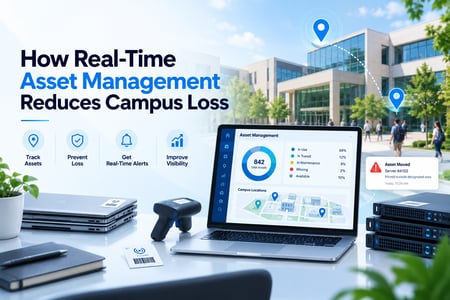
A missing laptop costs more than its replacement price. It costs the two hours an IT technician spends searching storage closets, the three emails to department heads asking who checked it out last, and the audit finding that flags a gap in your grant-funded equipment records. Multiply that by the hundreds of devices, lab instruments, and AV carts spread across a university campus, and equipment loss stops being an inconvenience. It becomes a budget problem.
Most higher education IT teams already know this. The harder question is why equipment keeps disappearing despite existing inventory processes. The answer, almost always, is that those processes rely on periodic counts instead of continuous visibility. Real-time asset management closes that gap by tracking where equipment is, who has it, and when it moves, without waiting for the next scheduled audit.
The shift from periodic to continuous tracking changes the math on campus equipment loss in ways that go well beyond finding lost laptops faster.
Most "lost" campus equipment was never stolen. It drifted.
When a university reports "lost" equipment, outright theft accounts for a small fraction. The bulk of missing assets are victims of what inventory managers call drift: a projector gets borrowed from one building and returned to a different closet. A laptop funded by a chemistry grant ends up in the English department's storage room after a faculty office move. An RFID reader sits in a box labeled "IT surplus" that nobody opens for 14 months.
Drift happens because campuses are physically large and organizationally complex. A mid-sized university might manage equipment across 40 to 60 buildings, each with its own departmental staff, storage protocols, and checkout habits. Equipment crosses departmental boundaries constantly, especially shared items like AV carts, testing instruments, and loaner laptops.
Spreadsheet-based tracking can't keep up with that movement. A quarterly inventory count tells you what's missing. It doesn't tell you when or how it went missing, which means it can't prevent the next loss.
What "real-time" means in practice for campus IT
Real-time asset management doesn't mean someone watches a blinking dot on a screen 24 hours a day. It means the system records every location change, custody transfer, and status update as it happens, so the data is current when someone needs it.
On the hardware side, RFID tags attached to equipment transmit location data to fixed readers or handheld scanners. When tagged equipment moves between zones, say from a chemistry lab to a shared storage room, the system logs the transition automatically. Barcode scanning fills the same role for manual checkouts: a technician scans the asset, scans the destination, and the record updates.
AssetVue RFID ITAM platform handles both methods. It maps assets to specific buildings, floors, rooms, and custodians within a single hierarchy, so IT teams and departmental admins see the same data without reconciling separate spreadsheets.
The result is a current inventory, not a historical snapshot. That difference is what separates "we know where everything is" from "we'll find out in December."
How continuous visibility reduces loss
Real-time tracking reduces equipment loss through shorter search windows, faster detection when something moves where it shouldn't, and stronger accountability at the individual level.
Shorter search times
When equipment goes missing under a periodic inventory system, IT staff retrace steps manually. They check the last known location (often outdated), contact the last assigned custodian (who may have transferred departments), and physically walk buildings until they find the asset or declare it lost.
Real-time tracking compresses this process. The system shows the asset's last recorded location and the timestamp of that reading. If a laptop was scanned into Room 204 of the Science Building on Tuesday at 3:15 PM, the search starts there, not at the IT help desk three buildings away.
Universities running RFID-based systems report that what used to take hours of manual searching drops to minutes. That time savings compounds across hundreds of assets per year.
Faster detection of unauthorized movement
Under periodic counting, a missing asset might go unnoticed for weeks or months. The gap between counts creates a window where equipment can leave campus entirely before anyone flags it as missing.
Continuous monitoring shrinks that window. If a tagged laptop leaves its assigned zone, the system can generate an alert the same day. That early detection matters because recovery rates for missing equipment drop sharply after the first 48 hours. A projector that gets flagged on Thursday afternoon is far more likely to be found than one that shows up missing during the December audit.
Stronger accountability through custody chains
Equipment loss correlates with weak custody tracking. When nobody's name is attached to an asset, nobody feels responsible for returning it.
Real-time systems build an automatic custody chain. Every checkout, transfer, and return gets logged with a name, timestamp, and location. This chain of custody means that at any point, someone is accountable for every piece of tracked equipment.
That accountability alone changes behavior. Departments that know their equipment records are visible and current tend to be more careful about returns and storage. Tracking finds missing equipment. Accountability keeps equipment from going missing.
The ghost asset problem
Ghost assets are items that appear on the books but no longer physically exist on campus. They might have been disposed of without updating the record, damaged beyond use, or simply walked off during a staffing transition.
Ghost assets cost money even though they don't exist. Insurance premiums stay inflated because coverage is calculated from the total asset list, including items that are long gone. Depreciation schedules get distorted, throwing off departmental budgets. And for grant-funded equipment, a ghost asset on your books can trigger compliance findings during a federal audit.
Real-time tracking reduces ghost assets by keeping records in sync with physical reality. When equipment gets disposed of, the system records the disposition. When it transfers between departments, the new custodian shows up immediately. The delta between what's on the books and what's actually on campus shrinks because the data refreshes continuously instead of once per quarter.
What this looks like across departments
Campus asset management isn't just an IT problem. Equipment is distributed across departments that manage their own budgets, follow their own processes, and have wildly varying comfort levels with technology.
A biology lab tracks expensive microscopes and centrifuges funded by NIH grants. The facilities team manages HVAC components and maintenance vehicles. The library circulates hundreds of loaner laptops and tablets to students each semester. Student housing has furniture, appliances, and network equipment spread across dozens of residence halls.
A real-time system needs to accommodate all of these without forcing every department into the same workflow. Role-based access lets departmental admins manage their own equipment within a shared platform, while central IT maintains oversight and reporting across the entire institution.
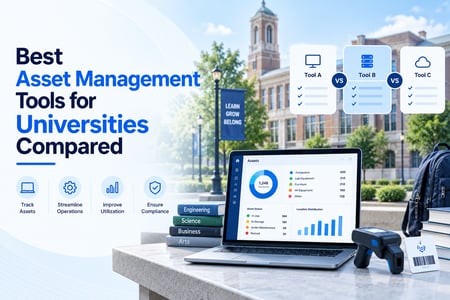
Comparing asset management tools for higher education comes down to this flexibility. Consumer ITAM products built for corporate offices assume a single-owner model. Campus environments need multi-dimensional ownership tracking: one laptop can be funded by a federal grant, assigned to a biology lab, checked out by a graduate student, and maintained by central IT, all at the same time.
What to look for in a campus asset tracking system
Not every asset tracking product fits a university's operational model. Before evaluating vendors, IT teams should confirm the platform handles:
Multi-site hierarchy: Buildings, floors, rooms, and outdoor spaces mapped in a single structure, not as separate databases that need manual reconciliation.
Mixed tagging methods: RFID for high-value or high-movement items. Barcode for everything else. Both feeding the same dashboard.
Custody history: A full audit trail showing who had what, where, and when, going back as far as the institution needs for compliance.
Role-based access: Departmental admins see their own equipment. Central IT sees everything. Finance sees depreciation and grant allocation. Nobody sees data they don't need.
Audit support: Exportable reports that satisfy institutional auditors, state regulators, and federal grant agencies without custom formatting work every cycle.
AssetVue helps universities track IT and physical assets across buildings, departments, and funding sources with RFID and barcode technology. Schedule a call to see how it works on your campus.


 Contact Us


 FAQ
FAQ