Contact Us
Table of contents
Ask an IT director how many assets the organization owns, and you get a number from a discovery tool. Ask the controller the same question, and you get a different number from a fixed asset register. Both are confident. Neither is wrong about its own scope. The gap between those two numbers is where equipment goes missing.
That gap exists because IT asset management and physical asset management were built to answer different questions, using different identification methods, for different departments. Understanding where the line falls tells you whether you need one system or two.
Key facts
- IT asset management tracks networked technology through its lifecycle: procurement, deployment, patching, licensing, refresh, and disposal.
- Physical asset management tracks tangible equipment through location and custody: where it sits, who holds it, and whether it still exists.
- IT asset management identifies assets by network discovery, software agent, and serial number. Physical asset management identifies assets by barcode label or RFID tag.
- Assets with no network footprint, including furniture, lab instruments, AV equipment, hand tools, and vehicles, stay invisible to network discovery.
- Hardware that is both an IT asset and a capitalized fixed asset often lives in two separate records that drift apart over time.
- Organizations with mixed asset populations need one record covering both disciplines rather than two systems reconciled by hand.
What is IT asset management?
IT asset management is the practice of tracking technology assets and software entitlements across their lifecycle, from purchase order through disposal, so the organization knows what it owns, what each item runs, and what it costs.
The discipline has a formal standard behind it. ISO/IEC 19770-1 defines requirements for an IT asset management system, and most enterprise ITAM programs also feed a configuration management database that maps dependencies between assets and the services they support.
The data collection is largely automatic. Agents installed on endpoints report back, network scanners poll for responses, and endpoint management platforms push inventory data on a schedule. An ITAM tool answers questions about state: is this laptop patched, is that license over-deployed, when does this server come off warranty, which assets are approaching refresh.
What is physical asset management?
Physical asset management is the practice of tracking tangible equipment by location, custody, condition, and value, so the organization can confirm that each item exists and find it when needed.
The same discipline goes by fixed asset management when the driver is accounting rather than operations. A fixed asset register records what was capitalized, what it cost, how it depreciates, and when it was disposed. The register is a financial document, and it decays the moment equipment moves without anyone updating it.
Data collection here is deliberate rather than automatic. Someone applies a barcode label or an RFID tag to the item, and a scan event updates the record. An RFID reader can capture hundreds of tags in a pass, which turns an annual count from a multi-week reconciliation into a walk-through. GPX Asset Management tracks roughly 250,000 fixed assets this way, with per-asset scan time dropping from 30 seconds to half a second and report generation falling from a week to 30 minutes.
How do IT and physical asset management differ in practice?
The two disciplines diverge on seven dimensions. The identification method is the one that drives everything else.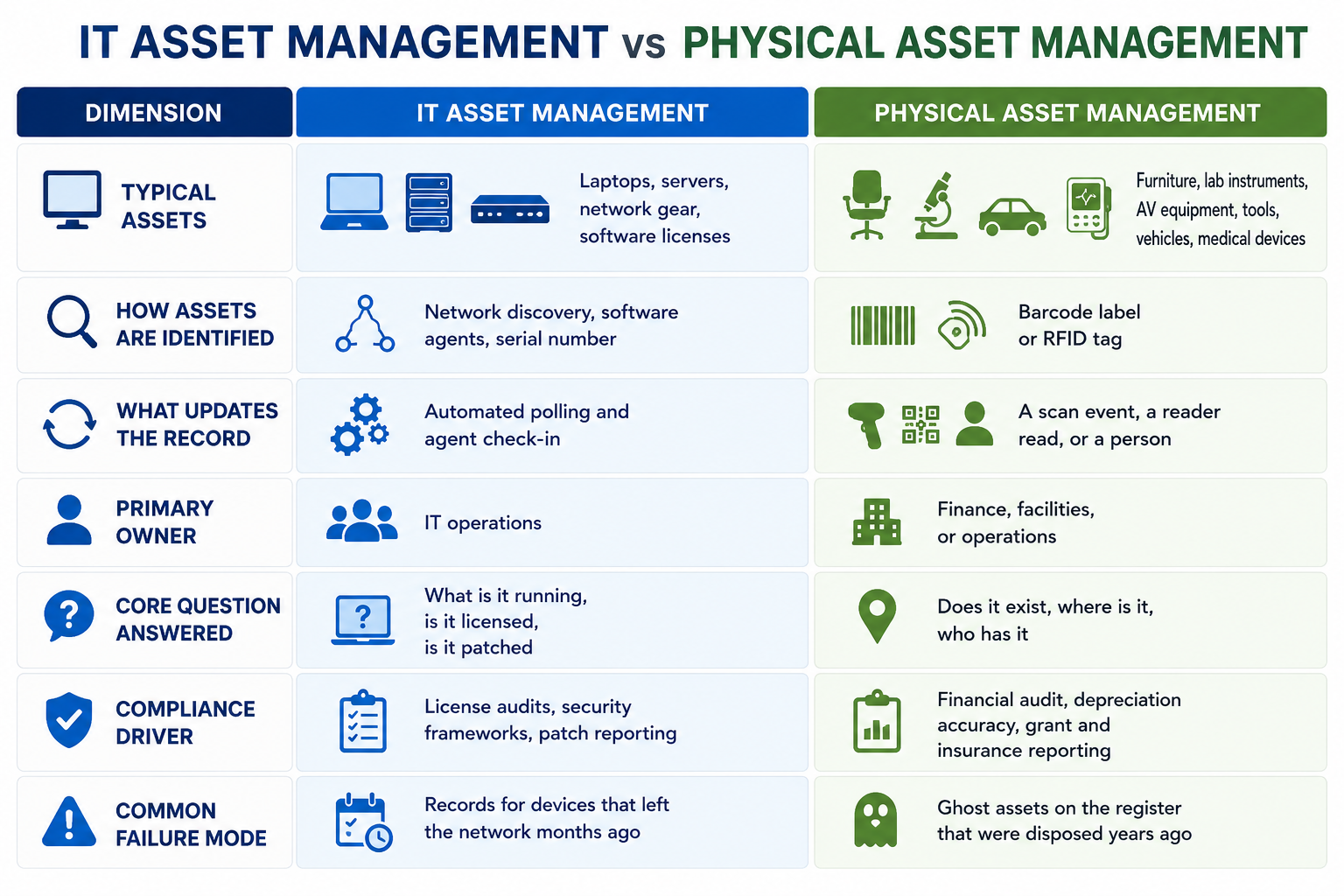
Read those two failure modes together. Both systems accumulate records for equipment that no longer exists, and both do it because nobody closed the loop on disposal. The difference is who gets hurt: IT carries phantom devices in its security scope, and finance carries depreciation on equipment that went to recycling three years ago.
Why does the network boundary matter so much?
Network discovery only finds assets that connect to a network, so any asset without a network footprint stays invisible no matter how capable the ITAM tool is.
The mechanics explain why. Agent-based discovery requires software installed on the device. SNMP polling requires the device to respond on the network. DHCP lease inspection requires the device to request an address. Endpoint management requires an operating system to manage. Each method depends on the asset being powered on, connected, and reachable.
Four categories fail those conditions routinely:
- Powered-off spares sitting in a storage room, which are still capitalized and still yours.
- Decommissioned equipment staged for disposal, which is the highest-risk population in the building.
- Off-network lab and clinical instruments that were never allowed on the corporate network.
- Everything that never had a network interface, from AV carts and projectors to furniture, tools, and test equipment.
Tagging closes this gap because a barcode or RFID tag does not care whether the asset has power or a network connection. That single property is the reason physical and fixed asset management exists as a separate discipline instead of a feature inside ITAM software.
Where do the two disciplines overlap?
The overlap is hardware that qualifies as both an IT asset and a capitalized fixed asset, which describes most of your expensive equipment.
A $2,400 laptop is a configuration item to IT and a depreciating asset to finance. A rack of servers is a set of managed hosts to one team and a capital purchase on a depreciation schedule to the other. Both teams need a record. Both teams create one. Neither record talks to the other.
The cost of that split shows up at audit. IT reports a device count from discovery, finance reports a different count from the register, and someone spends two weeks building a reconciliation spreadsheet to explain the variance. The variance is not a mystery. It is the predictable output of two systems tracking the same objects with different update triggers.
What breaks when you force one system to do both jobs?
Each direction fails in a specific way, and knowing which failure you are buying is more useful than a feature comparison.
ITAM software managing physical assets. Discovery finds nothing, so every record depends on manual entry that nobody sustains past the first quarter. The data model fights you too: there is usually no depreciation schedule, no custody or check-out chain, and no location hierarchy below site level. You end up with a spreadsheet running alongside the tool, which is the situation you were trying to fix.
Accounting software managing IT assets. The register has no patch state, no license entitlement, no warranty date, and no relationship map to the services a server supports. Its update cadence is the annual count, while IT hardware changes weekly. By the time the register is accurate, the IT estate has moved.
The pattern behind both failures is the same. Each tool was designed around an update trigger, automated polling in one case and a scan event in the other, and neither trigger covers the other tool's asset population.
Do you need one system or two?
Run a count comparison before deciding anything. It takes an afternoon and it is more informative than any vendor demo.
- Export the asset count from your discovery tool or endpoint management platform.
- Export the line count from your fixed asset register.
- Pull a list of asset categories that appear in the register but cannot appear in discovery, such as furniture, AV equipment, instruments, and tools.
- Compare the three numbers.
The third list is the population that no current system verifies. If it is small and low-value, keeping two systems and reconciling annually is defensible. If it holds material value, sits under grant or insurance reporting, or includes equipment that walks between buildings, you need one record covering both disciplines. Education, healthcare, and multi-site operations usually land in the second group, because their asset mix was never mostly networked to begin with.
What should a unified mixed-asset system handle?
Six requirements separate a system that covers both disciplines from one that covers IT and bolts on a spreadsheet.
- One record per physical item, carrying IT attributes and financial attributes together rather than in linked tables that fall out of sync.
- Tag-based identification through barcode and RFID, so an asset is findable without power or a network connection.
- A location hierarchy below site level, down to building, floor, room, and rack position.
- Custody and check-out tracking for shared and mobile equipment, which is how AV gear and loaner devices go missing.
- Bulk physical verification, so a full count is a walk-through with a handheld reader rather than a manual reconciliation.
- Export and integration into both the CMDB and the finance system, so IT and finance keep their own views of one shared record.
That last point decides adoption. Neither team will abandon its existing reporting, and neither should have to. The goal is one authoritative record of the physical object, with both teams reading from it.
Asset Vue covers IT and non-IT assets on a single platform using RFID and barcode tracking, with deployments across data centers, school districts, hospital networks, and multi-site operations. To see how it would map to your asset mix, schedule a call.


 FAQ
FAQ
Frequently Asked Questions
Our customers rely on Asset Vue to keep critical operations running smoothly. Here’s what they say about working with us.
Is physical asset management the same as fixed asset management?
They overlap heavily but answer to different owners. Physical asset management is operational and focuses on location, custody, and condition. Fixed asset management is financial and focuses on capitalization, depreciation, and disposal records. The same tagged item usually appears in both views, which is why a single record serving both is preferable to two registers.
Can IT asset management software track non-IT assets?
Most ITAM platforms allow manual records for non-IT items, but the discovery that makes ITAM accurate does not work on assets without a network connection. Without tag-based capture, those records depend on manual updates and drift quickly. Check whether the platform supports barcode or RFID scanning as a first-class capture method.
Do you need RFID for physical asset management?
No, barcode works and costs less per asset. RFID earns its cost when you count large populations frequently, need to read tags without line of sight, or track equipment that moves between rooms and buildings. A district tracking 25,000 assets annually may do fine on barcode, while a data center auditing racks monthly will save more labor with RFID.
Who owns physical asset management in most organizations?
Ownership usually sits with finance, facilities, or operations rather than IT, which is a large part of why the two disciplines stayed separate. In education it often falls to the business office, in healthcare to biomedical engineering or supply chain, and in multi-site operations to a regional operations manager.
Should IT and finance share one asset system?
Sharing one record is worth the coordination cost when both teams track the same physical hardware. Each team keeps its own fields, reports, and workflows on top of a single record of the object. That arrangement removes the annual reconciliation exercise without asking either team to adopt the other's process.