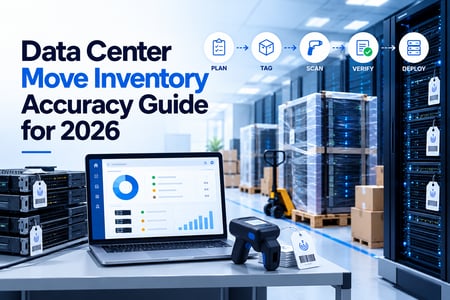
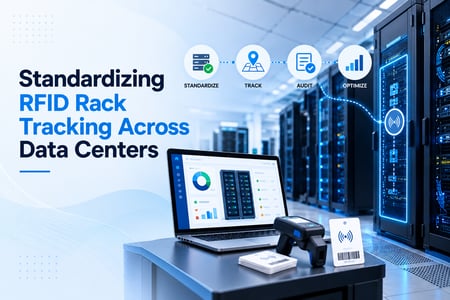
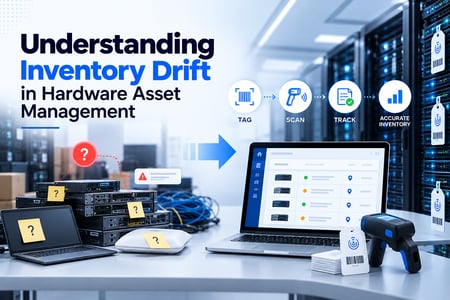
Most hardware asset management platforms show inventory accuracy in the high 90s. The data center floor often tells a different story. A server decommissioned eight months ago still draws a maintenance charge. An auditor asks for a device nobody can find. A capacity plan built on that clean-looking number turns out to be off by two racks. The dashboard was never lying exactly. It was reporting what it was told, and what it was told had drifted away from physical reality one small gap at a time.
That drift is the real enemy in hardware ITAM, and it rarely comes from a single dramatic failure. It accumulates through ordinary friction: a missed scan, a late update, a system that does not talk to the next system. This guide breaks down the eight risks that most often corrupt inventory data in hardware management platforms and what enterprise teams can do to prevent each one with stronger tracking, audit, and data governance.
Key takeaways
- Inventory accuracy degrades through many small, repeated errors, not one big failure, and looks fine on the dashboard until an audit or outage exposes it.
- The biggest structural risks are fragmented tracking systems, manual data capture, and integration gaps between your ITAM platform, DCIM, and CMDB.
- Periodic counts guarantee stale data; continuous or automated capture is the single highest-impact fix.
- Lifecycle blind spots, weak governance, and skipped audits let ghost assets and shadow spreadsheets accumulate.
- Most fixes come down to one principle: add verification, since a record never checked against the physical world will always drift.
Why does inventory data go bad in the first place?
Inventory data is inaccurate because most hardware asset management platforms are transaction-based, meaning they record what a person reports rather than verifying what is physically present. Every accurate record depends on a human action happening correctly every single time an asset is received, moved, or retired. In a busy enterprise environment, that assumption is constantly violated.
The danger is that the failure stays invisible. Reports keep reconciling against other reports, KPIs stay stable, and nobody notices until a physical check forces the issue. By then, the root cause is buried under months of compounded discrepancies. The eight risks below are the specific ways that drift takes hold.
1. Fragmented tracking across disconnected systems
The first risk is not having a single source of truth. When asset data lives scattered across departments, spreadsheets, and standalone databases, no one record is authoritative, and reconciling them becomes a permanent, losing chore. Teams lose track of what they own, buy hardware they already have, and inflate the IT budget without realizing it.
The fix is consolidation onto one platform that every team reads from and writes to. A unified hardware asset management system gives you a single, real-time record instead of a dozen partial ones, which cuts the reconciliation tax and removes the contradictions that fragmented data creates. Before choosing a platform, map every place asset data currently lives; the count is usually higher than anyone expects.
2. Manual data capture and human error
The second risk is the spreadsheet and the clipboard. Manual entry is slow, but more importantly, it is error-prone: a technician reading serial numbers off the back of a rack will transpose digits, skip a unit blocked by cabling, and lose focus partway through. Every missed or mistyped entry is a discrepancy that compounds over time.
Automated capture is the highest-impact fix on this list. Barcode scanning removes transcription errors, and RFID goes further by reading many assets at once without line of sight, including gear behind closed doors. Organizations moving from manual counts to automated capture commonly see accuracy climb from a typical 65% into the high 90s, not because they count better but because they remove the human bottleneck between the event and the record.
3. Periodic counts that leave data stale between audits
The third risk is the gap in time. If you only verify inventory annually or quarterly, the record is a snapshot that gets less true every day between counts. Anything that moves, fails, or gets swapped in the interim is invisible until the next walk of the floor, which itself may be partly stale before it finishes.
Continuous capture closes this gap. Fixed RFID readers built into racks, cabinets, and doorways log every entry and exit automatically, so the record updates without anyone touching a keyboard. Vendors built around this model make the point sharply: AV Realtime rack beacon each tagged asset's location every 30 to 60 seconds, which it describes as a live audit running all the time. Whether through always-on readers or frequent automated sweeps, the goal is the same, which is to shorten the interval between physical change and system update.
4. Integration gaps between ITAM, DCIM, and CMDB
The fourth risk is systems that do not talk to each other. A typical enterprise runs asset data across several platforms at once: the ITAM tool, a DCIM suite for capacity and power, a CMDB for configuration, and a ticketing system for changes. When those do not sync, the same asset can exist in three conflicting states, and a change logged in one place never reaches the others.
This produces a specific failure. A decommission recorded in ITAM but not in DCIM leaves your power and capacity models budgeting for hardware that was left months ago. The fix is to feed one verified physical record into every dependent system rather than maintaining parallel records by hand. Strong platforms integrate directly with DCIM, CMDB, and ticketing tools so accurate reads propagate everywhere, which keeps capacity planning, configuration management, and audit reporting all running on the same numbers.
5. Lifecycle blind spots and ghost assets
The fifth risk is losing track of where assets are in their life. When a platform does not capture acquisition, deployment, moves, and disposal cleanly, ghost assets accumulate in both directions. You keep paying maintenance and support on equipment that no longer exists or runs, and you have physical hardware in racks that the system never recorded, which never gets patched, secured, or counted in capacity.
The fix is disciplined lifecycle tracking plus a clean baseline reconciliation, ideally tied to a moment you are already touching the hardware, such as a migration or refresh. A one-time RFID baseline surfaces ghosts in both directions and gives you a defensible starting record. From there, continuous capture keeps it honest. The payoff is concrete: eliminating ghost assets stops maintenance overspend and removes the unknown hardware that creates security and audit risk.
6. Weak data governance and inconsistent processes
The sixth risk is process drift. Even good tools degrade when half the team follows the standard and half improvises. Inconsistent tagging at receiving, optional scans, and undocumented moves all reintroduce the errors that automation was supposed to remove. Accuracy is not a one-time install; it is a discipline.
The fix is governance: write down how receiving, moves, and decommissions get recorded, make the scan or read a required step rather than a nice-to-have, and enforce it. The cleanest baselines start at the loading dock, where hardware is tagged the moment it arrives, before it disappears into a rack. Governance also means controlling what enters the database in the first place, so bad data is caught at capture rather than discovered in an audit.
7. Skipped audits and no verification layer
The seventh risk is treating the system of record as if it were a system of truth. Software gives you visibility, but visibility is not verification. A record that is never checked against the physical world will degrade no matter how good the platform is, and skipping regular audits lets that degradation run unchecked until a failure exposes it.
The fix is to build verification into the cadence rather than saving it for an annual scramble. Automated RFID sweeps make frequent audits cheap enough to run often, reconciling thousands of assets in hours instead of weeks. Frequent checks catch discrepancies while they are small and traceable, before they compound into a systemic gap nobody can untangle. The point is not to count more painfully; it is to verify continuously so the record and the floor never drift far apart.
8. Inadequate training and shadow spreadsheets
The eighth risk is people. When staff are not trained on the tracking system, they mishandle it, underuse it, or quietly route around it. The most telling symptom is the shadow spreadsheet: when teams stop trusting the official record, they start keeping private notes as a hedge, and that fragmentation is itself both a cause and a sign of inaccuracy.
The fix has two parts. First, invest in training so the people capturing data know how to use the tools and why accuracy matters. Second, restore trust in the central record so the shadow systems lose their reason to exist. When the platform is reliable and the team knows how to use it, the private spreadsheets disappear, and with them the competing versions of the truth that quietly corrupt enterprise inventory.
How do you keep hardware inventory accurate long-term?
Keep hardware inventory accurate by combining automated capture, system integration, and continuous verification, since no single fix holds on its own. The common thread across all eight risks is verification: a record that is never checked against physical reality will always drift, no matter how polished the dashboard looks. Automated tracking removes human error, integration keeps your systems aligned, governance keeps the process consistent, and frequent audits catch the gaps early.
A practical starting point before any platform decision: write down your current inventory accuracy, the hours your team spends per audit, and every system your asset data must integrate with. Those three numbers turn vague improvement goals into a concrete plan and make it obvious which risks are costing you the most. Close the gap between what your system says and what is actually in the rack, and the rest of the hardware ITAM gets easier.
For enterprise teams that need audit-ready accuracy across racks and sites, Asset Vue builds data center asset tracking programs combining RFID, barcode, and on-site services. To see how it closes the accuracy gap in your environment, you can schedule a call.


 Contact Us


 FAQ
FAQ