Contact Us
Table of contents
TL;DR / Key Facts
- Government asset tracking software gives public agencies a real-time view of every physical asset they own, from IT hardware to field equipment, across all locations.
- Without it, agencies rely on manual spreadsheets that go stale the moment someone moves a laptop or transfers a vehicle.
- Automated tracking cuts inventory audit time from days to hours and eliminates the chronic overspending that comes from buying equipment that already exists somewhere in the agency.
- RFID-enabled systems, like those used by Asset Vue, can scan assets 60 times faster than manual barcode methods.
- Federal and state regulations increasingly require agencies to maintain auditable asset records a spreadsheet will not hold up under scrutiny.
What Is Government Asset Tracking Software?
Government asset tracking software is a platform that records, monitors, and manages the physical assets owned by a public agency from laptops and servers to vehicles, furniture, and field equipment. It replaces manual spreadsheets and paper logs with a live, searchable database that updates automatically as assets move between locations, get assigned to staff, or reach end-of-life.
Most modern government asset tracking systems combine three things: a hardware layer (RFID tags or barcodes attached to assets), a mobile scanning layer (handheld readers or smartphones), and a cloud-based software layer where all the data lives. Agencies use the software to run audits, generate compliance reports, track asset depreciation, and flag missing or unaccounted items.
The category sits under the broader umbrella of IT Asset Management (ITAM) and physical asset management. For government agencies specifically, it also carries regulatory weight; the Government Accountability Office and state audit bodies routinely flag asset management as a control weakness, and a well-documented tracking system is one of the first things auditors look for.
Why Do Government Agencies Struggle Without Asset Tracking?
The short answer: government agencies manage enormous asset portfolios across multiple sites, and manual processes cannot keep pace.
A mid-size city department might own 10,000 assets spread across a dozen buildings. A school district with 30 campuses could have 25,000 individual devices alone. When inventory lives in spreadsheets, a few predictable things happen. Data goes stale fast. Assets get transferred between departments and the record never gets updated. Audits take a week of dedicated staff time. And purchasing teams buy new equipment because they cannot confirm whether spare assets exist somewhere else in the system.
The cost consequences add up. Agencies buy duplicate equipment they already have. Untracked assets go missing without triggering any alert. Depreciation schedules fall out of sync with actual asset conditions, creating reporting problems at year-end.
Cedar Falls School District faced this before implementing Asset Vue's system. Their district-wide inventory across 25,000 assets went from a multi-day process to one that completed in minutes. That time savings is not just an operational win — it frees staff to do work that actually advances the district's mission.
How Does Government Asset Tracking Software Actually Work?
Government asset tracking software follows a straightforward workflow: tag, scan, sync.
Every physical asset gets a tag either a passive RFID tag or a barcode label attached at the point of procurement. RFID tags broadcast a unique ID signal that readers can capture from several feet away without line of sight. Barcode tags require a direct scan but cost less per tag. Most government deployments use a mix of both depending on asset type and budget.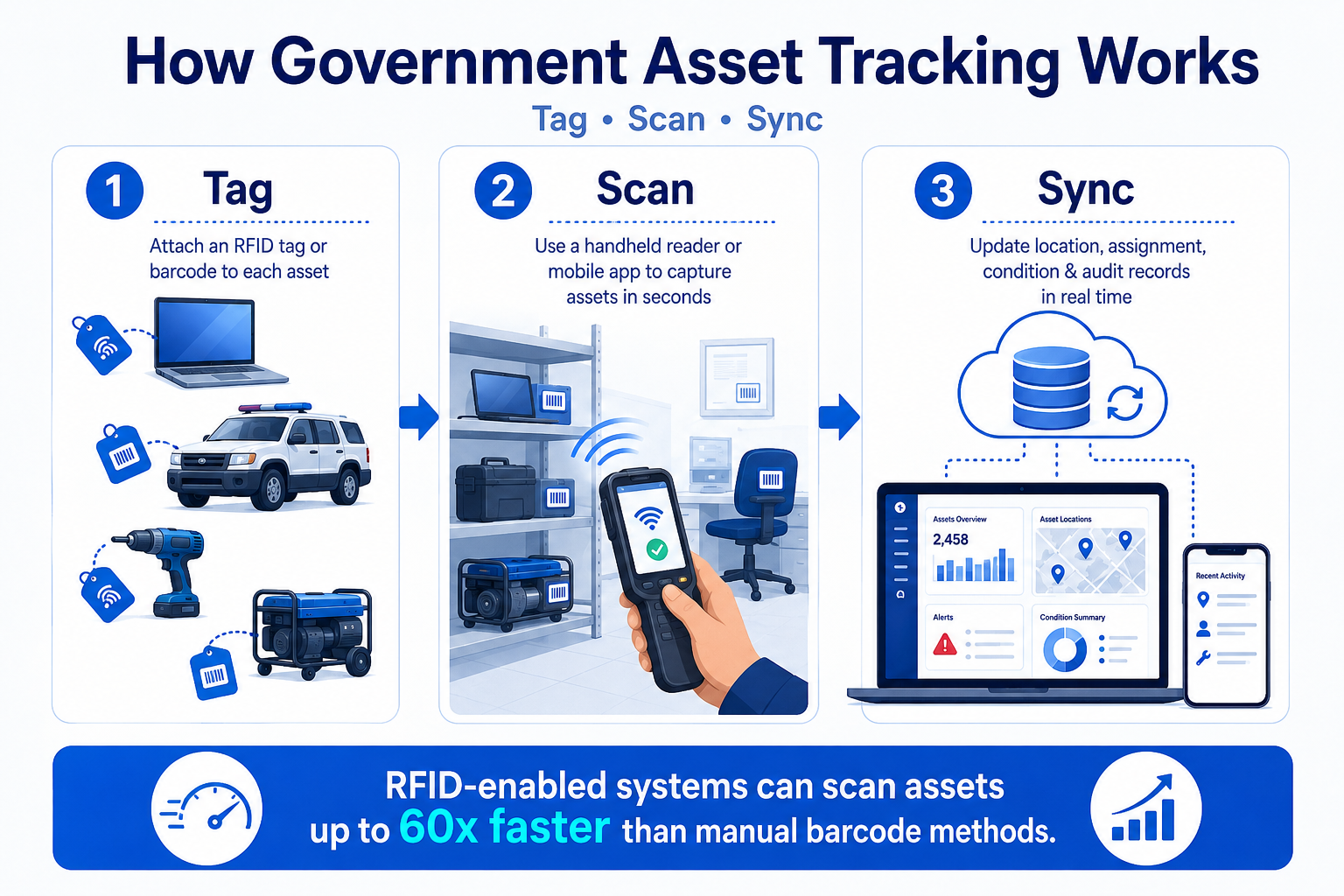
When staff run an inventory, they carry a handheld reader or use a mobile app that connects to the platform. The reader captures every tag in the room within seconds. That data syncs to the cloud database in real time, updating asset location, condition, and assignment records automatically.
The software layer handles the rest: generating audit reports, flagging discrepancies, tracking chain of custody, calculating depreciation, and producing the documentation that compliance officers and auditors need. Agencies can set alerts for assets that have not been scanned in a set period, which catches items that have gone missing before they disappear from the books entirely.
Asset Vue's platform brings all of this into a single system — RFID, barcode, smart cabinets, and mobile scanning — so agencies do not need separate tools stitched together with manual exports.
What Types of Assets Can Government Agencies Track?
Government asset tracking software handles the full range of physical assets a public agency owns.
IT hardware is the most common starting point: laptops, desktops, monitors, servers, network equipment, tablets, and phones. These assets have high replacement costs, move frequently, and are prime targets for theft or loss. They also have the clearest regulatory tracking requirements under most state IT asset management policies.
Beyond IT, agencies track office furniture, AV equipment, medical devices (in health departments and clinics), vehicles, field tools, and specialized equipment. Any capital asset above a certain dollar threshold typically $1,000 to $5,000 depending on the jurisdiction generally needs to appear in the agency's fixed asset register for accounting and audit purposes.
Some agencies also track leased assets and assets assigned to partner organizations or contractors. Government asset tracking software handles these scenarios by allowing custom asset statuses, location hierarchies, and assignment records that reflect how assets actually move in practice rather than how they look on an org chart.
How Is RFID Different from Barcode Tracking for Government Use?
RFID and barcode tracking both work, but they serve different needs in government operations.
Barcode systems require a staff member to point a scanner directly at each asset label, one at a time. It is accurate, inexpensive to set up, and works fine for smaller inventories or situations where assets sit in fixed locations. The limitation shows up in large-scale audits: scanning 500 assets one by one takes significant time, and a reader who gets fatigued starts making mistakes.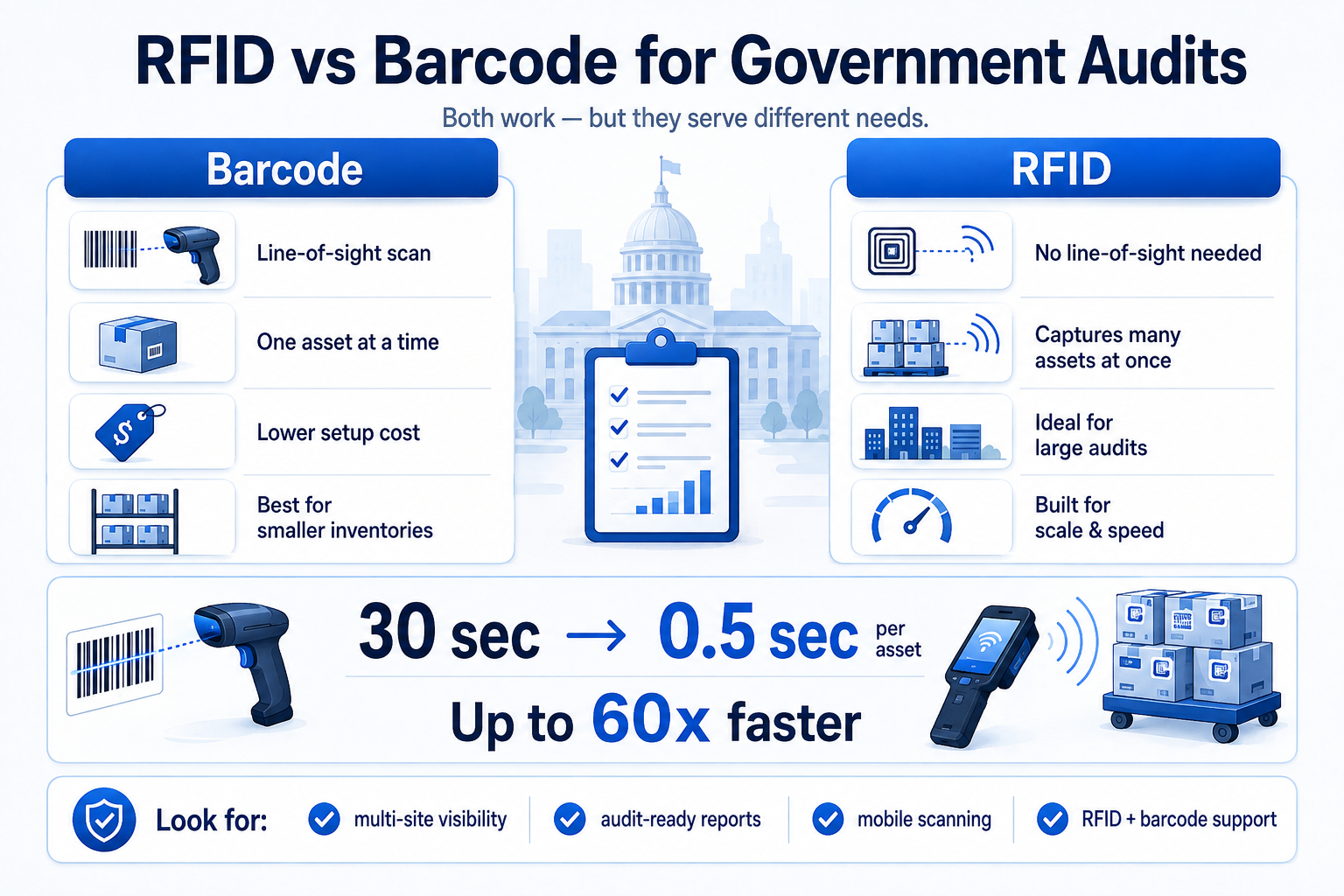
RFID readers capture multiple tags simultaneously without line of sight. A staff member walking through a server room with an RFID reader can capture every tagged asset in the room in seconds. GPX Asset Management measured this directly after switching to RFID-enabled tracking with Asset Vue: per-asset scan time dropped from 30 seconds to 0.5 seconds. Reporting time for their 250,000-asset inventory went from one week to 30 minutes.
For government agencies running mandatory annual audits or dealing with audit findings that require more frequent verification cycles that speed difference is not a convenience. It determines whether the audit is actually completed accurately and on time.
Passive RFID, which Asset Vue uses, requires no battery in the tag itself, so tags last for years without maintenance. This matters for government deployments where assets get tagged once and tracked for 5 to 10 years before reaching end-of-life.
Which Government Agencies Use Asset Tracking Software?
Most public-sector organizations that own significant physical assets use some form of asset tracking. The maturity of the system varies widely.
School districts and higher education institutions track student devices, classroom technology, and lab equipment. The shift to 1:1 device programs in K-12 created urgency around tracking because districts are managing 10,000 to 50,000 student-assigned devices that leave school buildings every day.
State and local government IT departments track hardware across office buildings, courthouses, public safety facilities, and remote sites. Multi-site visibility is the core problem here — an asset moved from one building to another can disappear from the record unless the system updates automatically.
Public safety agencies, including police departments and fire departments, track vehicles, weapons, body cameras, communications equipment, and specialized gear. Chain-of-custody requirements in law enforcement make accurate tracking not just operationally useful but legally necessary.
Healthcare agencies and county health departments track medical equipment, diagnostic devices, and supplies. Financial services agencies use asset tracking to support audit and compliance work, where accurate fixed asset records directly affect financial reporting.
What Should Agencies Look for in a Government Asset Tracking Solution?
Not all asset tracking platforms are built for government requirements. Here is what matters most when evaluating options.
Multi-site visibility. A system that only works within a single building is not useful for a city department spread across 15 facilities. The platform should aggregate asset data across all locations into a single view, with location-level filtering for staff who only need to see their site.
Audit-ready reporting. The system should generate reports that satisfy government auditors without custom exports or manual formatting. Look for built-in compliance reporting that matches the fixed asset register format required by state or federal oversight bodies.
RFID capability. Barcode-only systems hit a ceiling at scale. Any agency managing more than a few thousand assets will eventually need RFID to make audits feasible. Confirm the platform supports passive RFID, not just barcode, before committing.
Mobile scanning. Staff running audits should be able to use a mobile app or handheld device without being tethered to a desktop. The mobile interface should sync to the cloud in real time, not in batches.
Integration with procurement and financial systems. Asset tracking data should connect to the systems agencies already use for purchasing and financial reporting, so asset records update when procurement happens rather than requiring manual data entry.
Cloud platform with a single source of truth. Agencies that manage assets across multiple departments cannot afford data siloed in different systems. A cloud platform that serves as the single record of all assets eliminates the reconciliation problem that plagues multi-department inventories.
Key Takeaways
Government asset tracking software replaces manual spreadsheets and disconnected records with a live, auditable system that covers every physical asset an agency owns. It matters most for agencies managing large asset portfolios across multiple sites, running mandatory audit cycles, or facing compliance requirements that demand accurate fixed asset records.
RFID-enabled systems deliver the biggest efficiency gains at scale. Agencies that have moved from manual barcode scanning to RFID tracking report audit time reductions of 90% or more. The Cedar Falls School District moved from days to minutes. GPX Asset Management moved from one week to 30 minutes for 250,000 assets.
The software category is not one-size-fits-all. Government buyers should prioritize multi-site visibility, audit-ready reporting, mobile scanning, and a cloud platform that integrates with their existing procurement and financial systems.
Asset Vue's platform brings RFID, barcode, smart cabinets, and mobile scanning into one system built for government and institutional buyers. Schedule a call to see how it fits your agency's asset management workflow.


 FAQ
FAQ
Frequently Asked Questions
Our customers rely on Asset Vue to keep critical operations running smoothly. Here’s what they say about working with us.
What is government asset tracking software?
Government asset tracking software is a platform that records and monitors every physical asset a public agency owns — from IT hardware to field equipment using RFID tags, barcodes, or both. It replaces manual spreadsheets with a live, cloud-based database that updates automatically as assets move between locations or get assigned to staff.
Why do government agencies need dedicated asset tracking software?
Government agencies manage large asset portfolios across multiple sites and face mandatory audit requirements from state and federal oversight bodies. Manual spreadsheet tracking fails at scale because data goes stale, assets disappear between departments without being recorded, and audits take days of staff time that automated systems reduce to minutes.
How does RFID asset tracking work for government agencies?
RFID tags attached to assets broadcast a unique ID signal that handheld readers capture without line-of-sight scanning. Staff walk through a facility and the reader logs every tagged asset automatically. Asset Vue's RFID system reduced per-item scan time from 30 seconds to 0.5 seconds for GPX Asset Management, cutting a week-long audit to 30 minutes across 250,000 assets
What types of assets can government asset tracking software manage?
Government asset tracking software manages IT hardware, office furniture, vehicles, medical devices, field equipment, AV systems, and any capital asset that appears on the agency's fixed asset register. Systems like Asset Vue handle both fixed assets in facilities and mobile assets assigned to individual staff members.
What should government agencies look for when choosing asset tracking software?
The most important factors are multi-site visibility, audit-ready compliance reporting, RFID capability (not just barcode), mobile scanning through a native app, integration with procurement and financial systems, and a cloud platform that serves as a single source of truth across all departments and locations.