The best school asset tracking software is the one that records where a device is the moment it moves, not the one with the longest feature list. For a district with thousands of Chromebooks or a university with lab instruments spread across 50 buildings, that single property, a current record instead of a last-known guess, decides whether an audit takes an afternoon or three weeks.
This guide compares real-time asset management software for schools and universities the way an IT or finance buyer should: by the criteria that matter, not by the logos. Most institutions are not choosing between two near-identical products. They are choosing between categories of tools that solve different parts of the problem. Spreadsheets, finance modules, general IT asset platforms, and hardware-enabled tracking systems each have a place, and the wrong fit is where budgets and audit findings go to die.
TL;DR: For large schools, districts, and universities, judge asset tracking software on five things: real-time inventory visibility, integrations with the systems you already run, scale across sites and asset types, audit and compliance control, and the physical verification method (RFID, barcode, or both). Hardware-enabled platforms that combine RFID and barcode, like AssetVue, fit multi-site institutions with mixed IT and fixed assets. Finance modules and general ITAM tools cover narrower slices.
Key facts
- Federal grant-funded equipment must be physically inventoried and reconciled against records at least once every two years, and the institution must run a control system that guards against loss, damage, and theft (2 CFR 200.313, eCFR).
- The Center for Internet Security makes inventory and control of enterprise assets its first control, and calls for reviewing the asset inventory at least twice a year (CIS Control 1).
- AssetVue reports that Cedar Falls Community School District tracks about 25,000 assets with barcode tagging and cut audit time from days to minutes.
- AssetVue reports that a 250,000-asset fixed-asset deployment (GPX) brought scan time from about 30 seconds to half a second per asset and inventory reporting from a week to roughly 30 minutes.
What makes school asset tracking different from corporate ITAM?
Schools and universities break the assumptions that corporate asset tools are built on. A company usually has one owner per device, a handful of offices, and a single IT budget. A university has a microscope funded by a federal grant, assigned to a biology lab, checked out by a graduate student, and maintained by central IT, all at once. Institutional asset tracking has to hold that multi-dimensional ownership, not flatten it.
Three differences drive the whole comparison. First, scale and spread: a mid-sized district or university manages tens of thousands of assets across dozens of buildings with their own staff and storage habits. Second, mixed asset types: IT devices sit next to lab equipment, AV carts, furniture, and vehicles, and finance wants them all on the fixed-asset register. Third, compliance: grant-funded equipment and public money bring audit rules that corporate IT never faces. A tool that nails one of these and ignores the others is a partial fit.
What should real-time asset management software do for a school?
Real-time asset management software records every location change, custody transfer, and status update as it happens, so the inventory is current when someone queries it. That is the baseline. Everything else is how well it does that across an institution's size and mix of assets.
A useful shortlist covers five capability areas, and you can map any product against the features that matter in asset management software:
- Real-time inventory tracking: a live record of location, custody, and status, not a quarterly snapshot.
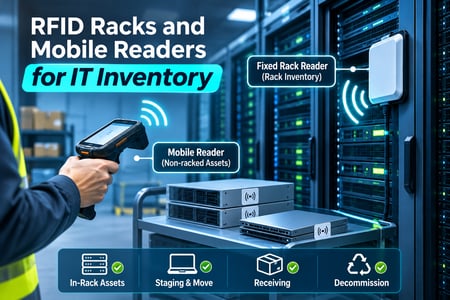
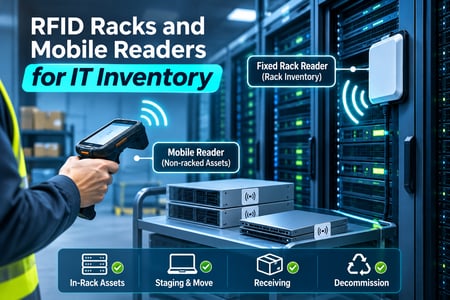
- Physical verification: RFID, barcode, or both, so the record ties back to a device someone can touch.
- Multi-site hierarchy: campuses, buildings, floors, rooms, and outdoor spaces in one structure.
- Chain of custody: every checkout, transfer, and return logged with a name, time, and location.
- Audit and compliance reporting: exportable records that satisfy institutional, state, and federal reviewers.
If a product cannot do these across your full asset count, it is solving a smaller problem than you have.
Which types of asset tracking software do schools actually compare?
Buyers rarely compare five products. They compare four categories and pick the one whose strengths match their biggest problem. Spreadsheets cost nothing and track nothing in real time. Finance and fixed-asset modules handle depreciation well but treat location as a text field. General IT asset and CMDB tools discover what is on the network but cannot confirm what is physically in a room. Hardware-enabled platforms add RFID and barcode so the digital record stays tied to the physical device.
The table compares these categories against the criteria that matter for schools and universities. Treat it as a category-level guide, not a vendor scorecard.
|
Criterion
|
Spreadsheet / manual
|
Finance / fixed-asset module
|
General ITAM / CMDB
|
Hardware-enabled RFID + barcode platform
|
|
Real-time inventory tracking
|
No
|
No
|
Partial (network discovery only)
|
Yes
|
|
Physical verification of location
|
Manual count
|
Manual count
|
No
|
Yes (RFID and barcode)
|
|
Multi-site / campus hierarchy
|
Weak
|
Limited
|
Varies
|
Yes
|
|
Chain of custody
|
No
|
Limited
|
Limited
|
Yes
|
|
Fixed-asset and depreciation records
|
Manual
|
Yes
|
No
|
Yes
|
|
Grant and audit reporting
|
Manual
|
Partial
|
Partial
|
Yes
|
|
Scales to 100,000+ mixed assets
|
No
|
Varies
|
Varies
|
Yes
|
|
Role-based department access
|
No
|
Limited
|
Yes
|
Yes
|
The pattern is consistent. Finance tools own the ledger, ITAM tools own the network, and neither confirms the device is in the room. A hardware-enabled platform exists to close that last gap, which is where most institutional inventory goes wrong.
How do you evaluate inventory visibility and real-time tracking?
Start by asking a vendor one question: for any asset, can you show me when its location was last physically verified? A system that shows a location but not a timestamp is showing you a guess. The gap between the last confirmed scan and today is where real-time inventory tracking either earns its cost or doesn't.
Under periodic counting, a missing device can sit unnoticed until the next audit, and recovery odds fall sharply after the first couple of days. Continuous, real-time IT asset tracking shrinks that window: a tagged laptop that leaves its zone can trigger a same-day flag, and a search starts at the last recorded room instead of the help desk. When you evaluate visibility, test three things: how location is captured (fixed readers, handhelds, or manual), whether every record carries a verification age, and whether the system routes a missed scan to someone as a task rather than leaving a silent stale record.
Which integrations matter for institutional asset tracking?
Asset software that cannot talk to your other systems becomes another silo to reconcile. For educational institution management, the integrations that earn their keep are the ones that remove manual re-entry at a handoff. Student information and device-management systems (for loaner and 1:1 device programs), the finance or ERP fixed-asset register, the help desk or ticketing tool, and HR or identity systems for custody changes when staff and students leave.
Offboarding shows why this matters. HR marks a laptop returned, the device lands on an IT shelf, and the asset record still names a person who left in March, because nobody connected the HR step to the asset system. The same multi-owner problem that makes university asset management and tracking hard also makes integrations non-negotiable: one asset can carry a funding source, a department, a custodian, and a maintenance owner, and each of those lives in a different system. Ask every vendor which of your systems it writes to automatically, and which it only reads.
How does the software scale across a large district or multi-campus system?
Scale for a school system is not just asset count. It is sites, departments, and the speed of a full inventory sweep. A platform that works for one building can stall across 40, and large organization asset management is where thin tools show their limits.
Two numbers tell you whether a product scales. The first is how long a complete physical inventory takes, because that decides how often you can afford to do one. AssetVue reports that a 250,000-asset fixed-asset deployment brought per-asset scan time from about 30 seconds to half a second and cut inventory reporting from a week to roughly 30 minutes, which turns an annual ordeal into a routine check. The second is role-based access: departmental admins manage their own equipment inside a shared platform while central IT keeps oversight, so scale does not force everyone into one workflow. If a vendor cannot speak to both, it is built for a smaller institution than yours.
What audit and compliance controls should the software enforce?
For public schools and universities, audit control is not a nice-to-have. Equipment bought with federal grant money must be physically inventoried and reconciled against the records at least once every two years, and the institution has to run a control system that protects against loss, damage, and theft (2 CFR 200.313). Auditors have cited institutions for failing exactly this. On the security side, the Center for Internet Security puts asset inventory as its first control and expects a review at least twice a year (CIS Control 1).
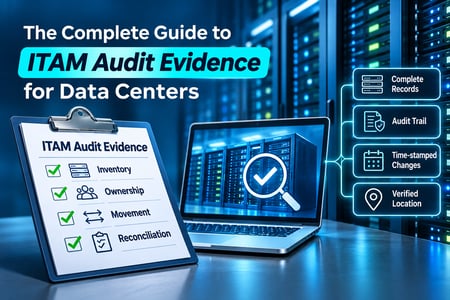
The software should make those obligations routine, not a fire drill. Require three things: a full custody history showing who had each asset, where, and when; exportable reports that satisfy institutional, state, and federal reviewers without custom formatting every cycle; and clean physical and fixed asset management records so disposed items leave the books and stop inflating insurance and depreciation. Ghost assets, devices recycled long ago that still count as active, are both a budget leak and an audit finding waiting to happen.
How does AssetVue fit school and university asset tracking?
AssetVue sits in the hardware-enabled category: it combines RFID and barcode tracking and maps assets to buildings, floors, rooms, and custodians in one hierarchy, with role-based access for departments and central IT. That design targets the institutional problems above, mixed asset types, multi-site spread, and multi-owner compliance, rather than a single-owner corporate model.
The proof points come from its own deployments. AssetVue reports that Cedar Falls Community School District tracks about 25,000 assets with barcode tagging and reduced audit time from days to minutes. Its asset management built for higher education covers IT devices, lab equipment, and fixed assets under one record, with the custody chain and exportable reporting that grant audits ask for. For a buyer, the fair read is this: if your deciding criteria are physical verification, scale, and audit control across a campus or district, a hardware-enabled platform is the category to shortlist, and AssetVue is one of the options in it.
AssetVue helps schools, districts, and universities track IT and physical assets across buildings, departments, and funding sources with RFID and barcode technology. Schedule a call to compare it against your current setup.


 Contact Us


 FAQ