Data center asset visibility gaps are the difference between what your management system says you have and what is physically sitting in the racks. In 2026, with hardware refresh cycles accelerating and audits tightening, those gaps have moved from a housekeeping annoyance to a real source of wasted spend, security exposure, and failed compliance reviews. This guide explains why the gaps form and how enterprise teams close them with better tracking, integration, and audit workflows.
Key facts
- Data center inventory accuracy commonly sits near 65% under manual, periodic processes and climbs to well over 95% with continuous real-time asset management.
- The Uptime Institute has estimated that roughly 20% of servers in the average facility are obsolete or unused, yet most managers do not believe their own facilities contain them.
- Manual inventory costs roughly one hour per rack, turning a full audit into a multi-day project that is partly stale before it finishes.
- The three root causes of visibility gaps are delayed data capture, disconnected systems, and inconsistent processes, not bad software.
- The highest-impact fix is shortening the time between a physical change and the system update, through RFID and automated capture.
What is a data center asset visibility gap?
A data center asset visibility gap is any discrepancy between the recorded state of an asset and its actual physical state, location, or status. It shows up as a server that was decommissioned months ago but still appears active, a device an auditor requests that nobody can locate, or hardware physically racked that the system has no record of at all.
These gaps matter because everything downstream depends on the asset record being true. Capacity planning, power modeling, security patching, maintenance contracts, and compliance audits all read from that record. When it drifts, each of those functions inherits the error, usually without anyone noticing until a physical check forces the issue.
Why do real-time asset management gaps form in data centers?
Real-time asset management gaps form because most data center tools record transactions rather than verifying physical reality, so the record depends on a human updating it correctly every single time. In a live facility running constant moves, adds, and changes, that assumption breaks continuously, and the small misses compound into a record that drifts steadily from the truth.
The root causes fall into three groups:
- Delayed data capture. Periodic counts and manual entry mean physical changes are invisible to the system until the next audit. A drive swapped at 2 a.m. may not be logged for a week, if ever.
- Disconnected systems. When the asset platform, DCIM, and CMDB do not sync, the same asset holds different states across tools, and a change in one never reaches the others.
- Inconsistent process. Tagging that happens late or inconsistently, and scans treated as optional, reintroduces the errors automation was meant to remove.
The dangerous part is that the drift stays invisible. Dashboards keep reconciling against other data in the system, so KPIs look stable right up until an audit, a stockout, or an outage exposes the gap, by which point the root cause is buried under months of accumulated discrepancies.
Why does inaccurate asset data cost so much?
Inaccurate asset data costs money in three concrete ways: wasted maintenance spend, over-provisioning, and audit exposure. The Uptime Institute has estimated that about 20% of servers in a typical facility are obsolete or unused, and most managers do not believe their own facilities contain them, which is exactly the blind spot visibility gaps create.
The costs break down as follows:
- Ghost asset overspend. You keep paying support and maintenance contracts on hardware that was decommissioned or moved without a record update.
- Capacity waste. Planning built on a stale register leads to over-provisioning power, cooling, and rack space you do not need.
- Security and compliance risk. Untracked hardware in a rack never gets patched or secured, and a single missing drive can carry the personal data of tens of thousands of people, turning a tracking gap into a regulatory liability.
- Audit labor. Manual reconciliation before every SOC or ISO review consumes days of expensive engineering time.
How do you close data center asset visibility gaps?
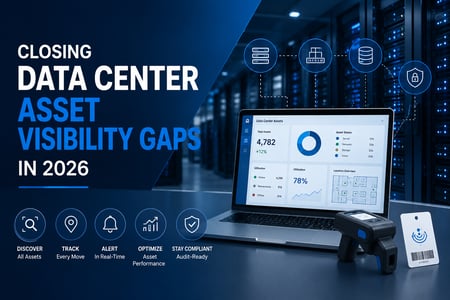
Close data center asset visibility gaps by shortening the time between a physical change and the system update, integrating your tracking data across systems, and building verification into a regular cadence. No single step holds on its own; the gaps return unless capture, integration, and audit all improve together.
The workflow looks like this:
- Establish a clean baseline. Run a one-time full reconciliation, ideally during a migration or refresh when hardware is already being handled, to surface ghost assets in both directions and create a defensible starting record.
- Automate capture. Replace manual counts with RFID and barcode. RFID reads many assets at once without line of sight, including gear behind closed doors, cutting a multi-day count to hours.
- Add continuous or rack-level reads. Fixed readers in racks, cabinets, and doorways log every entry and exit automatically, so the record updates without anyone touching a keyboard.
- Integrate the systems. Feed one verified physical record into DCIM, CMDB, and ticketing so accurate data propagates everywhere instead of drifting per tool.
- Verify on a cadence. Use automated sweeps to run frequent audits cheaply, catching discrepancies while they are small and traceable.
Teams that follow this sequence report inventory accuracy climbing from a typical 65% to well over 95%, with audits that once took weeks finishing in hours.
How does RFID close the capture gap?
RFID closes the capture gap by removing the human delay between a physical change and the system update, reading many tagged assets at once through the metal, cabling, and closed doors that defeat barcode line-of-sight scanning. The accuracy gain does not come from counting better; it comes from removing the manual bottleneck entirely.
In practice, a data center deployment combines a few RFID methods:
- Handheld sweeps for rapid full audits, reading thousands of tags in hours instead of days.
- Fixed rack and cabinet readers for continuous monitoring, logging assets on entry and exit and firing an alert the moment a high-value asset leaves its location.
- Room and zone location for tracking movement across the floor.
Tag selection is an engineering decision, not an afterthought. A data hall is hostile to RFID, so metal-dense racks require mount-on-metal tags placed to avoid covering ports or labels while still delivering a usable read range. Getting that right is the difference between a system that works in a data center and one that only claims to.
Why is system integration essential to visibility?
System integration is essential because a data center runs asset data across several platforms at once, and visibility fails whenever those platforms disagree. The asset system, DCIM, CMDB, and ticketing each hold a version of the truth, and without sync, a decommission logged in one leaves the others budgeting for hardware that left months ago.
Integration fixes this by making the verified physical inventory the single source of truth and pushing it outward. Accurate RFID reads feeding DCIM mean capacity and power models reflect reality instead of assumptions. The same accurate baseline feeding audit and compliance reporting gives a defensible record for SOC and ISO reviews on demand, rather than a scramble before each one. One accurate record, distributed automatically, beats four approximate records maintained by hand.
Which audit workflow keeps visibility from slipping?
The audit workflow that keeps visibility from slipping is continuous verification, not the annual walk of the floor. Because software gives you visibility but not verification, a record never checked against the physical world will degrade no matter how good the platform is.
An effective cadence includes:
- Automated RFID sweeps run frequently enough to catch drift early, made cheap by reading thousands of assets in hours.
- Real-time alerts on high-value or sensitive assets, so movement triggers a notification rather than waiting for the next count.
- Exception reporting that flags missing assets or items in unexpected locations automatically.
- A documented process for receiving, moves, and decommissions, with the scan or read treated as a required step rather than optional.
Frequent, automated checks catch discrepancies while they are small and traceable, before they compound into a systemic gap nobody can untangle.
Key takeaways
- Visibility gaps come from delayed capture, disconnected systems, and inconsistent process, not from bad software, so the fixes target workflow rather than tooling alone.
- Shortening the time between a physical change and the system update is the single highest-impact move; RFID and automated capture do this directly.
- Integration makes one verified record the source of truth for DCIM, CMDB, and audit reporting, so accuracy propagates instead of drifting.
- Continuous verification, not the annual audit, is what keeps the record and the floor aligned over time.
- Done together, these steps lift data center inventory accuracy from roughly 65% to well over 95% and cut audits from weeks to hours.
For enterprise IT and data center operators closing these gaps in 2026, Asset Vue builds data center asset tracking programs designed by former data center professionals, combining RFID, barcode, and on-site services with direct DCIM and CMDB integration. To see how it closes the visibility gap in your environment, you can schedule a call.


 Contact Us


 FAQ
FAQ