Contact Us
Table of contents
Your asset management software shows 98% accuracy. Then a server you decommissioned eight months ago turns up on a maintenance invoice, an auditor asks for a device nobody can locate, and a capacity model built on that "98%" turns out to be off by two racks. The dashboard looked right. The floor told a different story.
If that sounds familiar, you are not running a broken system. You are running a system that does exactly what it was built to do, which is record what it was told. The gap between what the record says and what is physically sitting in the rack is where data center inventory accuracy quietly falls apart. And in a facility full of servers, storage shelves, network gear, and cabling that moves constantly, that gap is rarely small for long.
This guide breaks down why the inaccuracy happens and, more importantly, how to fix it. The causes fall into three buckets: process, data capture, and integration. Work through each one, and you close the gap between your system and reality. Here is how.
Why accurate-looking data is so often wrong
Before the fixes, it helps to understand the trap. Most asset management software is transaction-based. Someone receives a device and logs it. Someone moves it and updates the record. Someone decommissions it and marks it as retired. Every entry depends on a human action happening, and happening correctly, every single time.
That assumption breaks down fast in a live data center. A drive gets pulled during an emergency swap at 2 a.m., and nobody updates the system until next week, if at all. A blade moves to a different chassis during a migration, and the record never catches up. A box of spare optics gets shelved in the wrong cage. None of these are dramatic failures. They are ordinary friction. But inventory is a high-frequency system, and small errors repeated across thousands of transactions compound into a record that drifts steadily away from the truth.
The dangerous part is that the drift stays invisible. Dashboards still look clean. KPIs still look stable. The numbers reconcile against other numbers in the system, so everything appears fine right up until an audit, a stockout, or an outage forces a physical check. By then, the root cause is buried under months of accumulated discrepancies and almost impossible to trace.
This is the core problem to keep in mind: software gives you visibility, but visibility is not the same as verification. A record that is never checked against the physical world will degrade no matter how good the software is. The fixes below all share one goal, which is to add verification back into a system that assumes it is unnecessary.
Fix 1: Replace periodic counts with continuous capture
The single biggest source of inaccuracy is the gap in time between something physically happening and the system finding out. Periodic inventory, whether that is an annual walk-the-floor count or a quarterly spot check, guarantees that gap. Between counts, your data is a snapshot that gets less true by the day.
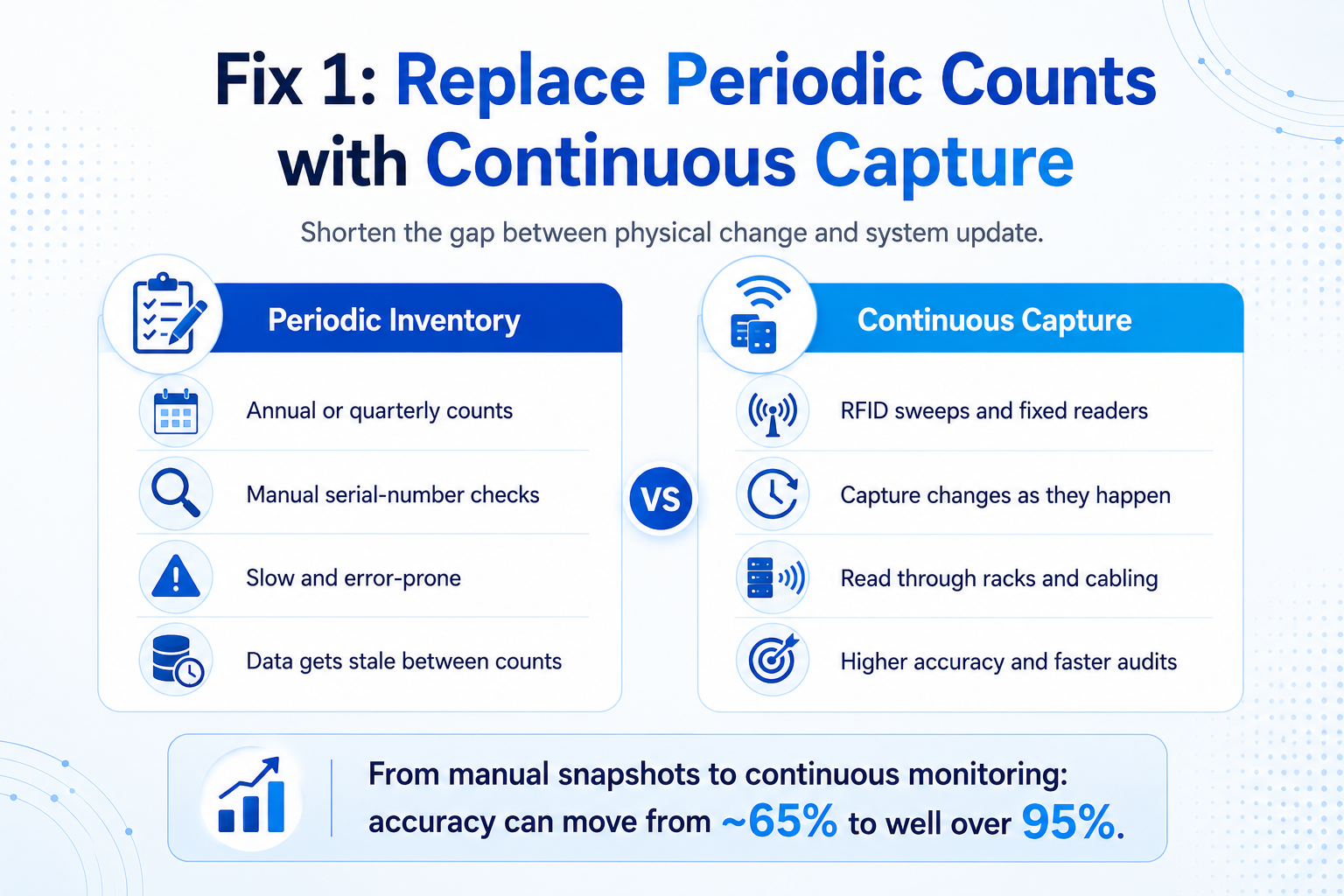
Manual counts also introduce their own errors. A technician reading serial numbers off the back of a rack for an hour will transpose digits, skip a unit blocked by cabling, and lose focus somewhere around rack forty. Asset Vue puts the cost of manual inventory at roughly an hour per rack, which in a large facility means counts that stretch into days and are partially stale before they finish.
The fix is to capture changes as they happen rather than reconstructing them later. This is where hardware-enabled tracking earns its keep. RFID sweeps that read thousands of tags in hours instead of days turn a multi-day project into an afternoon, and they read through the real-world obstacles, including cabling, blanking panels, and closed doors, that defeat barcode line-of-sight scanning. Fixed readers built into racks and cabinets go further by logging every entry and exit automatically, so the record updates without anyone touching a keyboard.
Asset Vue's own figures show what closing the time gap does to accuracy. Data center teams moving from periodic counts to continuous RFID monitoring report inventory accuracy climbing from a typical 65% to well over 95%, with audits that once consumed weeks finishing in hours. The accuracy gain does not come from better counting. It comes from removing the human bottleneck between the event and the record.
If you do nothing else from this guide, shorten the interval between physical change and system update. Everything downstream depends on it.
Fix 2: Standardize the tagging and data-capture process
Continuous capture only works if every asset is identifiable and every change runs through a consistent process. A lot of accuracy problems are not technology failures at all. They are process gaps, the most common being inconsistent or missing identification at the moment an asset enters the building.
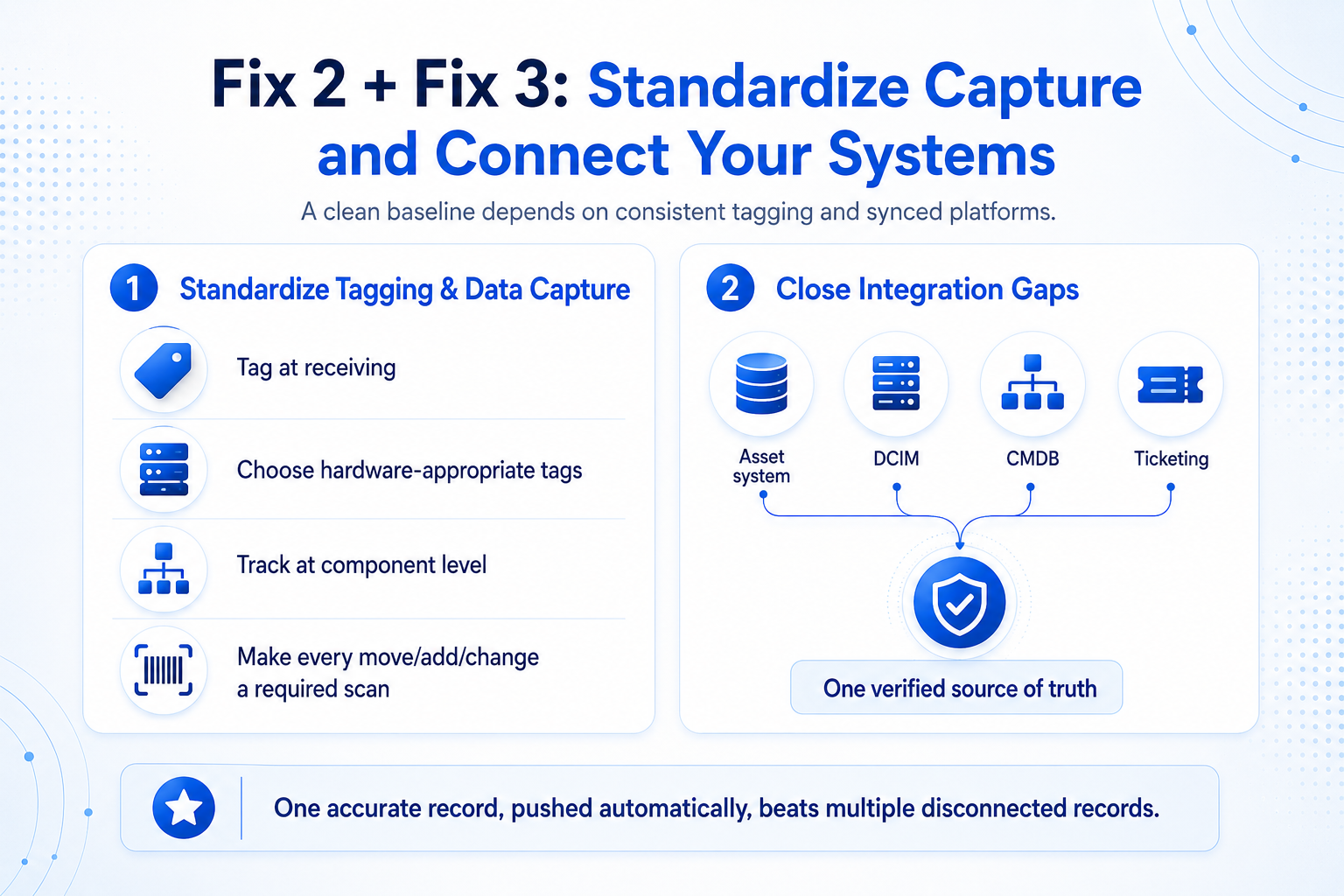
Start at the loading dock. The cleanest baseline is established when hardware is tagged the moment it arrives, before it disappears into a rack. Better yet, work with your vendors ot have the assets pretagged before shipping. Tag at or before receiving, and every later move, add, and change has something to attach itself to. Tag late, or tag inconsistently, and you spend the next year chasing assets that entered your facility as ghosts.
Tagging strategy matters as much as tagging timing, and a data center is a hostile environment for it. Metal chassis interfere with RFID signals, components are packed tightly, and a tag in the wrong spot can cover a label or a port. The social media company in Asset Vue's data center case study ran into exactly this. Their solution required a mount-on-metal tag small enough to fit without covering critical components yet still capable of a useful read range. The tag they landed on delivers up to seven feet in a low-profile, metal-tolerant form factor. The lesson is that tag selection is an engineering decision tied to your specific hardware, not an afterthought.
Component-level tracking is the next layer of discipline. Tracking only the chassis leaves you blind to the blades, storage shelves, optics, and drives inside it, which are often the assets that actually move and disappear. A standardized process tags at the level where things change.
Finally, write the process down and make data entry non-negotiable. Standardize how receiving, moves, and decommissions are recorded, and treat the scan or read as a required step rather than a nice-to-have. Consistent execution is what keeps a clean baseline clean. The most sophisticated hardware inventory management system in the world still degrades if half the team follows the process and half improvises.
Fix 3: Close the integration gaps between your systems
Even with perfect capture, accuracy falls apart when your systems do not talk to each other. A typical data center runs asset data across several platforms at once: the asset management system, a DCIM tool for capacity and power, a CMDB for configuration, and a ticketing system for changes. When those systems do not sync, the same asset can exist in three states across three platforms, and nobody knows which one is right.
Integration gaps produce a specific kind of error. A change logged in ticketing never reaches the CMDB. A decommission recorded in the asset system never updates DCIM, so your power and capacity models keep budgeting for hardware that left months ago. Data entered once should propagate everywhere; when it does not, discrepancies spread across platforms and multiply.
The fix is to feed verified asset data into the systems that depend on it rather than maintaining parallel records by hand. Asset Vue's data center deployments integrate directly with DCIM, CMDB, and ticketing tools so that real-time asset data flows into the platforms teams already rely on. Accurate reads feeding DCIM mean capacity and power models reflect reality instead of assumptions. The same accurate baseline feeds audit and compliance reporting, giving you a defensible record for SOC and ISO reviews instead of a scramble before every audit.
The principle is to make the verified physical inventory the source of truth and let it push outward, instead of letting each system drift on its own and trying to reconcile them after the fact. One accurate record, distributed automatically, beats four approximate records maintained separately.
Fix 4: Add real-time monitoring and alerting for high-value assets
Some assets cannot wait for the next sweep. A single missing drive in a data center can carry the personal data of tens of thousands of people, which turns a tracking gap into a regulatory and financial liability. For assets like these, periodic accuracy is not enough. You need to know the instant something moves.
Real-time monitoring closes that window. When fixed readers continuously watch designated locations, the system can flag an asset the moment it leaves where it belongs. In the social media company case study, the deployment was configured so that removing a drive from its designated location triggered an immediate alert to personnel. That is a different capability than knowing your count was accurate last Tuesday. It is knowing, right now, that something changed and being able to act before it becomes an incident.
This kind of alerting also strengthens security and compliance at the same time. The same continuous read that keeps your inventory accurate also surfaces anomalous movement, which means the system protecting your data accuracy is also protecting against loss and theft. For the highest-value or most sensitive hardware, smart cabinets and rack-level readers turn the asset record from a periodic report into a live monitor.
You do not need this level of coverage for everything. The discipline is to identify which assets carry outsized risk and give those continuous, alert-driven monitoring while the broader population is covered by regular automated sweeps.
Fix 5: Eliminate ghost assets and reconcile what you already have
Most facilities carry years of accumulated drift before they start fixing the underlying causes. Before continuous capture can keep your data clean, you have to establish a trustworthy starting point, which means hunting down the ghost assets already hiding in your records.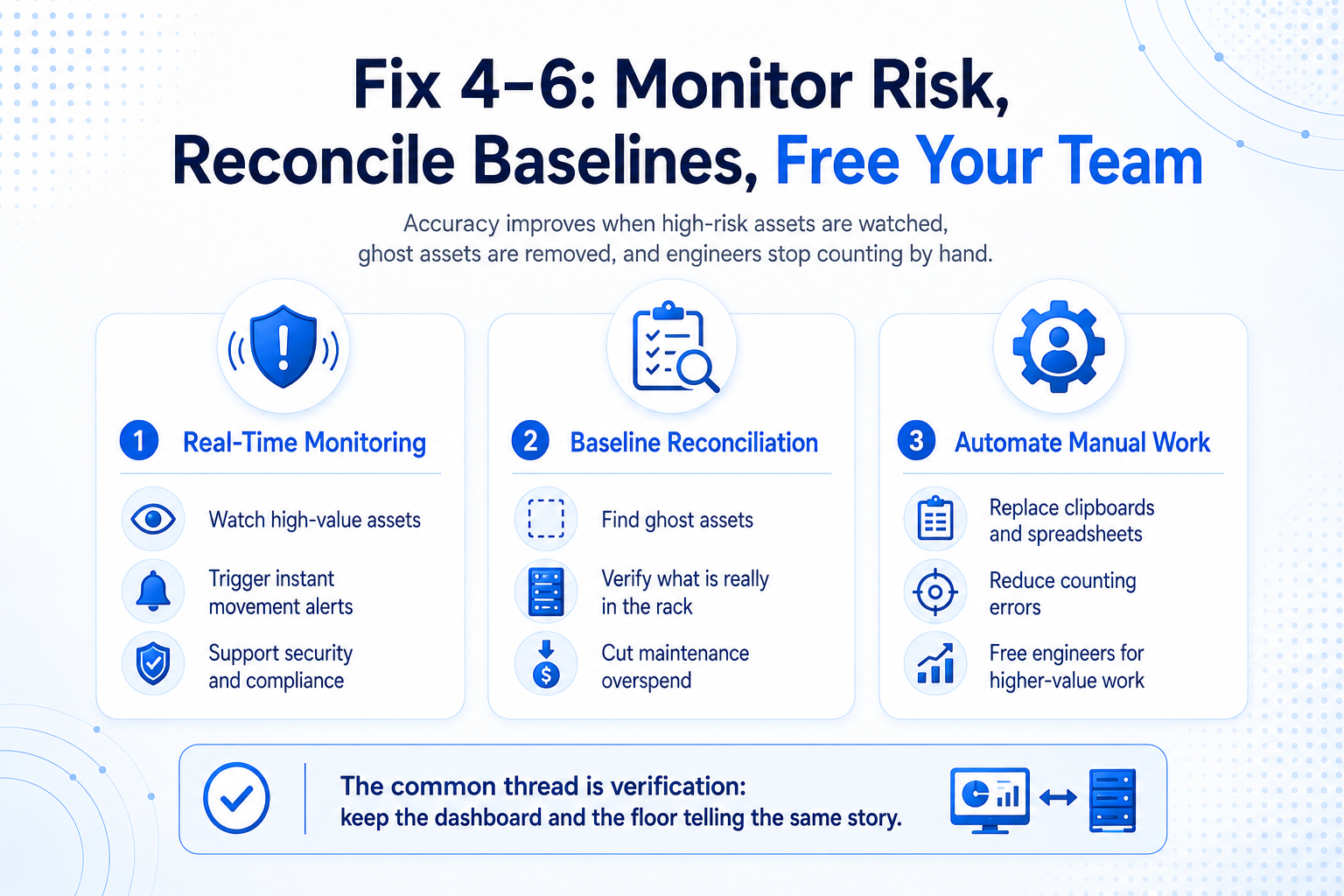
Ghost assets come in two flavors, and both cost money. The first is hardware the system says you have but cannot be found, often equipment that was decommissioned or moved without a record update. You keep paying maintenance and support contracts on gear that no longer exists or no longer runs. The second is the reverse: physical hardware in your racks that the system has no record of, which means it never gets patched, secured, or counted in capacity planning.
The fix is a clean baseline reconciliation, ideally tied to a moment you are already touching the hardware. A migration, a refresh cycle, or an audit is the ideal time, because the equipment is already in motion and a full physical sweep adds little marginal disruption. A one-time RFID baseline reconciles thousands of assets against the system, surfaces the ghosts in both directions, and gives you a defensible starting record. From there, continuous capture keeps it accurate.
The payoff is concrete. Eliminating ghost assets stops maintenance overspend on equipment that is no longer in service, and it removes the unknown hardware that creates security and audit risk. Teams that establish a clean baseline and maintain it with automated tracking report payback in as little as a year, mostly from cutting audit labor and recovered contract spend.
Fix 6: Free your engineers from the clipboard
The last fix is about people, and it is easy to overlook. When accuracy depends on staff manually counting and reconciling, you are spending your most expensive talent on your least valuable work. A data center engineer reconciling spreadsheets is an engineer not working on resiliency, capacity, or uptime.
Manual inventory is not just slow and error-prone. It is demoralizing, and it scales badly. Every new rack adds more counting, more reconciliation, more chances for transcription error, and the burden grows faster than the team. Eventually, accuracy becomes a function of how many hours people can stand to spend on it, which is a losing position.
Automating capture changes the equation. When sweeps replace manual counts, and readers replace clipboards, accuracy stops competing with engineers' time. Asset Vue frames this as freeing high-value staff from clipboards and spreadsheets so they can focus on the work that actually keeps systems online. The accuracy improvement and the productivity improvement come from the same change, which is the strongest argument for it. You are not choosing between better data and better use of your team. You get both from the same investment.
There is a cultural piece here too. When the system is trusted, people stop keeping private spreadsheets and offline notes as a hedge against bad data. That fragmentation, the thing that happens when teams quietly stop believing the official record, is itself a symptom of inaccuracy. Restore trust in the data, and you eliminate the shadow systems that compete with it.
Putting it together
Data center inventory accuracy does not fail for one big reason. It fails for many small ones that compound: the time gap between change and record, inconsistent tagging, systems that do not sync, high-value assets nobody is watching in real time, ghosts accumulated over years, and a team stretched too thin to count by hand. Each fix above targets one of those failure points.
The common thread is verification. Software gives you a record; only continuous, automated capture checked against the physical world keeps that record true. Start by shortening the gap between physical change and system update, establish a clean baseline, wire your systems together so accurate data propagates, and put real-time eyes on the assets that carry the most risk. Do that, and the dashboard and the floor finally tell the same story.
If your team is wrestling with the gap between what the system says and what is actually in the rack, Asset Vue builds data center asset tracking programs designed by former data center professionals, combining RFID, barcode, and on-site services. To see how a real deployment closes the accuracy gap, you can schedule a call for a walkthrough of your specific environment.


 FAQ
FAQ
Frequently Asked Questions
1. Why does my asset management software show high accuracy when my physical inventory does not match?
Most asset management software records transactions rather than verifying physical reality. It reflects what was entered, not what is actually in the rack. Missed updates, delayed entries, and unrecorded moves cause the record to drift from the truth while the dashboard still looks clean.
2. What is the most common cause of data center inventory inaccuracy?
The time gap between a physical change and the system update. When inventory is captured periodically rather than continuously, every change between counts is invisible. Human error during manual counts and inconsistent tagging at receiving compounds the problem.
3.How much can RFID improve inventory accuracy?
Data center teams moving from periodic manual counts to continuous RFID monitoring commonly report accuracy rising from a typical 65% to well over 95%, with audits shrinking from weeks to hours. The gain comes from removing the human delay between an event and the record.
4.Can RFID be deployed in a live production data center?
Yes. Tagging and reader installation can be staged around maintenance windows to minimize disruption, and properly selected tags do not interfere with equipment performance. A migration, refresh cycle, or audit prep is often the ideal time, since the hardware is already being handled.
5.How do integration gaps affect inventory accuracy?
When the asset system, DCIM, CMDB, and ticketing tools do not sync, the same asset can show different states across platforms. A change in one system never reaches the others, so capacity models, configuration records, and audit reports drift apart. Feeding one verified record into all of them keeps them aligned.