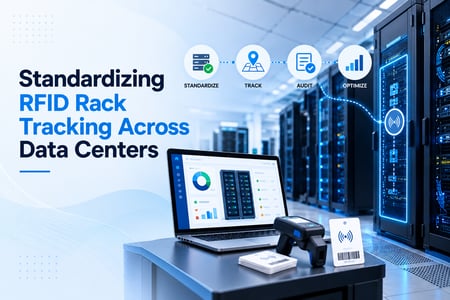
Two data centers, same company, same RFID vendor, and the asset counts still don't reconcile. One site tags servers on the chassis; the other tags the rail kit. One reads tags at the cage door; the other relies on a quarterly handheld walk. Roll both sites up to a single dashboard and the enterprise total is a guess, not a count.
That gap is the standardization problem, and it explains why RFID rack asset tracking often works well in one building and falls apart across a portfolio. The technology reads tags in bulk without line-of-sight and cuts a rack audit from about an hour of manual checking to under a minute. What it cannot do on its own is make three sites that deployed it differently agree.
This guide covers how to standardize RFID rack asset tracking across multiple data centers: the tag and reader choices that survive dense metal, the blind spots that corrupt counts between audits, the healthcare compliance rules that raise the stakes, and the operational consistency that lets one report speak for every site.
Key facts
- RFID rack asset tracking reads tagged equipment in bulk without line-of-sight, which drops a full rack audit from roughly an hour of manual checking to under a minute.
- Metal racks and packed chassis detune ordinary RFID tags. On-metal tags and planned reader placement are what keep read rates high.
- The hardest part of multi-site tracking is rarely the hardware. It is inconsistent: each site tags, names, and integrates assets its own way.
- Healthcare data centers carry extra weight. The HIPAA Security Rule's device and media controls require a record of the movement and disposal of any hardware that stores electronic protected health information.
What is RFID rack asset tracking?
RFID rack asset tracking is an inventory method that attaches radio-frequency tags to servers, switches, and other rack-mounted hardware, then reads those tags automatically to record what sits in each rack and where. Unlike a barcode, an RFID tag needs no line-of-sight, so a reader captures dozens of assets in a single pass instead of one scan at a time.
A working deployment has four parts. Tags go on each tracked device. Fixed readers or rack-level antennas sit at cabinets, rows, and doorways. Handheld readers cover areas without fixed coverage. Software ties the reads to an asset record and a location in the rack.
The payoff is speed and freshness. In one AssetVue deployment managing 250,000 fixed assets, per-asset scan time dropped from about 30 seconds to under one second, which turns a week-long count into a same-day one. The record stays current because reads happen as a side effect of normal floor work, not as a separate project.
Why is RFID rack tracking inconsistent across data centers?
RFID rack tracking goes inconsistent across data centers because each site tends to get deployed as its own project, with its own tag type, reader layout, naming scheme, and integration. Nothing forces those choices to match, so the records never roll up cleanly into one enterprise view.
Four differences cause most of the trouble:
- Tag placement. One site tags the chassis, another the rail kit or bezel. When a tag rides on a removable part, the record follows the part, not the computer.
- Location naming. Building, room, row, rack, and U-position get labeled differently at each site, so "Rack 14" means something different in two facilities.
- Reader coverage. One site reads at the cabinet and the cage door; another reads only when someone remembers a handheld sweep. The two produce counts of different ages.
- Integration. One site syncs reads to the DCIM and CMDB; another exports to a spreadsheet nobody reconciles.
None of these is a hardware fault. They are governance gaps. Standardizing the estate means setting one rule for each of these four decisions and holding every site to it.
How does dense rack metal interfere with RFID reads?
Dense rack metal interferes with RFID reads because steel racks and tightly packed metal chassis reflect and detune radio-frequency signals, which weakens or blocks the tag's response. A standard label tag laid flat against a metal server often will not read at all.
The fix is a tag-and-mounting problem, not a software one. On-metal tags, built with a spacer or ground plane that lets them radiate off a metal surface, read reliably where ordinary tags fail. Mounting matters as much as the tag: a small air gap, a consistent orientation, and a position clear of the densest metal all raise read rates.
Reader placement carries the rest of the load. Rack-level or row-level antennas read tags at short, controlled range inside the cabinet, which beats a far-field reader trying to punch through a full row of steel. The goal is to read each tag at a known distance and angle every time, so a successful read in one aisle looks the same as a successful read in the next.
How do you eliminate RFID blind spots on the data center floor?
You eliminate RFID blind spots by mapping every point where an asset can move unseen, then covering each one with a fixed reader, a rack antenna, or a scheduled handheld sweep. A blind spot is any path in or out of a tracked zone that no reader watches.
The usual gaps are predictable. Side doors and freight entrances that lack a reader let hardware leave without a read. Staging rooms and build areas hold assets that never pass a fixed antenna. Cages with weak coverage report a last-seen location that is weeks old. Handhelds used offline in a poorly connected cage keep their reads until someone syncs them, and until then the floor and the record disagree.
Two habits close most gaps. Put a read point wherever custody changes, including the dock, the staging door, and the cabinet. Then surface a last-verified timestamp on every asset, so a stale location looks different from a fresh one instead of hiding in plain sight.
A reference architecture for standardized rack tracking
Standardizing across sites means fixing five layers and writing each one down as the enterprise default. Every new or refreshed data center then matches the same pattern instead of inventing its own.
|
Layer
|
The standard to set
|
Why it matters
|
|
Tag spec
|
One on-metal tag family, placed on the chassis, with a defined position and orientation
|
Reads behave the same at every site; records follow the computer, not a removable part
|
|
Reader layer
|
Rack-level and row-level antennas plus door readers, with handhelds for gaps
|
Continuous, controlled-range reads instead of occasional sweeps
|
|
Location hierarchy
|
One naming scheme for building, room, row, rack, and U-position
|
"Rack 14" means one thing across the estate, so counts roll up
|
|
Integration
|
A defined contract for which system owns location, configuration, and power and space
|
Syncs stop overwriting verified data with stale or planned data
|
|
Governance
|
One owner for the standard, one reconciliation cadence, one exception queue
|
The standard holds after rollout instead of drifting apart again
|
The reader layer is where rack-level hardware earns its cost. Real-time RFID rack tracking uses rack antennas and smart cabinets to report installed equipment and open U-space as it changes, rather than waiting for the next audit. That continuous read is what keeps the location hierarchy accurate between counts.
The integration layer is where the estate becomes one view. Pointing every site at a single RFID ITAM platform, with clear rules for which system owns which field, is what lets a central team pull one number for the whole portfolio and trust it.
How does RFID rack tracking support healthcare IT compliance?
RFID rack tracking supports healthcare IT compliance by producing an automatic, timestamped record of where each device sits and when it moved, which is close to what the HIPAA Security Rule's device and media controls ask for. Those controls require covered entities to track the receipt, movement, and disposal of hardware that stores electronic protected health information.
A manual spreadsheet struggles to prove that. An RFID system builds the evidence as a byproduct of operation. Every read logs an asset, a location, and a time, so the chain of custody for a server holding patient data exists without anyone writing it down. When a drive is pulled and destroyed, the disposition gets recorded against the asset instead of living in a loose certificate.
That record shortens audits and reduces the risk of an unaccounted device holding protected data. The same pattern that works in a clinical setting carries into the data center; RFID in hospital asset management shows how the tracking and chain-of-custody logic applies to regulated equipment. Compliance still depends on configuration and policy, but the raw material, a current and defensible movement history, comes from the tracking itself.
How do you audit RFID read discrepancies across sites?
You audit RFID read discrepancies by comparing each site's RFID reads against its DCIM, its CMDB, and a physical count on the same schedule, then routing every mismatch to a named owner before it compounds. A discrepancy is any asset whose read count, location, or status disagrees across those sources.
Most discrepancies fall into two groups. Missed reads leave an asset showing its last-seen location, which may be stale, when it has actually moved or left. Stray reads place an asset in a zone it only passed near, common in staging areas where antennas pick up tags through doors and across aisles. Telling the two apart decides whether you fix coverage or fix antenna range.
Run the comparison on a set cadence and treat a variance above a small threshold as a signal to investigate, not a number to overwrite. A detailed walk-through of how to audit inventory discrepancies in RFID asset systems covers the reconciliation steps and the filtered-report traps that hide gaps. Standardizing the cadence across sites is what makes the enterprise rollup meaningful.
Which RFID rack tracking system should enterprises standardize on?
Enterprises should standardize on the RFID rack tracking system that handles on-metal tags, continuous rack-level reads, and native DCIM and CMDB integration, because those three capabilities decide whether multi-site data rolls up cleanly. A system strong on one and weak on the others leaves a gap that reopens the standardization problem.
Weigh candidates on a short set of criteria that matter across a portfolio:
- Read reliability on metal, proven with on-metal tags in a dense rack, not an open-bench demo.
- Rack-level and row-level reader options, so coverage scales from a single cabinet to a full site.
- Native integration with the DCIM, CMDB, and ticketing tools the estate already runs.
- A location model that supports building, room, row, rack, and U-position in one hierarchy.
- Multi-site reporting that presents every facility through one consistent view.
A structured look at the market helps frame the shortlist; comparing RFID inventory management systems lays out how platforms differ on these points. Match the choice to the estate you actually run, then hold every site to it.
A standardization checklist for multi-site rack tracking
Use this as the go or no-go list before you call a multi-site deployment standardized:
- One tag spec. Every site uses the same on-metal tag family, placed on the chassis in the same position.
- One naming hierarchy. Building, room, row, rack, and U-position follow identical labels everywhere.
- One coverage standard. Fixed reads at every custody change point, with handhelds filling defined gaps.
- One integration contract. Each field has a single owning system, and syncs never overwrite verified reads with planned data.
- One reconciliation cadence. Every site compares reads against the DCIM, CMDB, and a physical count on the same schedule.
- One governance owner. A named person owns the standard and the exception queue across the estate.
Each item you cannot check is a place where two sites will drift apart again.
Running RFID in more than one data center and still can't trust the enterprise total? AssetVue standardizes RFID rack asset tracking across sites with on-metal tagging, real-time rack-level reads, and DCIM and CMDB integration, so one report speaks for every facility. Schedule a call to plan a multi-site standard


 Contact Us


 FAQ
FAQ