Contact Us
Table of contents
Introduction
Hospitals operate in one of the most asset-intensive environments on the planet. From infusion pumps and portable ventilators to surgical instruments and wheelchairs, thousands of mobile assets cycle through departments, floors, and shifts every single day. Yet in most facilities, nursing staff spend up to an hour per shift searching for misplaced equipment, a systemic inefficiency that costs the U.S. healthcare industry an estimated $14 billion annually.
The solution is not more headcount or bigger procurement budgets. It is a smarter infrastructure. RFID technology in hospitals is fundamentally reshaping how medical facilities track, manage, and protect their most critical assets in real time. When deployed with precision, hospital RFID asset tracking eliminates guesswork, reduces equipment loss, and frees clinical teams to focus on patients rather than hunting down inventory.
This guide breaks down how RFID works in a healthcare context, the measurable operational benefits it delivers, and why it represents one of the most commercially sound infrastructure investments hospital operations leaders can make today.
RFID Technology Basics in Healthcare
What is RFID in Healthcare?
RFID — Radio Frequency Identification is a wireless technology that uses radio waves to automatically identify and track objects fitted with electronic tags. In a hospital setting, RFID tags are attached to medical equipment, high-value devices, pharmaceutical supplies, and patient wristbands. When a tagged asset moves through the facility, fixed or handheld RFID readers capture that movement and update a central asset management system in real time with zero manual scanning required.
Unlike barcode systems that demand line-of-sight and individual operator effort, RFID asset tracking basics operate automatically and continuously, even through walls, carts, and closed storage units. This makes RFID in the healthcare industry fundamentally different from legacy inventory approaches. To understand how RFID asset tracking functions at a foundational level, start with Asset Vue's detailed guide: What Is RFID Asset Tracking
Active vs Passive RFID for Hospitals
The choice between active and passive RFID for hospitals depends on asset mobility, value, and the precision of location data required.
Active RFID tags carry an internal battery and broadcast signals continuously. They are ideal for high-value, high-mobility assets, such as portable cardiac monitors, defibrillators, and infusion pumps that move across large clinical floors and require real-time location awareness. Active tags integrate well with Real-Time Location Systems (RTLS) and offer read ranges exceeding 100 meters.
Passive RFID tags carry no battery. They are energised by the reader signal when in proximity. Passive RFID excels in inventory-dense environments, such as supply rooms, pharmacies, and RFID smart cabinets for medical devices. They are lower cost, maintenance-free, and ideal for tracking consumables, linen, and semi-fixed equipment categories.
Most enterprise hospital deployments combine both: active RFID for mission-critical mobile assets and passive RFID for controlled storage and inventory locations. This hybrid model maximises coverage while managing deployment costs intelligently.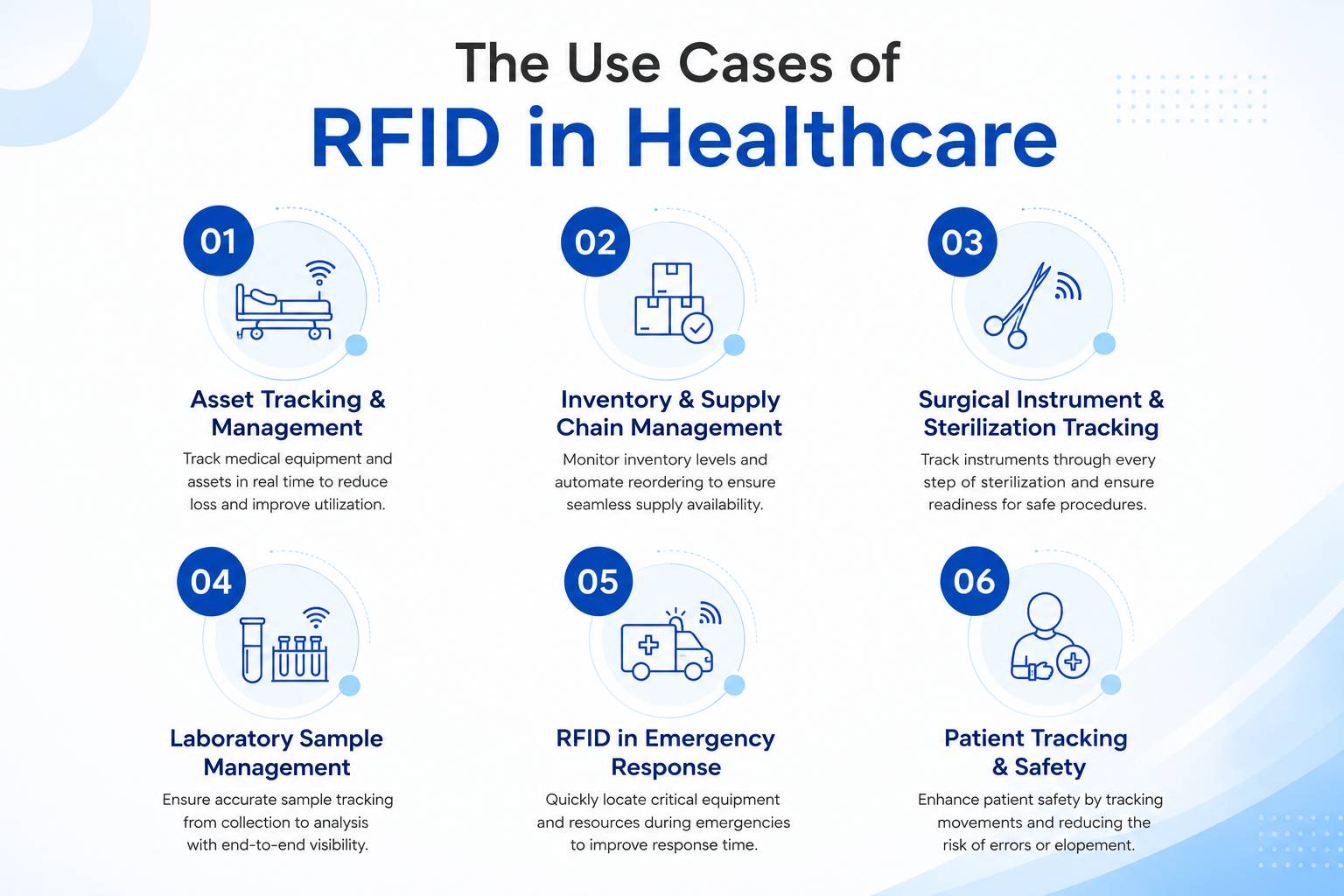
Operational Benefits and ROI
Benefits of RFID in Healthcare
The operational case for RFID in healthcare is built on a direct value proposition: eliminate asset search time, reduce shrinkage, and create continuous real-time visibility across your entire equipment ecosystem.
Real-Time Asset Visibility: RFID hospital asset tracking gives biomedical engineers, clinical staff, and procurement leaders instant location awareness of every tagged asset. Equipment is located in seconds, not after a floor-by-floor search that delays patient care.
Reduced Equipment Loss and Theft: Hospitals lose between 10–20% of mobile assets to misplacement, unreturned cross-department loans, and theft across their asset lifetime. RFID eliminates this exposure through geofencing alerts that trigger automatically whenever a tagged asset moves outside an authorised zone.
Maintenance and Compliance Automation: RFID logs usage cycles automatically, flagging devices for preventive maintenance before failure occurs. Joint Commission audits, equipment certification reviews, and infection control documentation become measurable, auditable, and largely hands-off.
RFID ROI in Medical Facilities
The financial returns on RFID in medical facilities are well-established. Enterprise hospital deployments consistently demonstrate a 20–30% reduction in unnecessary capital equipment expenditure through improved utilisation, a 60–80% reduction in staff time spent locating equipment, and payback periods ranging from 12 to 24 months in mid-to-large facility rollouts.
Cost reduction with RFID in hospitals also extends to equipment rental elimination. When assets cannot be located, facilities rent replacements at high recurring costs. RFID closes this gap permanently by maintaining a live, accurate asset register at all times.
For enterprise-grade RFID asset management, delivering these outcomes at scale, explore Asset Vue's RFID Inventory Management platform.
Benefits of Unified Communication in Hospital Asset Management
One of the most underappreciated advantages of RFID technology in hospitals is its ability to enable unified communication across clinical, operational, and procurement teams simultaneously. When asset data flows into a single connected platform visible to nurses, biomedical leads, supply chain managers, and operations directors in real time departmental silos collapse entirely.
Historically, a missing infusion pump triggered a manual verbal chain: a nurse alerts a charge nurse, who calls central supply, who checks a paper log. Every link in that chain introduced delay and dependency on human memory. RFID-driven unified communication replaces that chain with instant, shared visibility. Every stakeholder sees the same real-time asset status on their dashboard or mobile device without a single phone call.
This integration goes further when RFID platforms are connected with EHR systems, CMMS maintenance tools, and procurement software. A device that fails inspection is automatically flagged for replacement review in procurement. A supply dropping below par level in a tracked cabinet triggers a reorder alert to the supply chain without human intervention.
The operational impact of this unified data layer is significant. It accelerates clinical decision-making, reduces communication errors that delay care delivery, and ensures that the right equipment is available at the right location at the right moment, a performance standard every hospital targets, but few achieve without purpose-built technology.
RFID Smart Cabinets and Medical Device Security
RFID smart cabinets for medical devices are among the highest-impact deployment points in hospital asset management. These sensor-enabled storage units automatically log every item placed in or removed from the cabinet, recording user identity, timestamp, quantity, and compliance status without any manual documentation.
For high-value consumables, controlled medical supplies, and frequently accessed device accessories, smart cabinets simultaneously deliver inventory accuracy and compliance documentation. Shrinkage drops. Expiry management improves. Staff time previously consumed by manual counts is redirected to patient-facing work.
Asset Vue's RFID ITAM solution brings this intelligence level to enterprise healthcare operations, managing both IT assets and biomedical equipment within one unified, auditable platform.
RFID Patient Tracking and Clinical Safety
RFID in the healthcare industry extends beyond equipment it directly reinforces patient safety protocols throughout the care journey. RFID patient tracking wristbands provide accurate identification at every care touchpoint, significantly reducing the risk of wrong-patient medication administration, surgical misidentification, and emergency response errors.
At the equipment level, RFID status tagging integrates infection control documentation directly into the asset workflow. Clinical staff can verify in real time that a device has been cleaned, certified, and cleared for use before it reaches a patient's bedside, removing a material source of clinical risk that manual documentation systems cannot reliably close.
The pros and cons of rfid in healthcare show a clear clinical advantage when systems are thoughtfully deployed. The challenges, upfront cost, signal calibration, and staff training are real but manageable. The safety and efficiency gains are structural and lasting.
Where to Begin Your Hospital RFID Implementation
The strongest implementations start with a targeted asset audit. Identify your highest-value, most mobile equipment categories first, typically infusion pumps, portable monitors, and powered mobility assets. Tag these assets, establish baseline metrics for utilisation and loss rate, and build your ROI evidence before scaling deployment.
Next, integrate your RFID platform with existing EHR, CMMS, and procurement systems to unlock the full unified communication advantage. Asset Vue's RFID solutions are built for phased enterprise deployment, giving hospital IT and operations teams the flexibility to expand tracking across departments without clinical disruption.
See How Asset Vue Tracks Hospital Equipment in Real Time | Book a Demo


 FAQ
FAQ
Frequently Asked Questions
How does RFID improve patient safety?
RFID improves patient safety across two critical dimensions. First, RFID patient tracking wristbands provide real-time, accurate patient identification at every care point, reducing medication errors, wrong-patient procedures, and misidentification during emergency response. Second, RFID-tagged medical equipment carries full status records, maintenance history, cleaning certification, and inspection logs, ensuring only compliant, verified devices are deployed at the bedside. Together, these capabilities reduce clinical risk across the entire patient care continuum.
What are the pros and cons of RFID in healthcare?
Pros of RFID in healthcare: real-time asset visibility, significantly reduced equipment loss and theft, automated maintenance compliance, faster emergency response, accurate patient identification, lower long-term operational costs, and audit-ready regulatory documentation.Cons: Higher initial deployment cost compared to barcode systems, potential signal interference from certain medical electronics, requirement for staff training and change management, and longer implementation timelines in large multi-floor facilities.The long-term RFID ROI in medical facilities consistently outweighs initial investment costs, particularly for hospitals managing more than 500 trackable assets. A phased deployment model starting with high-value mobile equipment is the most effective path to demonstrating early returns before scaling hospital-wide.