Contact Us
Table of contents
Depreciation is one of accounting's most useful tools. It lets a business spread the cost of a long-term asset, such as a server, a forklift, or a delivery van, across the years that the asset actually generates revenue. But here's what trips up many finance teams: not everything a company owns qualifies.
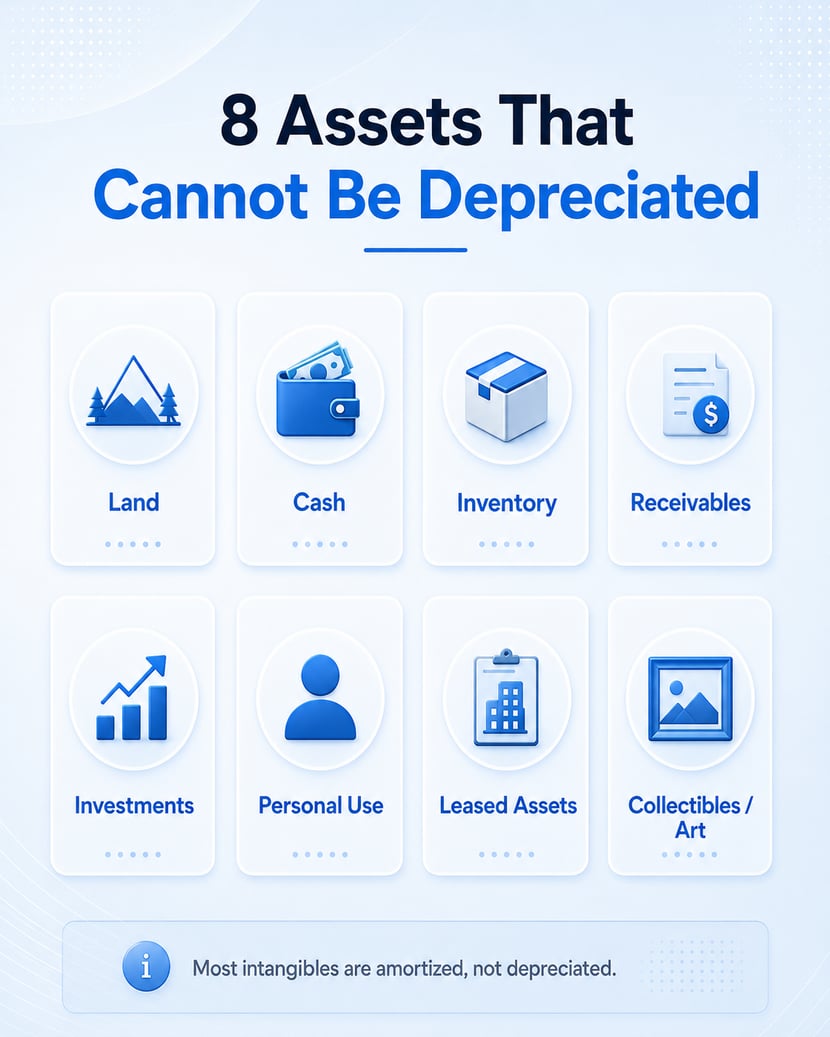
So, which assets cannot be depreciated? The short list includes land, current assets like inventory and cash, investments, personal-use property, leased equipment, collectibles, and most intangibles. Each one fails at least one of the IRS's core depreciation tests, and treating them as depreciable anyway is one of the fastest routes to a misstated balance sheet and an uncomfortable audit.
This guide walks through the complete non-depreciable assets list, explains the asset depreciation rules behind each exclusion, and shows how to account for these assets correctly.
What Is a Non-Depreciable Asset?
A non-depreciable asset is any asset whose cost cannot be written off gradually over time through depreciation. Instead, its value stays on the books at cost, gets expensed immediately, or follows a different accounting treatment altogether, such as amortization or impairment testing.
To understand why, start with what qualifies. Under IRS rules (Topic 704), an asset is depreciable only when it meets four conditions:
- You own it. Leased or rented assets belong on the lessor's books, not yours.
- It's used in your business or income-producing activity — not for personal purposes.
- It has a determinable useful life. The asset must wear out, decay, become obsolete, or lose value from natural causes in a predictable way.
- It's expected to last more than one year. Short-lived items are expensed, not capitalized.
Fail any one of these tests, and the asset cannot be depreciated. That single framework explains every entry on the list below.
Non-Depreciable Assets List: 8 Key Exceptions
1. Land
Land is the textbook example and the one most worth memorizing. Land does not wear out, become obsolete, or get used up. It has an unlimited useful life, which means there's no period over which to spread its cost.
The nuance: while land itself is never depreciated, land improvements often are. Fences, parking lots, driveways, landscaping with a limited life, and drainage systems all deteriorate, so they qualify as depreciable assets with their own useful lives. This is why companies split a property purchase into land value and improvement value at acquisition — only the second portion generates depreciation deductions.
Buildings sitting on the land are also depreciable (typically over 27.5 years for residential rental property or 39 years for commercial buildings under MACRS in the US). The land underneath them never is.
2. Current Assets: Cash, Inventory, and Receivables
Current assets exist to be converted into cash within a year, and that short lifespan disqualifies them immediately. Depreciation only applies to assets that serve the business for more than one accounting period.
- Cash and cash equivalents are already at their stated value; there's nothing to write down over time.
- Inventory is held for sale, not for use in operations. Its cost flows to the income statement as cost of goods sold when it sells.
- Accounts receivable are cash claims. If some become uncollectible, they're written off through a bad debt allowance a different mechanism entirely.
- Prepaid expenses like insurance or rent are expensed as the benefit is consumed.
3. Investments: Stocks, Bonds, and Securities
Financial investments don't have a useful life that expires; a share of stock doesn't wear out from being held. Their value fluctuates with the market, so accounting standards require them to be reported at fair value or cost (depending on classification), with gains and losses recognized when values change or when the investment is sold. Depreciation never enters the picture.
4. Personal-Use Property
Assets used for personal purposes cannot be depreciated, no matter how expensive they are. Your family car, your home, your personal laptop, none qualify, because depreciation is strictly a business cost-recovery method.
The mixed-use rule matters here. If an asset serves both business and personal purposes, only the business-use percentage is depreciable. A vehicle driven 60% for business and 40% personally can only be depreciated on 60% of its eligible basis and the IRS expects documentation, such as a mileage log, to support that split.
5. Leased or Rented Assets
You can only depreciate what you own. Equipment under an operating lease, a rented office, borrowed machinery, these belong to someone else, so the depreciation deduction belongs to them too.
Two exceptions are worth knowing. First, leasehold improvements, upgrades a tenant makes to a rented space, like built-in shelving or new flooring, are owned by the tenant and depreciated (or amortized) over the shorter of the improvement's life or the lease term. Second, assets under finance leases (where ownership effectively transfers) are capitalized and depreciated by the lessee under current accounting standards.
6. Collectibles, Art, and Antiques
A painting in the lobby or a rare antique desk generally cannot be depreciated. The IRS's logic: these items don't have a determinable useful life, and many actually appreciate over time rather than wearing out. An asset that grows more valuable with age has no cost to recover through depreciation.
There's a narrow carve-out artwork that is genuinely subject to wear and tear through business use, but has occasionally qualified, but for most organizations, the safe default is to carry collectibles at cost.
7. Low-Cost Items Below the Capitalization Threshold
Technically, these could be depreciated, but in practice, they never are. Most companies set a capitalization threshold commonly $2,500 to $5,000, and immediately expense anything below it. A $40 keyboard or a $200 office chair hits the income statement in full the month it's purchased. Depreciating hundreds of small purchases would create administrative work with no meaningful benefit.
In the US, the IRS's de minimis safe harbor election formalizes this, letting businesses expense items up to $2,500 per invoice (or $5,000 with audited financial statements).
8. Assets Bought and Disposed of in the Same Year
Depreciation rules require an asset to be in service across more than one accounting period. If equipment is purchased and retired, sold, or scrapped within the same year, its cost is handled through the disposal entry; there's no multi-year life to allocate.
What About Intangible Assets and Goodwill?
This is the most common point of confusion, and it deserves its own section.
Intangible assets, such as patents, copyrights, trademarks, software licenses, and customer lists, are not depreciated, but most of them are amortized. Amortization works the same way mechanically (spreading cost over useful life) but applies to non-physical assets. A patent with a 15-year legal life, for example, is amortized over that period.
Goodwill is the special case. Under US GAAP, goodwill has an indefinite useful life, so public companies don't amortize it at all. Instead, it's tested for impairment at least annually: if the value of the acquired business has declined, the company writes goodwill down and records an impairment loss. (Private companies can elect to amortize goodwill over 10 years; for tax purposes, the IRS allows 15-year amortization under Section 197, another reminder that book and tax treatments often diverge.)
The takeaway: if someone asks whether goodwill can be depreciated, the answer is no, it's either held and impairment-tested or amortized, depending on the framework.
Depreciable vs Non-Depreciable Assets: Quick Comparison
A useful mental shortcut: depreciation requires ownership, business use, and a predictable decline in value over more than a year. Strip away any one of those, and you're looking at a non-depreciable asset.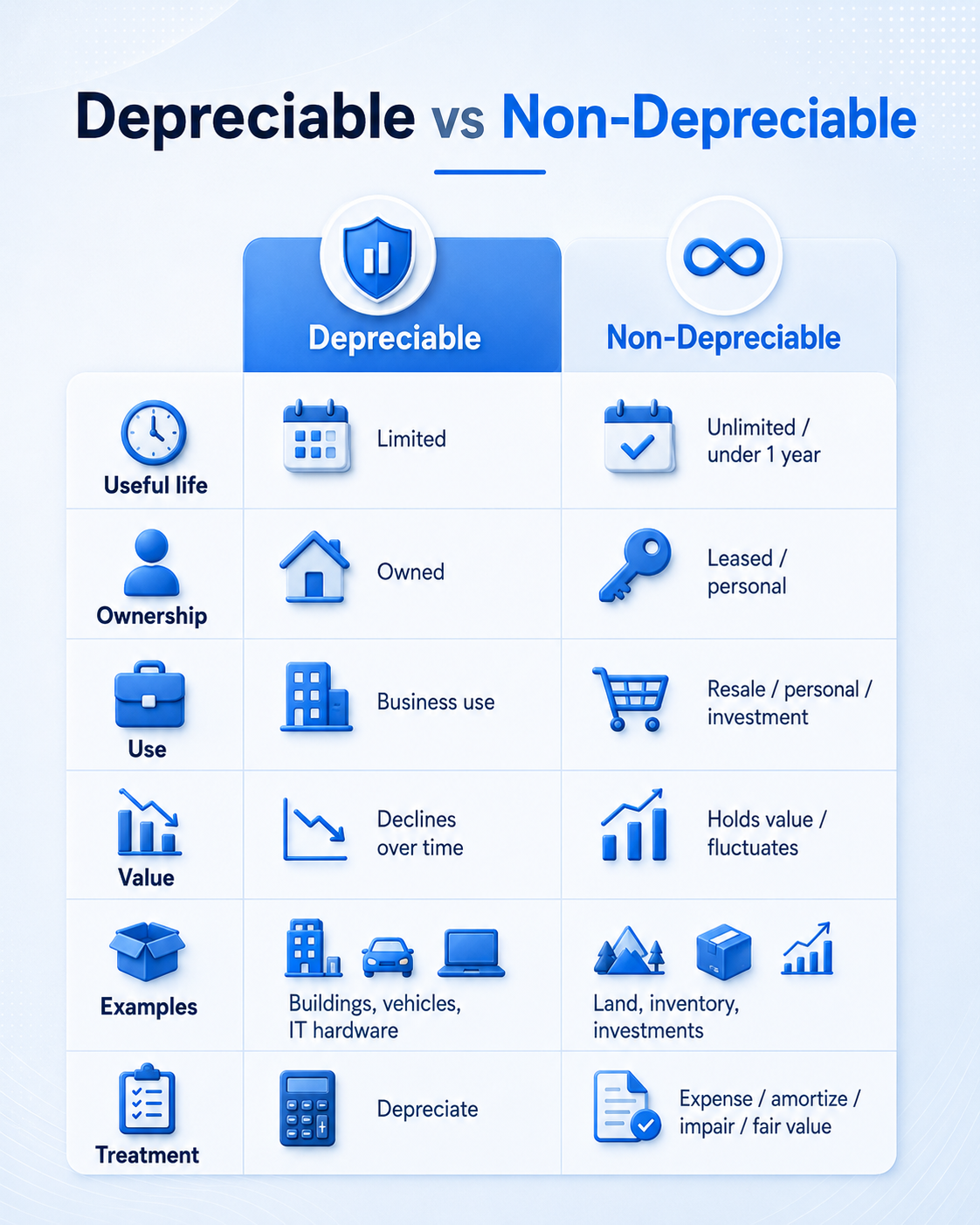
Why Can't These Assets Be Depreciated?
Every exclusion on the list traces back to one of three root causes:
No determinable useful life. Land, investments, collectibles, and goodwill don't decline on a predictable schedule. Depreciation is a systematic allocation without a defined endpoint; there's no system to apply.
No qualifying ownership or use. Leased assets fail the ownership test. Personal property fails the business-use test. Depreciation is a business cost-recovery mechanism, and the IRS polices both boundaries closely.
Too short-lived. Current assets and same-year disposals never span multiple accounting periods, so there's nothing to spread. Their costs flow through the income statement by other routes.
Understanding the why matters more than memorizing the list, because edge cases come up constantly: Is a demo unit inventory or equipment? Is that renovation a land improvement or maintenance? The four-part test answers questions that a static list can't.
How to Account for Non-Depreciable Assets
Non-depreciable doesn't mean ignorable. Each category has its own treatment:
- Land stays on the balance sheet at historical cost. If its value becomes permanently impaired (say, environmental contamination), an impairment loss is recorded.
- Current assets are managed through working capital processes, inventory valuation methods, receivable aging, and bad debt allowances.
- Investments are marked to fair value or carried at cost depending on classification, with gains and losses recognized per the applicable standard.
- Intangibles with finite lives are amortized; indefinite-lived intangibles and goodwill are impairment-tested.
- Low-cost items are expensed at purchase but should still be physically tracked if they're loss-prone (laptops and tools walk away regardless of their accounting treatment).
That last point is where accounting policy and physical reality collide, and it's worth dwelling on.
Why You Should Track Both Depreciable and Non-Depreciable Assets
The fixed asset register only tells you what finance believes the company owns. Whether an asset is depreciated or not, the physical item still needs to be located, maintained, secured, and eventually retired. Three problems show up when tracking stops at the accounting boundary: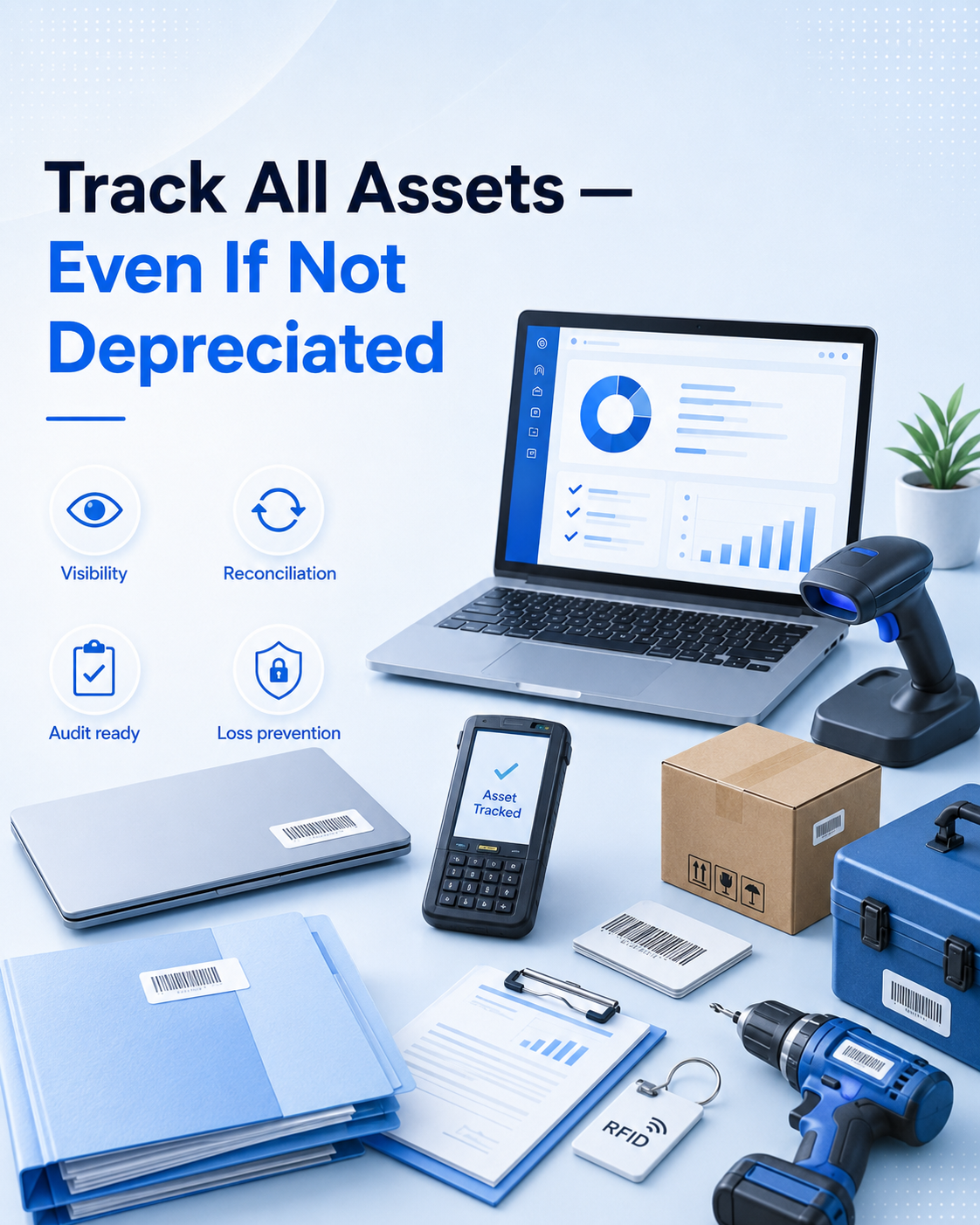
Ghost assets inflate the books. Equipment that was lost, stolen, or scrapped years ago keeps generating depreciation entries, insurance premiums, and property taxes because nobody told the register it was gone. Industry estimates suggest a meaningful share of asset registers contain items that no longer physically exist.
Expensed items vanish from visibility. Because sub-threshold purchases never hit the fixed asset register, many organizations have no record of them at all. Yet a fleet of $800 barcode scanners or $2,000 laptops represents real money and real security risk.
Audits become archaeology. When the depreciation schedule, the purchase records, and the physical floor don't agree, every audit turns into a multi-week reconciliation project.
The fix is connecting the financial record to a physical one. With RFID and barcode tracking, every asset, depreciable or not, carries a tag tied to its location, condition, owner, and lifecycle status. A full physical audit that used to take weeks of clipboard work happens in hours, and the results reconcile against the register automatically. Asset Vue's platform was built for exactly this: tracking every asset across data centers, campuses, and warehouses with a verified, audit-ready trail, whether or not that asset appears on a depreciation schedule.
If your depreciation schedules and your actual floor inventory have drifted apart, Schedule a call with the Asset Vue team to see what automated reconciliation looks like.


 FAQ
FAQ
Frequently Asked Questions
1. Which assets cannot be depreciated?
The main categories are land, current assets (cash, inventory, accounts receivable, prepaid expenses), financial investments like stocks and bonds, personal-use property, leased or rented assets, collectibles and artwork, items below the capitalization threshold, and assets disposed of in the same year they were purchased. Intangible assets are also not depreciated; finite-lived intangibles are amortized instead, and goodwill is tested for impairment.
2.What is the difference between depreciable and non-depreciable assets?
Depreciable assets are owned, used in business, last more than a year, and decline in value predictably, so their cost is spread over their useful life. Non-depreciable assets fail at least one of those tests: they may have an unlimited life (land), be held for resale (inventory), be personally used, or not be owned at all (leased equipment).
3. Can you depreciate inventory?
No. Inventory is a current asset held for sale, not a long-term asset used in operations. Its cost is recognized as the cost of goods sold when the inventory is sold. If inventory loses value before sale, it's written down to net realizable value a separate process from depreciation.