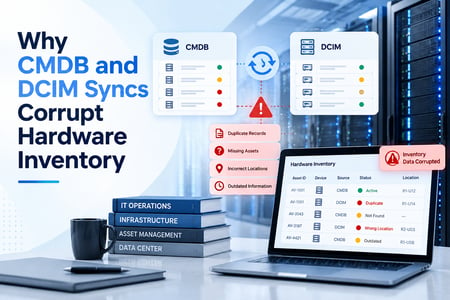
The accuracy report says 99.2 percent. An auditor pulls twelve assets at random and finds three in the wrong building. Both numbers are correct, and that is the problem. The report measured what it was told to measure, and the three assets sat outside the filter.
Key facts
- The hardest inventory data errors to find are the ones that never produce an error. They pass validation, survive reconciliation, and often improve the accuracy score.
- Most of these causes sit in process and integration design rather than in RFID physics. Tag placement and read rates get the attention; field authority, status mapping, and intake coverage do not.
- Five of the ten causes below are measurement problems rather than data problems. The record is wrong and the report says otherwise.
- Eight of the ten can be found from a desk with database queries, before anyone walks a floor.
- The signature to look for: a population of assets that is neither counted as present nor flagged as missing. Assets in that gap generate no exception and no ticket.
- Every cause below ends with the first check to run, ordered so the cheap queries come before the physical verification.
What makes a cause of inaccurate inventory data hard to find?
A cause stays hidden when it produces a plausible record rather than an error. Nothing fails, no exception fires, and the data looks like data. Compare that with a dead reader or a torn tag, which announces itself the first time someone runs a count.
Hardware-enabled asset management removes the manual count from the equation, and it does not remove the ways a record can be wrong before the count starts.
Hidden causes share four traits:
- They pass field validation, because the values are well-formed and simply wrong.
- They remove assets from the reconciliation scope instead of failing the reconciliation, so the affected population leaves the process silently.
- They often raise the reported accuracy score, which removes any pressure to investigate.
- They live between two systems or two teams, where neither side owns the field in dispute.
Teams that run hardware asset tracking across several sites tend to find the same ten causes in roughly the same order. Our earlier work on diagnosing data center inventory errors covers the symptom side; this piece works backward from symptom to cause.
What are the 10 hidden causes of inaccurate hardware inventory data?
Ten causes account for most of the inventory data accuracy loss that survives a working RFID deployment. They are ordered by how often they turn up in enterprise environments rather than by severity.
1. Why does replacing a damaged tag create two asset identities?
Replacing a damaged tag creates a second identity when the technician enters the new tag as a new asset instead of rebinding the existing record. The platform sees an unknown EPC, offers to create an asset, and the fastest path through the screen is to accept.
One asset now holds two records that both look valid. The original ages into a stale last-seen date while the replacement reads perfectly, so the accuracy score on the new record is 100 percent and the count is off by one. Retagging happens often enough in dense racks that a site can accumulate hundreds of these over two years.
First check: query for serial numbers that appear on more than one active record, then cross-reference EPCs with no read events since the date of a retag ticket.
2. Why does location accuracy drop every time two systems sync?
Location accuracy drops on sync when the two systems store location at different precision and the coarser value wins the write-back. The RFID platform tracks room, row, cabinet, and U position. The ITSM or CMDB record often holds one free-text location field, or tracks to building.
Map cabinet-level detail into a building-level field and the detail is gone. Push that field back on the next cycle and it overwrites the precise value with the coarse one. The result is a location that is technically correct and operationally useless: the asset is in the building, somewhere.
First check: count records whose location value is coarser than your standard, such as site-only or room-only, grouped by which integration last wrote the field.
3. What happens when two platforms both own the same field?
When two platforms both write the same field, the last write wins and neither team can say which value an auditor will see. Bidirectional sync gets configured with both sides marked authoritative, usually because nobody wanted to be the system that loses data.
Location and status are the usual casualties. The values alternate on a schedule, so the pattern reads as ordinary data entry noise rather than as an overwrite loop. Both teams report their system as accurate, and both are describing a different asset.
First check: pull last-modified user and source system for a contested field across 30 days. Regular alternation between two sources is the signature.
4. Which assets disappear when status vocabularies do not match?
Assets disappear from the count when their status value has no equivalent in the system running the reconciliation. Staged, reserved, in transit, RMA out, loaner, awaiting disposal, and pending imaging all exist in operational reality and rarely exist in the same form on both sides of an integration.
Reconciliation logic usually joins against a whitelist of known statuses. Values outside that list become nulls, defaults, or exclusions. Assets holding an unmapped status are neither counted as present nor flagged as missing, which means they generate no exception at all. This is the single most common way a real asset becomes invisible to a working platform.
First check: list the distinct status values in each system and compare them against your mapping table. Every value missing from the table represents a population no report is watching.
5. Why does the accuracy report look better than the data?
An accuracy report looks better than the data when its filters exclude the records most likely to be wrong. A score computed over active, tagged, in-scope records leaves out untagged assets, records with no location, and anything already marked disposed.
Those are the broken records. Excluding them raises the score while the underlying data quality falls, and the score keeps rising as more records break badly enough to be filtered. Asset management errors of this kind are measurement failures rather than data failures, and they are the reason a 99 percent number and a failed spot check can both be true.
First check: recompute the score with every filter removed, then publish both numbers alongside the record count each filter excludes.
6. What does a "last seen" timestamp actually prove?
A last-seen timestamp proves that a reader heard a tag at a moment in time. It does not prove the asset is in that location now, and a portal read proves only that the asset passed through the doorway.
The mixing problem does the real damage. Zones with fixed readers refresh last-seen continuously, while handheld zones refresh once a quarter. Sort a site-wide report by last-seen and the handheld zones look like a fleet of missing hardware, so the team learns to ignore the column. The column that would have flagged an asset nobody can find gets tuned out. Zones covered by real-time IT asset management need a different staleness threshold from zones counted by sweep, because the two read patterns mean different things.
First check: split last-seen reporting by read source, fixed, portal, and handheld, and set a separate staleness threshold for each.
7. How do component swaps hide inside a passing asset record?
Component swaps hide inside a passing record because the tag lives on the chassis while the value, warranty, and risk live in the components. A blade gets pulled, a drive gets replaced under warranty, a GPU moves between hosts, an optic gets swapped during a break-fix visit. The chassis reads correctly every time.
Asset-level accuracy of 99 percent tells you nothing about the serial numbers inside those enclosures. Lease true-ups, warranty claims, and data-bearing-device disposal all depend on component serials, which is where the exposure sits.
First check: take ten chassis, compare installed component serials against the record, and treat any mismatch as evidence that component tracking is a separate program rather than a field on the parent.
8. Which assets enter the building without entering the system?
Assets that arrive outside the receiving process never get a tag or a record, so no reader can find them and no count can include them. Warranty replacements shipped straight to the floor, RMA returns, evaluation units, loaners, project hardware bought on a card, and equipment inherited from an acquisition or a closed site all skip the dock.
None of these are unusual. Each one puts working hardware in a rack with no asset ID, and every future count records it as an unexpected read or misses it entirely. Asset tracking problems that look like read failures often turn out to be intake gaps.
First check: reconcile 90 days of hardware invoices and inbound shipping manifests against asset creation dates. An invoice with no matching record is a shadow asset.
9. What happens when a reader goes quiet?
A silent reader produces absence of data, and reconciliation logic reads absence of data as absence of assets. Readers drop off the network, switch ports get reassigned, antennas get knocked out of alignment during a rack install, firmware updates reset power settings, and a new cabinet blocks a line of sight that was clear at commissioning.
The zone then reports no anomalies, because it reports nothing. Most deployments alert on read anomalies and not on read silence, which is the wrong way round: a zone with zero reads is a louder signal than a zone with odd ones. Validation at install is standard; re-validation after physical change rarely gets scheduled.
First check: build an alert for readers with no events in 24 hours, and a second for zones whose daily read volume drops sharply week over week.
10. Why does decommission staging break the count?
Decommission staging breaks the count because assets waiting for disposal keep their active status and their tags, so they read as present and inflate the active inventory. The write-off waits on finance approval, a vendor pickup, or a certificate of destruction, and the hardware sits in a cage for weeks.
Two errors run at once. Active inventory is overstated, and the audit trail shows an asset live in production after the date it left service. Staging areas adjacent to production zones make it worse, since stray reads place retired hardware back on the floor.
First check: count assets whose location is a staging area and compare that against open disposal tickets. Anything in staging past your target window needs a status change or an escalation.
How do you find these causes without a full physical count?
Eight of the ten causes above surface from database queries alone, which means a competent analyst can scope the problem in an afternoon before anyone books floor time. Run these against the system of record and the read history:
- Serial numbers on more than one active record, and asset IDs sharing an EPC.
- Active records with no EPC assigned, grouped by creation date and creating user.
- Distinct status values per system, compared against the integration mapping table.
- Records whose location precision falls below your standard, grouped by last-writing integration.
- Last-modified history on location and status for contested records, looking for alternation between two source systems.
- Readers and antennas with no read events in the last 24 hours, plus zone read volume week over week.
- Assets whose last-seen date exceeds the staleness threshold for their read source, reported separately per source.
- Assets located in staging or disposal areas with an active status, aged against the open disposal queue.
Two causes need physical work. Component-level drift takes ten chassis and a technician with a list of serials. Shadow intake takes an invoice reconciliation, which is desk work but sits with procurement rather than with IT.
Which fixes hold up over time?
Five fixes address causes rather than records, which is what keeps the same ten items from returning next quarter.
- Assign one owning system and one write direction per field. Write it down at the field level, since "the CMDB is authoritative" is not specific enough to settle a location dispute.
- Make retagging a transaction type. A rebind screen that requires the old EPC removes the incentive to create a duplicate record.
- Publish the unfiltered accuracy score next to the filtered one, with the exclusion count for each filter. A rising score with a rising exclusion count is a warning rather than a win.
- Alert on reader silence and zone volume drops, not only on read anomalies.
- Reconcile hardware invoices against asset creation monthly, and route warranty replacements through receiving even when the vendor ships to the floor.
Hardware asset management platforms handle the counting well. The ten causes above sit in the seams between systems and teams, which is where hardware-enabled asset management programs need governance rather than more hardware.
Key takeaways
- Inventory discrepancies that produce an error are the easy ones. The expensive errors pass validation and improve the score.
- Assets in an unmapped status are invisible to reconciliation. They are neither present nor missing, so nothing escalates them.
- An accuracy score without its exclusion counts is not a measurement. Publish both numbers or neither.
- Last-seen data means different things from fixed readers, portals, and handhelds. One threshold across all three trains the team to ignore the column.
- Chassis-level accuracy says nothing about component serials, which is where warranty, lease, and disposal exposure lives.
- Eight of the ten causes here are findable with SQL. Start there, then spend floor time on the two that need it.


 Contact Us


 FAQ
FAQ