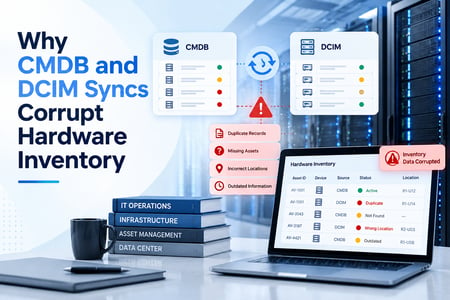
Your CMDB says you have 4,200 servers. Your DCIM says 4,350. The physical rack count comes back at 4,118. None of these numbers are wrong, exactly. They're each accurate within their own system. The problem is that the systems don't agree, and nobody can tell you which one reflects what's actually bolted into your cabinets right now.
This is the central failure of CMDB-DCIM integration: two platforms that each claim to be the authoritative record, feeding each other data on different schedules, at different levels of detail, through sync logic that silently drops or overwrites what doesn't map cleanly. The result is a slow drift where your hardware inventory data gets a little less trustworthy every week.
If your team has ever pulled an inventory report and immediately questioned it, the sync layer between your CMDB and DCIM is the first place to look.
The root problem: two systems, two data models
A CMDB (Configuration Management Database) tracks configuration items and their relationships. It thinks in terms of services, dependencies, and change records. A DCIM (Data Center Infrastructure Management) tool tracks physical infrastructure: power, cooling, rack space, and cabling.
Both systems store hardware records, but they model them differently. The CMDB cares that a server runs three production applications and was last patched on Tuesday. The DCIM cares that the same server sits in rack B-14, draws 840 watts, and has two network connections on ports 23 and 24.
When you sync these two systems, you're asking them to agree on records they fundamentally structure in different ways. That mismatch is where corruption starts.
Five ways sync logic breaks inventory data
1. Field mapping drops detail
CMDB and DCIM platforms store location at different levels of precision. A DCIM tracks position down to the rack unit: Building 2, Room 104, Row C, Rack 14, U22-U25. The CMDB might store the same asset as "DC-East, Rack B14."
When a sync job maps DCIM location data into CMDB fields, the extra detail often gets truncated or flattened. The cabinet position, the U-space, the row designation: gone. Now the CMDB record is technically accurate ("it's in that rack") but not precise enough to find the server without walking the floor. Over time, this precision loss compounds across thousands of records until location data becomes unreliable as a search tool.
The reverse sync is worse. If the CMDB writes its lower-resolution location back to the DCIM, it can overwrite the DCIM's detailed position data with a less accurate version. Both systems now agree on a vague location, and the precise original is gone.
2. Duplicate records from mismatched identifiers
CMDBs typically identify assets by configuration item ID. DCIMs use their own internal identifiers, often tied to rack position or asset tag number. Serial numbers should bridge the gap, but in practice, serial numbers get entered with inconsistent formatting (leading zeros, trailing spaces, different case), or one system stores the chassis serial while the other stores the component serial.
When the sync engine can't match an incoming record to an existing one, it creates a new record. Now you have two entries for the same physical server: one from the CMDB perspective, one from the DCIM perspective. Each gets updated independently. After six months of divergent updates, reconciling them requires manual verification on the data center floor.
A hardware asset tracking platform that uses RFID or barcode as the primary identifier avoids this problem. The physical tag on the device is the single source of truth, and every system references the same tag ID. No format mismatches. No dual-identity records.
3. Delayed sync creates stale windows
Most CMDB-DCIM integrations run on a schedule: hourly, nightly, or (worse) weekly. Between sync intervals, both systems accumulate changes independently. A technician decommissions a server and updates the DCIM at 10 AM. The CMDB doesn't pick up that change until the midnight sync. During those 14 hours, anyone querying the CMDB sees a server that no longer exists.
That's a nuisance for a single record. Across a 5,000-device data center with daily hardware moves, adds, and changes (MACs), the number of records that are stale at any given moment can reach into the hundreds. Teams making capacity decisions, security assessments, or audit preparations during those windows work from data that doesn't match physical reality.
The fix isn't just faster syncs. Event-driven updates, where a change in one system triggers an immediate push to the other, close the window. But most enterprise environments still run batch syncs because event-driven integration is harder to build and maintain.
4. Discovery tools and manual entry contradict each other
Large data centers typically run automated discovery: network scans, agent-based collectors, or SNMP polling that populates the CMDB with what's actually on the network. This discovery data then syncs (or conflicts) with DCIM data entered by technicians who physically install and move hardware.
The conflict pattern is predictable. Discovery finds a server at IP address 10.1.4.87 and creates a CMDB record. A technician installs the same server and logs it in the DCIM with a different hostname, a slightly different serial number entry, and location data from the work order. The sync engine now has two partially overlapping records from two different sources, neither of which is complete.
Over time, discovery overwrites manual entries, manual entries override discovery, and the authoritative version of each field depends on which system wrote it last. This is what the AssetVue team calls bidirectional field ownership conflicts, and it's one of the hardest sync problems to detect because both values look plausible.
5. Unmapped status values create invisible assets
CMDBs and DCIMs use different lifecycle status labels. A DCIM might track statuses like "staged," "burn-in," "active," "failed," and "pending disposal." The CMDB might use "deployed," "in maintenance," and "retired."
When "burn-in" has no equivalent in the CMDB status taxonomy, the sync engine has to make a choice: skip the record, force it into the nearest match, or park it in a catch-all bucket. All three options corrupt the inventory in different ways. Skipped records become invisible: the hardware exists physically, the DCIM knows about it, but the CMDB doesn't. Force-mapped records misrepresent the asset's actual state. Catch-all buckets accumulate noise that nobody reviews.
Multiply this across five or six lifecycle stages that don't translate cleanly, and you end up with a meaningful percentage of your hardware inventory that exists in a gray area between the two systems.
What teams should validate to prevent drift
Knowing how sync corrupts data is useful. Knowing where to check is more useful. These are the specific validation points that catch drift before it compounds.
Run a cross-system record count monthly. Compare total active hardware records in the CMDB against the DCIM against a physical count or RFID sweep. A variance above 2% points to a sync problem that needs a root-cause check. The "10 hidden causes" diagnostic covers how filtered reports can hide these gaps.
Audit field-level overwrite logs. Most integration platforms log which system wrote each field update. Pull a sample of 50 records monthly and check whether CMDB and DCIM are alternating writes to the same field. That alternation pattern is a bidirectional ownership conflict in progress.
Test location precision round-trips. Push a DCIM record with full rack-unit precision through the sync and read it back. If the CMDB stored "Rack B14" instead of "Rack B14, U22-U25," you're losing precision on every sync cycle.
Map every lifecycle status in both directions. Create a translation table that accounts for every DCIM status and every CMDB status. Any status without a clean mapping is creating invisible or miscategorized assets right now.
Compare discovery output against physical verification. Modern IT teams that combine network discovery with physical scanning (RFID or barcode) catch discrepancies that neither method catches alone. Discovery finds what's on the network. Physical scanning finds what's in the rack. The delta between those two sets is your blind spot.
Set a staleness threshold and alert on it. Any record that hasn't been confirmed by either discovery or physical scan within 90 days should trigger a review. Stale records are how ghost assets accumulate: the hardware is gone, but the record persists because nothing actively challenged it.
Why physical verification still matters
CMDB and DCIM syncs are useful. They reduce manual work and keep configuration data flowing between teams. But they operate entirely within the digital layer. Neither system can confirm that a specific piece of hardware is physically present in a specific location at this moment.
That confirmation requires a physical layer: RFID tags, barcode scans, or manual floor walks. The inventory shrinkage data from manufacturing environments shows that organizations adding RFID-based physical verification to their existing software workflows see shrinkage reductions of 30-60% in the first year. Data centers are different from factory floors, but the principle holds: software records drift from reality unless something periodically ties them back to a physical check.
The best setup isn't CMDB or DCIM or physical tracking. It's all three, with clear rules about which system owns which fields and a physical verification layer that catches what the sync logic misses.
AssetVue bridges the gap between CMDB, DCIM, and physical reality with RFID and barcode-verified hardware tracking. Schedule a call to see how it works in your data center.


 Contact Us


 FAQ
FAQ