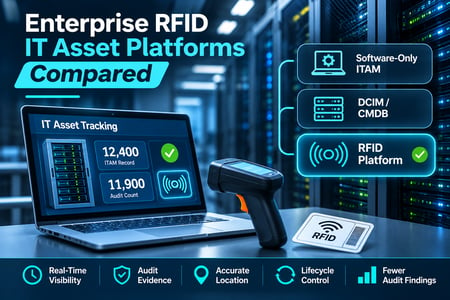
Your ITAM platform reports 12,400 active devices. Your last data center audit counted 11,900. Finance is depreciating all 12,400. Nobody on the team can say, with confidence, which number a regulator would accept.
That gap is the reason enterprise teams start looking at RFID IT asset management. Most asset platforms were built to manage records, not to confirm them, so the moment a server moves racks or a laptop changes hands, the record and the hardware begin to separate. An RFID platform closes the gap by tying every record to a physical tag on the device and a scan that proves where it was and when.
"Platforms compared" usually means a vendor bake-off. This is a different comparison. Before you line up vendors, you're choosing between three approaches to the same problem, and the approach you pick constrains what any single product can do for you. Get the approach right, and the shortlist gets short fast.
Key facts
- Enterprise teams choose between three approaches to IT asset tracking: software-only ITAM, DCIM and CMDB, and hardware-enabled RFID platforms. Only the RFID layer confirms a device is physically present.
- A record backed by an RFID or barcode scan is audit evidence. A record backed by a manual database entry is a claim an auditor can reject.
- AssetVue reports that RFID sweeps cut manual data center inventory from about an hour per rack to under a minute and reconcile thousands of assets in hours instead of weeks.
- Teams that add RFID or barcode verification report audit preparation dropping from weeks to days, with ghost-asset and location findings falling 40-60% in the first year.
- Four findings drive most IT asset audits: ghost assets, stale location data, custody gaps, and incomplete disposal records. Physical verification addresses all four.
Why enterprise ITAM needs a physical layer
Software asset platforms are good at the digital side of the job. They store configuration data, track license entitlements, map dependencies, and feed tickets. What they can't do is confirm that a specific server is bolted into a specific rack at this moment. They infer presence from the last thing someone typed or the last packet a discovery scan saw.
At enterprise scale, inference isn't enough. A 20,000-asset estate spread across offices, colocation space, and a few data centers generates thousands of physical events a month: moves, adds, repairs, returns, disposals. Each event that doesn't reach the record leaves the two a little further apart. Over a year, records drift from the hardware they describe until technicians stop trusting the location field and start walking the floor instead.
A physical layer fixes the root cause. An RFID or barcode scan records movement as a side effect of the work, so the record updates without anyone remembering to type anything. The difference is what an auditor accepts: a record backed by a scan event is evidence, and a record backed by a database entry is a claim. When you compare platforms, that distinction is the one that matters.
What enterprise teams are actually comparing
Three categories of platform claim to solve asset tracking. They solve different parts of it.
Software-only and discovery-based ITAM
These platforms populate records from network discovery, agents, or manual entry, then manage licenses, contracts, and change. They see anything that talks to the network and nothing that doesn't. A powered-off switch in a staging room, a spare GPU on a shelf, a laptop in a drawer: invisible to discovery, present on the floor. Strong on the digital lifecycle, blind to physical presence.
DCIM and CMDB platforms
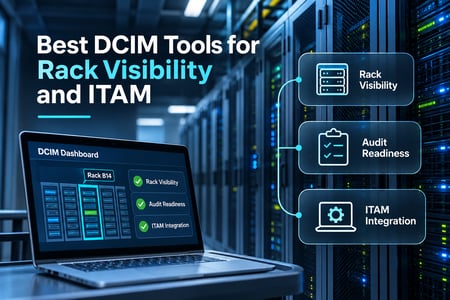
A CMDB tracks configuration items and their relationships. A DCIM tracks power, cooling, rack space, and cabling. Most enterprises run both and sync them to each other. The trouble is that they model the same asset in different ways and update on different schedules, so CMDB and DCIM syncs can quietly corrupt that record through dropped fields, duplicate entries, and unmapped status values. There's a deeper limit, too: DCIM discovery tools report only the assets on your network, while a physical layer can place an asset down to the room and rack. Neither system confirms a device is present. They describe infrastructure; they don't verify it.
Hardware-enabled RFID platforms
These attach a passive RFID tag and usually a barcode to each asset, then read those tags at doorways, docks, racks, and cabinets. The platform records location and custody when the hardware moves, not when someone logs it. This is the category that adds physical hardware control on top of the digital record, and it's the one most enterprise buyers mean by "RFID IT asset management." Asset Vue, for example, is built by former data center operators from Comcast, Verizon, and JPMorgan Chase and combines passive RFID and barcode into a single system of record.
The three aren't mutually exclusive. The strongest enterprise setups keep the CMDB and DCIM for what they do well and add an RFID layer underneath for ground truth. The comparison that matters is how well a platform plays that physical-verification role.
Six criteria that separate enterprise RFID platforms
Once you've settled on a hardware-enabled approach, these are the dimensions that divide one platform from another.
Real-time asset visibility
A quarterly count tells you what was missing in March. It can't prevent the next loss. Real-time asset visibility means the record updates on every location change and custody transfer, so the data is current when someone queries it rather than current as of the last audit.
Ask how the platform handles a device that moves between reads. A strong one shows a "last verified" timestamp next to every location, so stale data and fresh data look different. A weak one shows a confident location with no date behind it, which hides its own uncertainty. Always-current rack views, where the platform shows what's installed and which rack units are free, are the enterprise benchmark here.
Data center asset tracking
The data center is where tracking gets physically hard. Steel racks and dense metal chassis interfere with RFID reads, assets pack into a single rack unit, and a device two units off is one nobody finds without walking the aisle. Generic RFID built for warehouses degrades in this environment.
Enterprise platforms handle it with purpose-built data center asset tracking. Asset Vue's Real-Time Racks and Smart Cabinets report installed equipment and open rack space continuously, the readers capture tags even when cables, blanking panels, or doors block line of sight, and the platform tracks components (blades, storage shelves, optics) rather than only the chassis. AssetVue reports that RFID sweeps cut manual inventory from about an hour per rack to under a minute. If a platform can't confirm a server down to the rack and unit, it isn't built for the data center.
Hardware lifecycle management
An asset passes through procurement, staging, deployment, repair, RMA, redeployment, and disposal. Hardware lifecycle management means the platform tracks the state transitions, not just the current location, and keeps them in sync with the physical device from request and receipt through maintenance and disposal.
The expensive failure is the ghost asset: a server wiped and recycled months ago that still counts as active, still carries a depreciation schedule, and still shows up in a license true-up. A platform earns its place here if a disposal event updates the record through a scan at the point of disposition, rather than waiting for a quarterly cleanup that never quite happens. Scanning the device into the decommission workflow and again at the e-waste station closes the disposal chain an auditor will ask to see.
Compliance audits
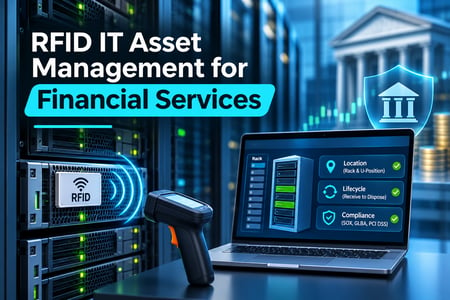
Enterprise asset management lives under audit. SOX, ISO 27001, SOC, PCI DSS, and federal or grant requirements all assume you can produce an accurate, defensible inventory on demand. The Center for Internet Security puts inventory and control of enterprise assets as the first of its 18 CIS Controls, because a device you don't know about is one you can't patch, monitor, or wipe.
Compare platforms on how little work an audit takes. Physical hardware control for IT asset audits turns audit prep from a pre-audit scramble into a byproduct of daily scanning: AssetVue reports teams cutting audit preparation from weeks to days, with ghost-asset and location findings falling 40-60% in the first year. The test is simple. Can the platform produce a custody and disposal report your auditor accepts, showing when each record was last physically confirmed, without a formatting project attached to it?
Physical hardware control
Tracking finds missing equipment. Control keeps it from going missing. Physical hardware control comes from custody chains and scan gates: every checkout, transfer, and return logged against a name, a location, and a timestamp, smart cabinets that record who took which drive, and fixed readers that flag a tagged asset leaving a zone it shouldn't.
Scan gates are where platforms separate. When scanning is optional, compliance drops to 60-70% within a few months because people skip it when they're busy. When the platform blocks a status change until a scan confirms it, compliance holds above 95%. A technician shouldn't be able to move an asset from "active" to "decommissioned" by editing a field; the change should require a scan that proves the device was pulled.
Scale, multi-site, and integration
An enterprise platform has to hold buildings, floors, rooms, racks, and outdoor space in one hierarchy across every site, not as separate databases someone reconciles by hand. A switch scanned in a branch office and a server scanned in a core data center should feed the same inventory, the same exception queue, and the same audit report. Role-based access lets a site admin manage local hardware while central IT sees everything and finance sees depreciation.
Integration is where many RFID tools stall. The value of integrating IT asset management throughout the enterprise is a single source of truth that feeds the systems teams already run: CMDB, ITSM tools like ServiceNow and Jira, ERP, directory services, and HR offboarding so a departing employee's assets don't sit under the wrong custodian. Reading tags is the easy part. Writing verified location back into the CMDB without overwriting good data, and pulling asset context forward into a ticket, is the part that separates an enterprise platform from a warehouse scanner.
Platform categories at a glance
|
Criterion
|
Software-only ITAM
|
DCIM / CMDB
|
Hardware-enabled RFID
|
|
Confirms physical presence
|
No (infers from network)
|
No (models infrastructure)
|
Yes (tag reads)
|
|
Real-time location
|
Discovery cadence only
|
Sync-schedule dependent
|
Continuous at read points
|
|
Data center rack-level detail
|
Rare
|
Manual entry only
|
Yes, via rack sensors
|
|
Component-level tracking
|
No
|
Rare
|
Yes (blades, optics, drives)
|
|
Lifecycle state tracking
|
Strong
|
Partial
|
Strong with scan events
|
|
Audit sweep speed
|
Manual reconciliation
|
Manual reconciliation
|
Thousands of assets in hours
|
|
Physical custody and control
|
Weak
|
None
|
Scan gates and custody chain
|
|
Best role
|
License and change
|
Power, space, config
|
Ground-truth verification
|
The table is a starting filter, not a verdict on any one product. Within the RFID column, platforms still vary widely on data center tagging, integration depth, and whether they surface verification age.
What to test before you buy
Demos show the happy path. These checks expose whether a platform holds up in an enterprise estate.
Read it in your own racks. RFID performance depends on tag type and mounting around steel, so a vendor's warehouse numbers don't transfer. Insist on a pilot that reads your hardware in your cabinets. Tag and reader strategy for metal-heavy environments is a pass/fail test, not a detail to sort out later.
Force a stale-data case. Move a tagged asset without scanning it and query the platform. A good one shows an aging "last verified" flag. A weak one shows a confident, wrong location.
Run a mock audit. Ask for the exact custody and disposal export your auditor needs, and hand it to someone who runs audits. If it needs reformatting, that cost repeats every cycle.
Test the scan gate. Try to change an asset's status without a scan. If the platform lets you edit the field, it can't enforce the discipline that keeps data audit-ready.
Test the write-back. Push a verified location into a staging CMDB and confirm it corrects the record without clobbering fields the CMDB owns. Field ownership rules are the difference between integration and corruption.
Price the full physical rollout. Tags, fixed and handheld readers, rack sensors, smart cabinets, and on-site tagging for the existing estate are the real cost, not the software seat. Weigh it against the audit hours and replacement spend you remove; AssetVue reports payback in as little as a year.
Where hardware-enabled tracking fits
No single system wins outright. Software ITAM owns licenses and change. DCIM and CMDB own power, space, and configuration. What they share is a blind spot: none of them can confirm a physical device is where the record says it is. That confirmation needs a physical layer.
Asset Vue is built for that layer. Its hardware asset tracking platform combines passive RFID, barcode, smart cabinets, and rack sensors, maps assets to buildings, floors, rooms, racks, and custodians in one hierarchy, and integrates with DCIM, CMDB, and ticketing so the physical reads correct the records rather than fighting them. Field teams tag the estate and run the baseline inventory on site, which gets most environments to a working system in weeks. The result is one vendor, one implementation, and one source of truth.
The right comparison isn't AssetVue against another logo. It's a verified physical inventory against an inferred one. For an enterprise under audit, with hardware moving every day across sites you don't fully control, verified wins.
Asset Vue gives enterprise IT a verified physical layer under the CMDB, DCIM, and ITAM systems you already run, with RFID, barcode, and rack-level tracking across every site. Schedule a call to compare it against your current setup.


 Contact Us


 FAQ