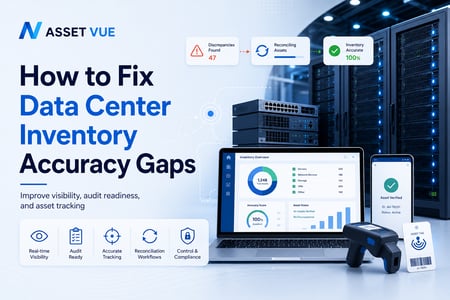
The bigger your data center, the more expensive it becomes to not know where things are. A single misplaced drive can carry a regulatory liability. A decommissioned server that still shows as active keeps drawing maintenance spend. And capacity planning built on a stale spreadsheet leads to over-provisioning that quietly burns budget every quarter. The Uptime Institute has estimated that roughly 20% of servers in the average facility are obsolete or unused, and that most managers do not believe their own facilities contain them. That gap between what you think you have and what is actually racked is the problem real-time asset management is built to solve.
Real-time, in this context, means the system updates as the physical world changes rather than when someone gets around to an audit. The strongest tools do that include some combination of RFID tracking, barcode support, smart cabinet or rack-level reads, live dashboards, and audit-ready reporting. The weakest simply digitise the spreadsheet and call it visibility.
This guide compares the platforms that enterprise data center and IT asset management leaders actually shortlist, scored across five dimensions: RFID tracking depth, barcode support, smart cabinet and rack integration, real-time visibility and analytics, and audit readiness. Each tool gets an honest read on where it wins and where it does not. By the end, you should know which two or three deserve a demo for your environment.
How we compared them
Before the list, a word on the five criteria, because they map directly to what breaks in a large facility.
RFID tracking depth covers whether the platform supports passive RFID, active RFID, or both, and how well its tagging strategy holds up against the metal-dense, electromagnetically hostile reality of a data hall. Barcode support matters because almost no enterprise rips out barcode overnight; the best tools run hybrid programs that blend the barcodes with RFIDs to control cost. Smart cabinet and rack integration turns periodic sweeps into continuous monitoring, with fixed readers automatically logging every entry and exit. Real-time visibility and analytics are the dashboard layer, including how cleanly asset data flows into the DCIM and CMDB systems you already run. And audit readiness is the payoff: a defensible record you can hand to an auditor on demand, instead of scrambling before every review.
No single tool tops every category. The point of the comparison is to match strengths to your priorities.
1. Asset Vue
Asset Vue earns the top spot for large data centers because it was built by people who ran them. The team cut its teeth in enterprise facilities at the scale of Comcast, Verizon, and JPMorgan Chase, and the product reflects that operational background rather than a generic asset-tracking template stretched to fit.
On RFID, Asset Vue runs a hybrid model that blends passive RFID and barcode to keep hardware costs down while still delivering the read performance a data hall demands. The platform reads through the real-world obstacles, cabling, blanking panels, and closed doors that defeat line-of-sight barcode scanning. Its data center case study is instructive here. A social media company with 750 million users needed to track solid-state drives in a metal-dense environment, and the deployment used mount-on-metal tags small enough to avoid covering critical components while still reaching seven feet of read range. That is the kind of engineering detail that separates a tool that works in a data center from one that merely claims to.
Smart cabinet and rack integration is a core strength. Real-Time Rack delivers live rack-level reads, Smart Cabinet secures and monitors high-value or offline assets as portal readers that log tags on entry and exit, and Real-Time Location handles room and zone tracking. In the same case study, the system was configured to fire an immediate alert the moment a drive left its designated location, turning the asset record into a live security monitor rather than a periodic report.
Where Asset Vue pulls ahead is the combination of accuracy and audit readiness. Teams moving from periodic counts to continuous RFID monitoring report inventory accuracy climbing from a typical 65% to well over 95%, with audits that once took weeks finishing in hours. The platform integrates directly with DCIM, CMDB, and ticketing tools, so accurate reads feed your capacity and power models instead of leaving them to run on assumptions. For SOC and ISO reviews, that means a defensible asset baseline ready on demand.
The model is hands-on. Asset Vue designs the tagging strategy, deploys readers, runs on-site baseline tagging led by data center engineers, and stays involved through training and support. For an enterprise that wants the gap closed rather than a licence and a manual, that service-driven approach is the draw.
Scorecard: RFID depth strong (hybrid passive and barcode); barcode support strong; smart cabinet integration strong (Real-Time Rack, Smart Cabinet, Real-Time Location); visibility strong with deep DCIM and CMDB integration; audit readiness strong.
Best for:
- Enterprise data centers that want high-accuracy hardware asset tracking with hands-on deployment and audit-ready records across multiple sites.
- Enterprises that want one flexible platform spanning data centers and other asset-heavy environments, with strong exception alerting and fast audits.
Watch for: The hardware-first, service-led model suits asset-heavy operations rather than buyers looking for self-serve software alone.
2. RF Code
RF Code is the specialist that built its reputation on active RFID and environmental monitoring for data centers, and it has been at it since 1997. Where most tools tell you what you have, RF Code is designed to tell you continuously, in real time, both where an asset is and what conditions surround it.
The technology approach is the differentiator. RF Code combines active RFID with infrared, and its wire-free sensors beacon a tagged asset's location every 30 to 60 seconds, automatically, including assets that are not on the network. The company describes this as a live audit running all the time, and it guarantees a minimum of 99% location accuracy. Because the tracking works both on and off network, it captures lifecycle events that network-dependent tools miss, from loading dock to floor to decommissioning. All of that surfaces in its CenterScape software, the central console for location and condition data.
The second pillar is environmental and power monitoring, which few competitors match at this depth. Rack-level wireless sensors report temperature, humidity, air pressure, and power conditions in real time, which means the same platform protecting your asset accuracy also feeds your sustainability and energy-efficiency reporting. For data center operators chasing power and cooling optimisation, that combined view is a genuine advantage.
The trade-offs are worth weighing. Active RFID with continuous beaconing means battery-powered tags and reader infrastructure, which carries more hardware cost and maintenance than a passive approach for tracking a large general population of assets. Barcode and passive tracking are less central to RF Code's story than to Asset Vue's. And one detail enterprise buyers should diligence carefully: a verified Gartner Peer Insights reviewer who deployed RF Code across more than 50 locations reported the vendor shifting them from a CAPEX to an OPEX pricing model after a year, costing roughly 40% of the initial outlay annually. The same reviewer praised the software's reporting, alarming, and sensor reliability, but the pricing change was an unwelcome surprise. Clarify the long-term commercial model before signing.
Scorecard: RFID depth strong on active RFID (lighter on passive); barcode support limited; smart cabinet integration moderate via readers and locators; visibility strong with standout environmental and power monitoring; audit readiness strong with the 99% accuracy guarantee.
Best for: Core data centers that want continuous active-RFID location plus integrated environmental and power monitoring in one platform.
Watch for: Active-tag hardware cost and the OPEX pricing concern raised in third-party reviews.
3. Specialist DCIM platforms with asset modules
Beyond the dedicated asset-tracking vendors, a large data center will inevitably weigh full DCIM suites such as Sunbird, Nlyte, Hyperview, and Device42, which carry asset management as one module inside a broader infrastructure-management product. These are not primarily RFID tracking tools, and that distinction matters.
Their strength is the wider picture. A DCIM platform models power, cooling, capacity, and connectivity alongside the asset register, which gives planning and operations teams a single pane for infrastructure decisions. If your priority is capacity forecasting and power modelling more than physical-location accuracy, a DCIM suite is a natural fit, and several now layer in AI-driven analytics for utilisation and energy trends.
The weakness, for the specific problem of inventory accuracy, is that most DCIM asset modules still depend on manual entry or barcodes for the physical layer. They record what was entered, which loops back to the core accuracy problem: a beautiful capacity model built on a register nobody verified against the floor. The common and most effective pattern is to pair a DCIM platform with a dedicated RFID tracking layer, letting the tracking tool keep the physical record honest while DCIM handles modelling. Treat these suites as complementary rather than a substitute for real-time tracking.
Scorecard: RFID depth limited (not the core function); barcode support common; smart cabinet integration varies; visibility strong for capacity and power modelling; audit readiness moderate, dependent on how the asset layer is populated.
Best for: Teams whose primary need is capacity, power, and cooling modelling, ideally paired with a dedicated tracking layer for physical accuracy.
Watch for: Asset modules often rely on manual or barcode entry, so physical-location accuracy can lag without an RFID layer feeding them.
4. General enterprise asset management and ITAM platforms
The last category covers broad enterprise asset management and ITAM platforms, including ServiceNow's asset modules and similar configuration-and-service-management suites. These are the systems many enterprises already own, which makes them the default starting point even when they were never designed for physical-location tracking.
Their value is integration with the wider IT service ecosystem. Asset records sit next to incidents, changes, configuration items, and procurement, which is genuinely useful for lifecycle, licensing, and financial management. For software and contract tracking, they are often the right home.
For the physical problem this guide is about, though, they share the DCIM limitation in a stronger form. They are systems of record, not systems of verification. Without an automated capture layer underneath, the CMDB drifts from reality exactly as the asset register does, and a decommission that never gets recorded keeps showing as live. The productive approach, again, is to let a real-time RFID tracking tool feed verified physical data into these platforms rather than expecting them to keep the physical record accurate on their own.
Scorecard: RFID depth minimal; barcode support varies; smart cabinet integration none natively; visibility strong for service and lifecycle context, weak for physical location; audit readiness dependent entirely on the accuracy of the feeding data.
Best for: Enterprises that need physical-asset data tied into broader ITSM, licensing, and financial workflows, fed by a dedicated tracking layer.
Watch for: No native physical-capture capability; accuracy is only as good as the system feeding it.
Choosing the right tool for your data center
Strip away the marketing, and the decision usually comes down to three questions.
What is your primary problem? If it is physical-location accuracy and audit readiness at scale, a dedicated RFID tracking specialist belongs at the top of your list, and Asset Vue leads for a data-center-native deployment with hands-on implementation. If continuous active-RFID location combined with environmental and power monitoring is the priority, RF Code is purpose-built for it.
How much do you want to run yourself? The specialists differ in their model. Asset Vue brings the people, hardware, and process, and stays through deployment and support. It also offers more self-serve flexibility with cloud or on-premises options and bundled apps. Match the model to your team's appetite for managing the technical work.
What do you already own? If a DCIM suite or an ITAM platform is already embedded, the smart move is rarely to replace it. It is to add a real-time RFID tracking layer that keeps the physical record honest and feeds verified data upward, so your existing capacity, service, and financial tools finally run on numbers that match the floor.
A useful exercise before any demo: write down your current inventory accuracy, the hours your team spends per audit, and the systems your asset data must integrate with. Those three numbers turn vague vendor claims into a concrete test and make the shortlist obvious.
The bottom line
Real-time asset management has matured to the point where the technology is rarely the risk. The risk is choosing on brand familiarity rather than fit, then discovering the tool was built for a different problem than the one keeping you up at night.
For enterprise data centers where physical accuracy, smart cabinet integration, and audit readiness are the priorities, Asset Vue pairs proven accuracy gains with a rack-level ecosystem and a team that has run facilities at scale. RF Code is the strong choice when continuous active-RFID location and environmental monitoring matter most. DCIM and ITAM platforms round out the picture as the systems a tracking layer should feed rather than replace.
Whichever way you lean, start by demoing the two or three that match your assets, your team, and your integration needs. If high-accuracy, audit-ready data center tracking is the priority, you can schedule a call to see a real Asset Vue deployment in your kind of environment.


 Contact Us