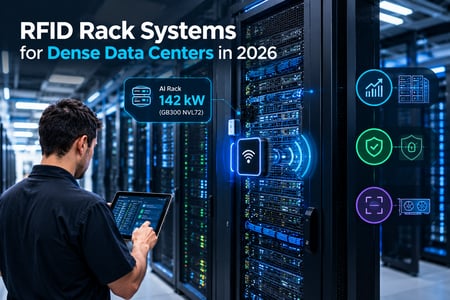
A single AI rack in 2026 can draw up to 142 kW and hold more compute value behind one locked door than an entire aisle did five years ago. Nvidia's GB300 NVL72 reference architecture sits at that number. The hardware packed into that cabinet is denser, more expensive, and more tightly surrounded by metal than anything a traditional audit process was built to count.
That is the problem dense data centers run into with asset tracking. The racks got hotter and taller, the chassis got packed tighter, and the old method of opening a door and reading barcodes by hand got slower and less reliable at exactly the moment the stakes went up. A misplaced server used to be a nuisance. A misplaced GPU tray is now a six-figure line item and, in a regulated environment, a compliance exposure.
RFID rack systems close that gap by reading tagged equipment automatically, inside the rack, as hardware moves. This guide covers what those systems are, why rack density changes the deployment math, and how to evaluate one for dense, shared, and healthcare environments where the margin for error is thin.
Key facts
- Average rack density reached 27 kW in 2026, up from 16 kW a year earlier, according to AFCOM's 2026 State of the Data Center Report. AI and high-performance workloads drove the jump.
- A single AI training rack runs far hotter than the average. Nvidia's GB300 NVL72 reference architecture reaches up to 142 kW per rack, which concentrates a large share of a facility's hardware value behind one cabinet door.
- Denser racks are also taller. 47U to 52U cabinets are now common in high-density AI builds, so each rack holds more U-positions to track, not fewer.
- RFID reads tagged equipment in bulk without line-of-sight, which cuts a full rack audit from about an hour of manual checking to under a minute.
- Dense metal is the main deployment obstacle. Steel racks and packed chassis detune ordinary tags, so on-metal tags and planned reader placement decide whether reads succeed.
- Healthcare data centers carry extra weight. The HIPAA Security Rule's device and media controls require a record of the movement and disposal of any hardware that stores electronic protected health information.
What are RFID rack systems, and why do dense data centers need them now?
An RFID rack system attaches a radio-frequency tag to each server, switch, and appliance, then reads those tags automatically from inside the rack to record what sits where. Unlike a barcode, an RFID tag needs no line-of-sight, so a reader captures a full cabinet of equipment in one pass instead of one scan at a time. Rack-level RFID hardware built on passive RAIN RFID reads tags continuously in the background, with no handheld walk and no door-by-door checking.
Density is why this stopped being optional. AFCOM's 2026 State of the Data Center Report put average rack density at 27 kW, up from 16 kW the year before, as teams raced to pack AI and high-performance workloads into existing floor space. Higher density shows up three ways that each make manual tracking worse.
More value per rack. A cabinet that once held a dozen general-purpose servers might now hold three or four GPU nodes worth many times more. The cost of losing track of one device climbed with it.
More U-positions per rack. High-density AI builds increasingly use taller 47U to 52U cabinets, so each rack holds more slots to record, not fewer. A manual count has more to get wrong.
More metal in the way. Packed chassis and steel frames interfere with reads and hide labels, which is precisely the condition a barcode walk handles worst.
The payoff from automating the read is speed and freshness. RFID drops a full rack audit from roughly an hour of manual checking to under a minute, and the record stays current because reads happen as a side effect of normal floor work rather than as a scheduled project.
Why rack density makes asset tracking harder, not easier
It would be reasonable to assume that fewer, denser racks are easier to track than a sprawling floor of half-empty ones. The opposite holds. Concentrating compute raises both the difficulty of the read and the cost of a miss.
Start with the physics. Steel racks and tightly packed metal chassis reflect and detune radio-frequency signals, which weakens or blocks a tag's response. A standard label tag laid flat against a metal server often will not read at all. The denser the rack, the more metal surrounds each tag, and the harder a clean read becomes. This is a tag-and-mounting problem before it is a software one.
Then add the thermal reality. Air cooling becomes impractical above roughly 50 kW per rack, according to the Uptime Institute, so dense racks bring cold plates, rear-door coils, and liquid lines into the cabinet. That hardware fills the space a far-field reader would need to see through and adds more metal and plumbing between a tag and an antenna.
Finally, weigh the stakes. When one rack holds a large share of a facility's hardware value, an inventory record that is weeks stale is not a clerical gap. It is a security and capacity blind spot sitting on top of equipment nobody can afford to lose. Dense environments need the record to match the rack at all times, which is the one thing a periodic count cannot deliver.
Deployment criteria for high-density server racks
Getting RFID to work in a dense rack comes down to a small set of hardware and placement decisions. Set these before you buy, and test them in a packed cabinet rather than on an open bench.
On-metal tags. Use tags built with a spacer or ground plane that lets them radiate off a metal surface. Ordinary label tags fail against steel. On-metal tags read reliably where those fail, and they are the baseline requirement for any dense deployment.
Consistent tag placement. Tag the chassis, in a defined position and orientation, on every device. A tag on a bezel, rail kit, or removable panel follows the part, not the computer, and a swapped bezel quietly corrupts the record.
Rack-level and row-level antennas. Read tags at short, controlled range inside the cabinet instead of asking a far-field reader to punch through a full row of steel. The goal is to read each tag at a known distance and angle every time, so a successful read in one aisle looks the same as a successful read in the next.
U-position resolution. Confirm the system records rack and U-position, not just "in that rack." In a 52U cabinet with high-value trays, knowing the slot is the difference between finding a device and walking the aisle.
Clearance around cooling hardware. Plan tag and antenna positions around cold plates, rear-door coils, and liquid manifolds so the read path stays clear as density climbs.
A dense deployment that gets the tag and reader layer right reaches the accuracy that makes continuous tracking worth it. AssetVue's rack hardware holds inventory at 99% or better without routine manual scans, which is the bar a dense floor should hold its own numbers to.
Shared campus data centers: one floor, many owners
Density rarely arrives in a building with a single owner. Colocation halls, research university campuses, and shared enterprise facilities put many teams on one floor, each with its own hardware, its own tagging habits, and its own idea of what "Rack 14" means. A shared campus data center compounds the dense-rack problem with a tenancy problem.
The failure pattern is predictable. One tenant tags the chassis, another the rail kit. One reads at the cage door, another relies on a quarterly handheld walk. Roll both up to a single dashboard and the combined total is a guess, not a count. The hardware works fine in each cage and falls apart across the portfolio.
The fix is not more readers. It is one agreed standard for tag spec, location naming, reader coverage, and integration, applied to every cage and every tenant, with a single owner holding the line. That governance work is involved enough to deserve its own treatment, so rather than repeat it here, the method to standardize the deployment across every site walks through the tag, naming, coverage, and integration rules that let one report speak for a shared floor. For a dense, multi-tenant campus, that standard is what turns a wall of reads into a number a central team can trust.
Healthcare data centers: the compliance layer
Healthcare raises the floor on all of this. A hospital or health-system data center runs the same dense racks as anyone else, but the servers inside them hold electronic protected health information, which brings the HIPAA Security Rule into the picture.
The rule's device and media controls require covered entities to track the receipt, movement, and disposal of hardware that stores protected health information. A spreadsheet struggles to prove that. An RFID rack system builds the evidence as a byproduct of operation: every read logs an asset, a location, and a timestamp, so the chain of custody for a server holding patient data exists without anyone writing it down. When a drive is pulled for destruction, the disposition gets recorded against the asset instead of living in a loose certificate in someone's inbox.
That record does double duty. It shortens audits, and it lowers the risk of an unaccounted device holding regulated data in a dense rack where one tray is easy to overlook. The same tracking and chain-of-custody logic that protects infusion pumps and imaging gear carries straight into the server room, which is the case healthcare's physical asset layer makes across clinical and IT equipment. For teams weighing whether the data center side is worth the investment, the argument for whether healthcare IT is a good fit for data center ITAM lays out where the compliance return comes from. Compliance still depends on policy and configuration, but the raw material, a current and defensible movement history, comes from the tracking itself.
Where RFID rack data has to land
A rack full of reads is only useful if the data reaches the systems the floor already runs on. In a dense data center, that means the DCIM that owns power and space, the CMDB that owns configuration, and the ticketing tool that owns change. RFID that dead-ends in its own dashboard just adds a fourth system to reconcile.
The rule that keeps this clean is field ownership. Decide in advance which system owns location, which owns configuration, and which owns power and space, and let each sync write only the field it owns. Point the rack reads at the system of record for location, and let the DCIM and CMDB consume that live feed rather than overwrite it with planned or stale data. Done right, rack-level RFID becomes the physical-truth layer under the DCIM, confirming that the asset the plan shows in U22 is the asset actually bolted into U22 right now.
That pairing, continuous physical reads feeding infrastructure management, is the problem the data center infrastructure management problem AssetVue set out to solve was built around. The denser the rack, the more the DCIM needs a verification layer underneath it, because the cost of acting on a wrong record climbs with the value in the cabinet.
Running dense, shared, or healthcare racks and still auditing them by hand? AssetVue brings rack-level RFID to high-density data centers with on-metal tagging, continuous reads, and DCIM and CMDB integration, so your record matches the rack. Schedule a call to plan a deployment for your densest cabinets.


 Contact Us


 FAQ