Contact Us
Table of contents
Introduction
Enterprise IT teams and data center operators are under increasing pressure to maintain accurate asset records, simplify compliance audits, and improve visibility across complex hardware environments.
Traditional inventory methods often struggle to keep up with thousands of servers, networking devices, racks, and critical infrastructure assets moving across facilities.
This is where RFID asset management platforms help.
Unlike manual inventory processes, RFID-based tracking allows organizations to automatically identify assets, reduce audit time, improve inventory accuracy, and maintain better visibility into physical infrastructure.
However, choosing the right RFID asset management platform depends on several factors:
- Data center environment requirements
- Real-time asset tracking needs
- Barcode and RFID integration
- Compliance audit requirements
- Existing IT infrastructure systems
- Scalability across multiple locations
This guide compares some of the leading RFID asset management platforms for enterprise organizations and highlights what makes each one suitable for different use cases.
What Is RFID Asset Management?
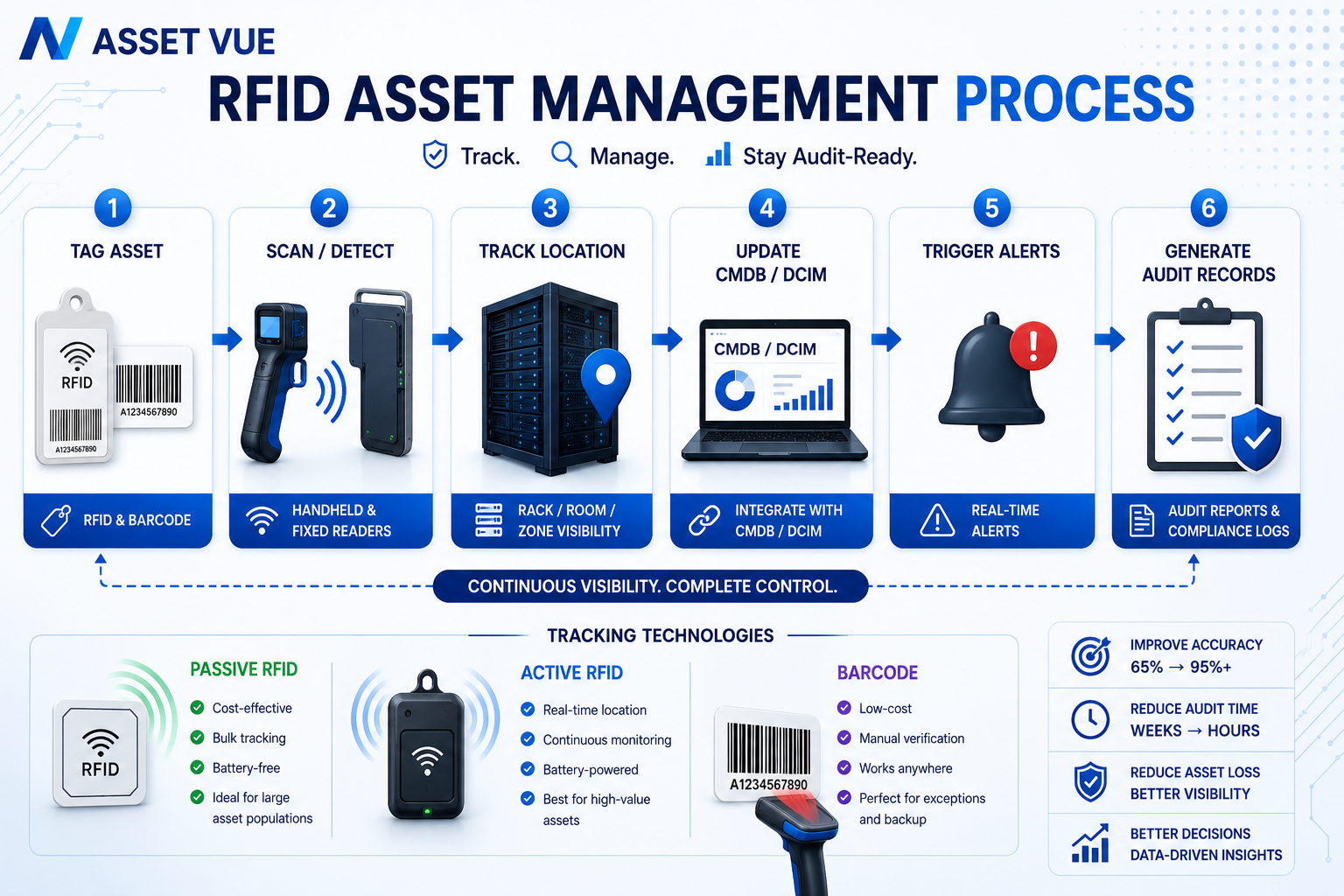
RFID asset management uses radio frequency identification technology to track and manage physical assets through RFID tags, readers, and asset management software.
Each tagged asset receives a unique identifier that allows organizations to track:
- Asset location
- Ownership
- Movement history
- Lifecycle status
- Maintenance information
- Audit records
Compared with manual barcode scanning, RFID can capture multiple assets simultaneously without requiring direct line-of-sight scanning.
This makes RFID especially valuable for:
- Data centers
- IT infrastructure environments
- Warehouses
- Enterprise campuses
- Equipment-heavy operations
Key Features to Look for in an RFID Asset Management Platform
Before selecting a platform, enterprise buyers should evaluate:
1. Real-Time Asset Tracking
The platform should provide visibility into:
- Current asset location
- Asset movement
- Rack-level visibility
- Historical tracking data
Real-time tracking reduces the risk of missing assets and outdated inventory records.
2. Barcode and RFID Integration
Many organizations use barcode systems alongside RFID.
A strong platform should support hybrid tracking workflows where teams can use:
- RFID for bulk inventory and automated tracking
- Barcode scanning for manual verification and lower-volume assets
3. Compliance Audit Support
Audit-ready asset management requires more than inventory lists.
Look for features such as:
- Asset history logs
- Location verification
- Audit reports
- Data reconciliation
- Compliance documentation
4. Data Center Compatibility
Enterprise data centers require specialized tracking capabilities, including:
- Rack-level asset visibility
- Server tracking
- Equipment movement tracking
- Integration with IT infrastructure systems
Top RFID Asset Management Platforms
1. Asset Vue
Best for: Enterprise IT asset tracking and data center environments
Asset Vue is designed for organizations that need accurate physical asset visibility across complex IT environments.
The platform combines RFID and barcode-based tracking to help enterprises manage hardware assets, improve inventory accuracy, and simplify audits.
Key Features:
✅ RFID-based asset tracking
✅ Barcode integration
✅ Data center inventory visibility
✅ Asset lifecycle management
✅ Audit support
✅ Location tracking
✅ Enterprise asset reporting
Best Fit:
- Data centers
- Enterprise IT teams
- Hardware-intensive environments
- Organizations requiring audit-ready inventory accuracy
- Organizations wanting to integrate with any ITSM tool, including ServiceNow.
Why Consider Asset Vue:
Asset Vue focuses on closing the gap between digital asset records and physical reality by helping teams quickly identify what assets exist, where they are located, and their current status.
2. Zebra RFID Solutions
Best for: Enterprise RFID hardware ecosystems
Zebra is widely recognized for RFID readers, scanners, printers, and enterprise tracking hardware.
Organizations often use Zebra technology as part of larger RFID asset tracking implementations.
Key Features:
✅ RFID readers and scanners
✅ RFID printing solutions
✅ Enterprise mobility hardware
✅ Barcode and RFID support
✅ Large-scale tracking capabilities
Best Fit:
- Organizations already using Zebra hardware
- Warehouses
- Logistics operations
- Large enterprise deployments
Considerations:
Zebra typically focuses more on RFID hardware infrastructure, so organizations may need additional software layers depending on their asset management requirements.
3. RF Code
Best for: Data center environmental tracking
RF Code specializes in real-time asset tracking solutions designed for data centers and IT environments.
The platform focuses on environmental sensing and asset visibility through RFID and sensor technologies.
Key Features:
✅ Real-time location tracking
✅ Data center asset visibility
✅ Automated inventory updates
✅ Environmental monitoring integrations
✅ Rack-level tracking
Best Fit:
- Large data centers
- Critical infrastructure environments
- Organizations requiring continuous monitoring
Considerations:
Best suited for organizations needing dedicated real-time tracking capabilities.
4. AMI AssetTrack
Best for: Asset lifecycle tracking
AMI AssetTrack focuses on managing physical assets throughout their lifecycle.
Key Features:
✅ Asset identification
✅ Inventory tracking
✅ Lifecycle management
✅ Reporting
Best Fit:
- Organizations managing large asset inventories
- Lifecycle-focused asset management programs
Considerations:
Best suited for organizations already ingrained in ServiceNow.
5. Impinj
Best for: Enterprise RFID infrastructure and IoT connectivity
Impinj is a leading provider of RAIN RFID technology, offering readers, gateways, endpoint ICs, and connectivity solutions that help organizations improve asset visibility and inventory accuracy. Its platform is widely used across retail, logistics, healthcare, and enterprise asset tracking deployments.
Key Features:
- ✅ RAIN RFID readers and gateways
- ✅ High-performance RFID infrastructure
- ✅ Enterprise-scale asset visibility
- ✅ Integration with RFID asset management solutions
- ✅ Support for large-volume inventory tracking
Best Fit:
- Enterprise asset tracking
- Data centers
- Retail and logistics
- Organizations building scalable RFID ecosystems
How to Choose the Right RFID Asset Management Platform
The best platform depends on your operational requirements.
Choose Asset Vue if you need:
- Data center asset visibility
- RFID + barcode workflows
- Audit-ready inventory
- Enterprise hardware tracking
Choose Zebra or Impij if you need:
- Enterprise RFID hardware infrastructure
- High-performance RFID readers and gateways
- Large-scale RFID deployments
Choose RF Code if you need:
- Continuous real-time asset location monitoring
- Data center-focused RFID deployment
Choose lifecycle-focused platforms if you need:
- General asset tracking
- Equipment lifecycle management
Benefits of RFID Asset Management for Enterprises
Faster Audits
RFID allows teams to verify large numbers of assets faster than manual counting.
Improved Inventory Accuracy
Automated tracking reduces human errors and outdated records.
Better Compliance Readiness
Complete asset history and tracking records support compliance requirements.
Reduced Asset Loss
Organizations gain better visibility into asset movement and ownership.
Improved Data Center Operations
Accurate asset information improves planning, maintenance, and infrastructure decisions.
Final Thoughts
Choosing an RFID asset management platform requires looking beyond basic tracking capabilities.
Enterprise teams should evaluate how well each platform supports:
- Real-time asset tracking
- Data center inventory
- Compliance audits
- Barcode and RFID integration
- Long-term scalability
For organizations managing complex IT environments, the right RFID solution can transform asset tracking from a manual audit process into a continuously verified source of truth.


 FAQ
FAQ
Frequently Asked Questions
Our customers rely on Asset Vue to keep critical operations running smoothly. Here’s what they say about working with us.
What is the best RFID asset management software?
The best RFID asset management software depends on your environment. Asset Vue, RF Code, Zebra, AssetPulse, AMI AssetTrack, and Impinj all serve different use cases, from enterprise IT tracking to data center infrastructure monitoring.
Can RFID replace barcode asset tracking?
RFID does not always replace barcode tracking. Many enterprises use a hybrid approach where RFID handles automated inventory capture while barcodes support manual verification.
How does RFID improve compliance audits?
RFID creates more accurate asset records by automatically capturing asset information, movement history, and location data, making audits faster and more reliable.
Is RFID useful for data centers?
Yes. RFID is especially useful in data centers because it helps track servers, networking equipment, racks, and other hardware assets across large environments.