Contact Us
Table of contents
Introduction
Keeping track of physical assets has become much harder for modern businesses.
Companies today manage thousands of laptops, servers, scanners, tools, warehouse equipment, and mobile devices across multiple locations. As organizations grow, manual tracking methods like spreadsheets and paper-based inventory records often become slow, inaccurate, and difficult to maintain.
This is one reason businesses are moving toward smarter tracking technologies that provide better visibility into where assets are located and how they are being used.
RFID asset tracking has become one of the most effective ways to achieve this.
Unlike traditional barcode systems that require individual scanning, RFID technology allows organizations to track assets automatically using radio signals. Businesses can scan multiple items at once, reduce manual work, and maintain more accurate inventory records in real time.
What Is RFID Asset Tracking?
RFID asset tracking is a technology that uses radio frequency signals to automatically identify and track physical assets.
RFID stands for Radio Frequency Identification.
Instead of manually checking assets one by one, RFID systems allow organizations to scan and monitor tagged assets automatically, often without direct contact or line-of-sight scanning.
This makes RFID much faster and more efficient than traditional manual tracking methods.
Businesses use RFID asset tracking to manage assets such as:
- laptops
- servers
- warehouse equipment
- medical devices
- tools
- scanners
- And high-value inventory.
Each asset is attached to an RFID tag that contains a unique identification number. RFID readers detect those tags and send the information to asset management software, where the data is updated in real time.
This creates a more accurate and centralized view of inventory across the organization.
Compared to spreadsheets or manual barcode scanning, RFID systems help businesses:
- reduce human error
- improve inventory accuracy
- automate audits
- Gain real-time visibility into asset movement.
RFID tracking is especially useful in environments where assets move frequently or where organizations manage large volumes of equipment.
For example, in warehouse asset tracking, employees can scan entire groups of tagged assets within seconds instead of checking every item individually.
In enterprise IT environments, RFID systems help organizations maintain visibility into servers, networking equipment, laptops, and other critical hardware assets across multiple facilities.
Many modern organizations now use RFID-powered real time asset tracking solutions to improve operational efficiency while reducing the time spent on inventory management tasks.
How Does RFID Asset Tracking Work?
RFID asset tracking may sound highly technical, but the basic process is actually simple.
An RFID system works by using radio signals to communicate between tagged assets and RFID readers. The information collected is then processed through asset management software, giving organizations real-time visibility into their inventory and asset locations.
Most RFID systems rely on three main components working together.
The 3 Main Components of an RFID System
RFID Tags
RFID tags are attached directly to physical assets.
Each tag contains:
- a small microchip
- And an antenna
The microchip stores a unique identification number that is connected to a specific asset inside the asset management system.
When the tag enters the range of an RFID reader, it sends that information back to the system automatically.
RFID tags can be attached to:
- laptops
- servers
- tools
- warehouse inventory
- medical equipment
- And other physical assets.
There are different types of RFID tags, including passive and active RFID tags, which we will cover later in this guide.
RFID Readers
RFID readers are devices that send out radio signals and detect nearby RFID tags.
These readers act as the bridge between the physical asset and the software platform.
RFID readers can be:
- handheld mobile scanners
- fixed doorway readers
- warehouse dock readers
- Mounted tracking devices.
For example, a warehouse may install fixed RFID readers near loading docks to automatically track inventory moving in and out of the facility.
In data centers or enterprise IT environments, technicians may use handheld RFID readers to perform fast inventory audits across server racks and equipment rooms.
Compared to manual inventory checks, RFID readers dramatically reduce the time required to locate and verify assets.
Asset Management Software
The software is the central system that processes RFID data.
When an RFID reader detects a tag, the software updates information such as:
- asset location
- movement history
- assignment status
- inventory records
- and asset availability
This creates a centralized and real-time view of all tracked assets.
Modern real time asset tracking systems often include:
- inventory dashboards
- reporting tools
- audit records
- lifecycle management
- And mobile asset tracking features.
For enterprise organizations, this software becomes the operational center for managing large hardware and inventory environments efficiently.
Step-by-Step Process of RFID Tracking
The RFID tracking process usually works in four simple steps.
Step 1: The RFID Reader Sends a Radio Signal
The RFID reader continuously sends out radio frequency signals within a certain range.
Step 2: The RFID Tag Responds
When an RFID tag enters the signal range, the tag responds by sending back its unique identification data.
Passive RFID tags use the reader’s signal for power, while active tags use their own internal battery.
Step 3: The Reader Captures the Asset Information
The RFID reader receives the tag’s data and identifies the asset connected to that tag.
Unlike barcode systems, RFID readers can often detect multiple assets at the same time without requiring direct scanning.
Step 4: The Software Updates the Asset Record
The information is sent to the asset management platform, where the system updates:
- asset location
- inventory status
- movement history
- And tracking records in real time.
This process happens automatically and helps organizations maintain accurate inventory visibility without relying heavily on manual updates.
Passive vs Active RFID: What’s the Difference?
Not all RFID systems work the same way.
One of the most important things businesses need to understand before implementing an RFID asset tracking system is the difference between passive RFID and active RFID.
Both technologies help organizations track assets, improve inventory visibility, and automate tracking processes, but they are designed for different environments and operational needs.
The biggest difference comes down to how the RFID tag receives power and how far the signal can travel.
Understanding these differences helps organizations choose the right RFID solution for their specific use case.
What Is Passive RFID?
Passive RFID tags do not have their own internal power source.
Instead, they use energy from the RFID reader’s radio signal to activate and send back their identification data.
Because passive tags do not require batteries, they are:
- smaller
- lighter
- more affordable
- and easier to maintain
Passive RFID is the most commonly used option for RFID asset tracking.
It is widely used for:
- IT asset tracking
- Warehouse asset tracking
- Inventory management
- Office equipment
- and retail inventory systems
For example, businesses often attach passive RFID tags to:
- laptops
- servers
- scanners
- tools
- storage bins
- Warehouse inventory
Passive RFID works especially well in environments where assets are scanned regularly but do not require long-range tracking.
What Is Active RFID?
Active RFID tags contain their own internal battery.
Instead of relying on the RFID reader for power, active tags continuously broadcast signals that can be detected over much longer distances.
Because of this, active RFID systems are commonly used for:
- vehicle tracking
- heavy equipment
- fleet management
- industrial operations
- Large facility monitoring.
Active RFID provides stronger real-time visibility in environments where assets move across wide areas or require continuous tracking.
For example, large manufacturing facilities or logistics operations may use active RFID to monitor the movement of expensive machinery or vehicles across multiple zones in real time.
Benefits of RFID Asset Tracking
Organizations adopt RFID asset tracking for one main reason.
It helps them gain faster, smarter, and more accurate control over physical assets.
Compared to spreadsheets, manual inventory processes, or even barcode-based systems, RFID technology significantly improves how businesses track, manage, and monitor equipment in real time.
As companies manage larger inventories and more distributed operations, the demand for real time asset tracking continues growing across industries like warehousing, healthcare, manufacturing, and enterprise IT.
Here are some of the biggest benefits businesses gain from RFID-powered asset tracking systems.
Faster Inventory Audits
Traditional inventory audits take time.
Employees often need to manually scan assets one by one, verify serial numbers, and update spreadsheets or inventory systems manually.
For organizations managing hundreds or thousands of assets, this process can become extremely slow and resource-intensive.
RFID dramatically speeds up inventory audits.
Since RFID readers can scan multiple tagged assets simultaneously, businesses can complete audits much faster compared to manual barcode scanning methods.
For example, in a warehouse or data center, employees can walk through aisles with a handheld RFID reader and automatically detect large numbers of assets within seconds.
This helps organizations:
- reduce audit time
- improve inventory efficiency
- and minimize operational disruptions during inventory checks.
Many enterprises using RFID-based real time asset tracking systems can complete inventory audits in a fraction of the time previously required.
Real-Time Asset Visibility
One of the biggest advantages of RFID is real-time visibility.
Organizations can continuously track where assets are located and monitor movement across facilities, departments, or operational zones.
This level of visibility is difficult to achieve with spreadsheets or manual tracking systems.
Real-time tracking helps businesses quickly identify:
- where assets are
- who is using them
- when equipment was moved
- and whether assets are missing or inactive.
This is especially important for industries where assets frequently move between locations, such as:
- warehousing
- healthcare
- manufacturing
- and enterprise IT operations.
Modern real time asset tracking solutions allow organizations to maintain centralized visibility across multiple locations while reducing dependency on manual updates.
Higher Inventory Accuracy
Inventory accuracy is one of the biggest challenges in asset management.
When businesses rely on spreadsheets or inconsistent manual updates, inventory records quickly become outdated.
This often leads to:
- Ghost Assets
- Duplicate purchases
- Missing devices
- And inaccurate reporting
RFID systems improve inventory accuracy by automatically updating asset data whenever tagged equipment is scanned or detected.
Because RFID readers can identify multiple assets quickly and consistently, organizations maintain more reliable inventory records over time.
This is particularly valuable for businesses managing:
- large hardware inventories
- warehouse equipment
- high-value assets
- and distributed IT environments.
Accurate inventory data also improves financial reporting, compliance management, and operational planning.
Where RFID Asset Tracking Fits Best
RFID asset tracking can be used in many different industries, but it becomes especially valuable in environments where organizations manage large numbers of moving assets.
The more complex the operation becomes, the more difficult manual tracking methods usually become.
This is why industries with high inventory volumes, multiple locations, or constantly moving equipment often benefit the most from RFID-powered tracking systems.
RFID helps organizations improve visibility, automate inventory processes, and maintain more accurate records without relying heavily on manual scanning or spreadsheets.
Here are some of the environments where RFID asset tracking fits best.
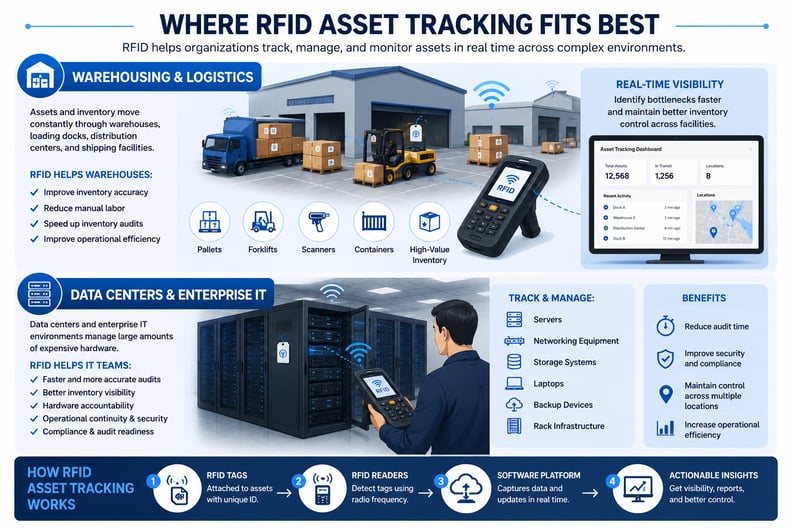
Warehousing & Logistics
Warehousing and logistics operations are some of the most common use cases for RFID technology.
Assets and inventory move constantly through:
- warehouses
- loading docks
- distribution centers
- and shipping facilities.
Tracking everything manually can slow operations and increase inventory errors.
RFID improves warehouse asset tracking by allowing businesses to automatically monitor inventory movement in real time.
Instead of scanning every item individually, employees can quickly scan large groups of tagged assets using handheld or fixed RFID readers.
This helps warehouses:
- improve inventory accuracy
- reduce manual labor
- speed up inventory audits
- and improve operational efficiency.
Many organizations also use RFID-based real time asset tracking systems to monitor:
- pallets
- forklifts
- scanners
- containers
- And high-value inventory.
Real-time visibility helps logistics teams identify bottlenecks faster and maintain better inventory control across facilities.
Data Centers & Enterprise IT
Data centers and enterprise IT environments manage large amounts of expensive hardware.
This often includes:
- servers
- networking equipment
- storage systems
- laptops
- backup devices
- Rack infrastructure.
Maintaining accurate inventory records in these environments is critical for:
- operational continuity
- security
- audits
- And compliance.
Traditional inventory audits in data centers can take significant time when assets must be manually verified one by one.
RFID asset tracking helps IT teams perform faster and more accurate hardware audits.
Technicians can quickly scan server racks and equipment areas using handheld RFID readers without manually checking every serial number.
This improves:
- inventory visibility
- hardware accountability
- and audit efficiency.
RFID also helps enterprise IT teams maintain better control over asset movement across multiple offices, facilities, or campuses.
RFID vs Barcode Asset Tracking
RFID and barcode systems are both used for asset tracking, but they work very differently.
Many businesses start with barcode tracking because it is simple and affordable. Over time, as operations grow and inventory becomes harder to manage, organizations often look for faster and more automated tracking methods.
This is where RFID becomes valuable.
Understanding the differences between RFID and barcode tracking helps businesses choose the right solution based on:
- inventory size
- operational complexity
- tracking speed
- Visibility requirements.
When RFID Makes More Sense
RFID becomes more valuable when organizations need:
- faster inventory processing
- real-time visibility
- higher inventory accuracy
- and large-scale asset tracking.
Industries such as:
- warehousing
- healthcare
- manufacturing
- data centers
- and enterprise IT
often benefit significantly from RFID-based real time asset tracking systems.
RFID is especially useful when:
- assets move frequently
- inventory audits take too long
- manual scanning creates delays
- or organizations manage thousands of assets across multiple facilities.
The ability to automate inventory tracking and scan multiple assets simultaneously gives RFID a major operational advantage in large environments.
Common Challenges With RFID Tracking
RFID asset tracking offers major advantages, but like any technology, it also comes with challenges.
Businesses considering RFID should understand these challenges before implementation so they can plan properly and choose the right solution for their environment.
The good news is that many of these issues can be reduced or solved with modern RFID systems, proper deployment planning, and the right hardware setup.
Here are some of the most common challenges organizations may face with RFID asset tracking.
Metal & Liquid Interference
RFID uses radio signals to communicate between tags and readers.
Certain materials, especially metal and liquids, can interfere with these signals and affect scanning performance.
For example:
- metal surfaces can reflect radio waves
- while liquids can absorb signals
This can sometimes reduce read accuracy or scanning range in certain environments.
Industries such as:
- healthcare
- manufacturing
- warehousing
- Data centers
often operate in environments where metal equipment and dense infrastructure are common.
To solve this, many organizations use specialized RFID tags designed specifically for:
- metal surfaces
- industrial equipment
- And challenging operational environments.
Modern RFID hardware has improved significantly, and many systems today are built to perform reliably even in complex enterprise environments.
Higher Initial Implementation Costs
Compared to barcode systems, RFID usually requires a larger upfront investment.
Businesses may need to purchase:
- RFID readers
- tags
- antennas
- software
- And supporting infrastructure.
For smaller organizations with limited inventory needs, barcode systems may initially appear more affordable.
However, many businesses find that RFID provides stronger long-term value through:
- reduced manual labor
- faster audits
- improved inventory accuracy
- And better operational efficiency.
For large enterprises managing thousands of assets, the operational savings often outweigh the initial implementation costs over time.
How to Choose the Right RFID Asset Tracking System
Choosing the right RFID asset tracking system is about more than buying tags and scanners.
The system should fit your operational needs, support long-term growth, and provide the visibility your organization needs to manage assets efficiently.
Some businesses only need basic inventory tracking, while others require enterprise-level real-time asset tracking solutions with automation, reporting, and multi-location visibility.
Understanding what to evaluate before investing helps organizations avoid costly implementation mistakes and choose a system that can scale over time.
Look for Scalability
One of the most important things to consider is scalability.
A system that works for a small inventory today may not support future operational growth.
As businesses expand, they often need to manage:
- more assets
- more employees
- multiple facilities
- And more complex inventory environments.
A scalable RFID asset tracking system should support:
- large inventories
- enterprise environments
- multiple locations
- cloud-based access
- And growing operational demands.
Organizations planning long-term growth should avoid systems that rely heavily on manual processes or limited infrastructure.
Evaluate RFID Hardware Compatibility
Not all RFID hardware works the same way.
Different environments may require different types of:
- RFID tags
- readers
- antennas
- And mobile scanning devices.
For example:
- warehouses may need fixed readers at dock doors,
- healthcare environments may require compact mobile scanners,
- and industrial operations may need rugged RFID equipment.
Businesses should choose systems that support the right hardware for their operational environment.
It is also important to ensure the RFID equipment tracking system can support:
- passive RFID
- active RFID
- handheld readers
- And mobile inventory workflows if needed.
The right hardware setup plays a major role in overall tracking accuracy and operational performance.
Prioritize Real-Time Visibility & Reporting
A modern real time asset tracking system should provide more than basic inventory records.
Organizations should look for software that offers:
- real-time asset visibility
- centralized dashboards
- inventory reporting
- movement history
- audit records
- And analytics tools.
Real-time visibility helps businesses quickly identify:
- where assets are located
- which assets are active
- and whether equipment is missing or underutilized.
Strong reporting tools also improve:
- compliance management
- operational planning
- And inventory accuracy.
For enterprise environments, centralized reporting becomes especially important when managing large inventories across multiple facilities.
How Asset Vue Helps Organizations Improve RFID Asset Tracking
As businesses manage larger inventories and more complex operations, many organizations are adopting RFID-powered tracking systems to improve visibility and inventory accuracy.
Asset Vue provides RFID asset tracking and real time asset tracking solutions designed to help organizations monitor physical and IT assets more efficiently.
Their solutions combine:
- RFID technology
- asset management sotware
- mobile scanning
- and centralized inventory visibility
to help businesses automate tracking workflows and reduce manual inventory processes.
Asset Vue supports organizations across industries such as:
- warehousing & logistics
- healthcare
- manufacturing
- enterprise IT
- and data centers.
By using RFID-powered asset tracking systems, organizations can improve:
- inventory accuracy
- audit speed
- operational visibility
- and overall asset management efficiency.
Conclusion
RFID asset tracking has become one of the most effective ways for organizations to improve visibility into physical and IT assets.
Compared to manual tracking methods and traditional barcode systems, RFID provides faster inventory management, stronger accuracy, and real-time operational visibility.
By using radio frequency technology, businesses can automatically track assets across warehouses, healthcare facilities, manufacturing operations, data centers, and enterprise environments without relying heavily on manual processes.
As organizations continue managing larger and more complex inventories, the demand for real time asset tracking solutions will continue growing.
RFID technology helps businesses:
- reduce manual work
- improve inventory accuracy
- speed up audits
- and maintain better control over asset movement across operations.
For industries that rely heavily on physical equipment and inventory visibility, RFID is no longer just an advanced tracking option. It is becoming a critical part of modern asset management and operational efficiency strategies.
Businesses that invest in scalable RFID asset tracking systems today will be better prepared to manage future operational growth while maintaining accurate, real-time asset visibility.


 FAQ
FAQ
Frequently Asked Questions
Our customers rely on Asset Vue to keep critical operations running smoothly. Here’s what they say about working with us.
What is RFID asset tracking?
RFID asset tracking is a system that uses radio frequency technology to identify and track physical assets automatically.Assets are tagged with RFID labels, and RFID readers detect those tags without requiring direct line-of-sight scanning. The information is then processed through asset management software to provide real-time visibility into inventory and asset locations.
How does RFID asset tracking work?
An RFID asset tracking system works using three main components:RFID tagsRFID readersasset management softwareThe RFID reader sends out radio signals, the tag responds with its unique ID, and the software updates the asset’s location and status in real time.This process helps organizations automate inventory tracking and maintain accurate asset records.
What are the benefits of RFID asset tracking?
RFID asset tracking helps organizations improve inventory accuracy, reduce manual work, speed up audits, and maintain real-time visibility into asset movement.Businesses also use RFID systems to reduce asset loss, improve operational efficiency, and automate inventory management processes across multiple locations.
What is the difference between RFID and barcode tracking?
Barcode tracking requires manual line-of-sight scanning, meaning assets usually need to be scanned one at a time.RFID tracking uses radio signals, allowing businesses to scan multiple assets simultaneously without direct scanning.RFID generally provides:faster auditsstronger automationbetter real-time visibilityand improved inventory accuracy compared to barcode systems.
How accurate is RFID asset tracking?
RFID asset tracking is generally more accurate than manual inventory methods and traditional barcode scanning.Because RFID systems automatically identify tagged assets using radio signals, businesses can reduce human error and maintain more reliable inventory records.Accuracy depends on factors such as tag placement, hardware quality, and the operational environment.
What are the challenges of implementing RFID asset tracking?
Some common RFID implementation challenges include:higher upfront costsmetal and liquid interferencehardware setup complexityand infrastructure planning.However, modern RFID systems and proper deployment planning can significantly reduce these challenges.