The IT service desk says the College of Engineering holds 1,850 devices. The finance fixed-asset register lists 2,100. A physical walk of the buildings turns up 1,660. Three systems, three numbers, and nobody can say which one matches what is actually plugged in, locked in a lab, or sitting in a graduate student's office.
That gap is the real test of IT asset management software on a university campus, and most tools were never built to pass it. They were built for a corporate office: one building, one IT department, one owner per laptop. A campus is none of those things.
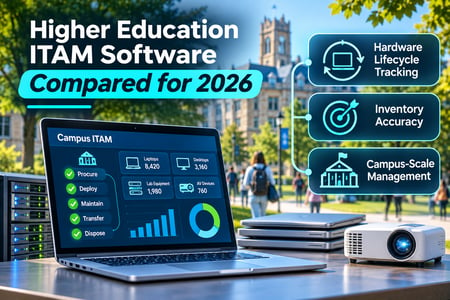
Choosing an ITAM platform for higher education comes down to three questions that a product demo rarely answers directly. Does it track the full hardware lifecycle, not just the software on the device? Does it keep inventory accurate between audits, not only on audit day? And does it hold up at campus scale, across dozens of buildings and departments that each run their own way? This guide compares the main categories of IT asset management software against those three criteria, with the facts that should shape the decision.
Key facts used
- ITAM software market valued at about $2.22 billion in 2026, projected to reach $3.01 billion by 2031 at a 6.28% CAGR (Mordor Intelligence).
- Hardware asset management market valued at $30 billion in 2024, projected to reach $72.58 billion by 2032 at an 11.7% CAGR, nearly double the ITAM software rate (Credence Research).
- Since 2020, the federal Higher Education Emergency Relief Fund has allocated roughly $74.8 billion to higher education institutions, much of it spent on devices for remote teaching and learning (CDW).
- "Inventory and Control of Enterprise Assets" is the first of the 18 CIS Controls; CIS guidance recommends reviewing the enterprise asset inventory at least twice a year (Center for Internet Security).
- Higher education IT is structurally decentralized, with asset and device management functions often located in individual colleges and departments (CDW, EDUCAUSE-aligned industry reporting).
Why higher education breaks generic ITAM software
Universities run on distributed ownership. Purchasing, budgets, and storage habits sit inside colleges, departments, and labs that each operate on their own. One laptop can be bought with a federal research grant, assigned to a biology lab, checked out by a graduate student, and supported by central IT, all at the same time. Generic ITAM software assumes one record, one owner, one cost center. On a campus, that model breaks on day one. AssetVue's guide to university asset management covers how that structure plays out building by building.
Device counts have climbed, too. Since 2020, the federal Higher Education Emergency Relief Fund has sent roughly $74.8 billion to colleges and universities, and much of it bought laptops, tablets, and lab hardware for remote teaching and learning (CDW). Those devices are still on campus. Many were deployed fast, tagged inconsistently, and tracked in spreadsheets that have drifted ever since.
So the question isn't which ITAM tool has the longest feature list. It's which one fits a decentralized institution where hardware moves constantly and no single team sees all of it. The three criteria below are where that fit gets decided.
Criterion 1: Hardware lifecycle tracking
Hardware lifecycle tracking follows a device through every stage: procurement, deployment, maintenance, transfer between departments, and disposal, with a record of who held it at each step. Most ITAM suites track the software and network side of that lifecycle well. They know what is installed, what is patched, and what is on the network. They treat the physical device itself as a line item.
On a campus, the physical device is the hard part. It moves between buildings without a ticket. It gets handed from one person to the next. It leaves on an AV cart through a side door the network never sees. Software discovery finds what is online; it cannot find a powered-down projector in a storage closet or a retired server waiting for pickup. Closing that gap takes a physical layer, which is the core of hardware asset management for modern IT teams.
The money is moving in that direction. Credence Research values the hardware asset management market at $30 billion in 2024, heading to $72.58 billion by 2032 at an 11.7% annual rate, nearly double the roughly 6% growth Mordor Intelligence projects for ITAM software over the same stretch. Software-only records keep drifting from the rack and the shelf, and institutions are investing in the physical tracking that ties them back.
When comparing tools on this criterion, check whether the platform records a custody chain for each asset, supports both procurement and disposal with dated status changes, and captures a physical scan at the moment hardware changes hands. A system that only ingests network discovery data will always be one move behind the device.
Criterion 2: Inventory accuracy
Inventory accuracy is a rate, not a one-time number. A register is close to right on the day it is reconciled, then it separates from reality as equipment moves, gets repaired, and gets disposed of without the record hearing about it. Periodic counts capture a snapshot. By the next semester, that snapshot is stale for a meaningful share of the fleet.
The most expensive form of inaccuracy is the ghost asset: a device on the books that no longer physically exists. Ghost assets inflate insurance premiums calculated from the total asset list, distort depreciation schedules that feed departmental budgets, and create compliance exposure when grant-funded equipment can't be located during a federal audit. Real-time capture closes the gap by recording movement as it happens, through fixed RFID readers at doorways, handheld scans in labs, and barcode check-in and check-out at the IT counter.
Accuracy also has a security weight. The Center for Internet Security makes Inventory and Control of Enterprise Assets the first of its 18 CIS Controls, and its guidance calls for reviewing the enterprise asset inventory at least twice a year, since a device you can't see is one you can't patch, monitor, or wipe. Drift decides how far off that inventory is by the time each review comes around.
Campuses that run their own data centers face the same drift at higher stakes, where one misplaced GPU server is a larger exposure than a loaner laptop. AssetVue's comparison of real-time asset management tools for data centers shows how continuous tracking turns the annual audit into a confirmation instead of a rebuild. When comparing ITAM software on accuracy, look for a "last verified" timestamp on every asset, an exception queue for items that miss an expected scan, and a capture method that doesn't depend on someone remembering to update a field.
Criterion 3: Campus scale
Scale on a campus means more than a large asset count. It means a single structure that holds buildings, floors, rooms, and outdoor spaces without forcing each one into a separate database. It means role-based access, so a department admin sees their own equipment, central IT sees everything, and finance sees depreciation and grant allocation. It means mixed tagging, with RFID for high-value and high-movement items and barcode for everything else, both feeding one dashboard.
Multi-dimensional ownership is the detail that separates campus-ready platforms from the rest. A tool built for a corporate office assumes one owner per device. A university needs the same laptop to carry a funding source, a departmental assignment, a current custodian, and a maintenance owner at once, and to report cleanly on any of them. Audit-ready exports matter here too, because institutional auditors, state regulators, and federal grant agencies each want the data cut a different way, and reformatting it by hand every cycle is a tax no team should pay.
The platform categories, compared
Most products a higher-ed IT team will evaluate fall into four categories. Each is strong somewhere and thin somewhere else.
General ITSM and ITAM suites (ServiceNow, ManageEngine, Freshservice) build asset tracking on top of a service desk and a configuration management database. They handle tickets, software, and network discovery well, and they suit institutions that want asset data living beside incident and change management. Their weak spot is physical hardware across buildings: they see what is on the network, not what is in a closet, and RFID or barcode tracking is usually an add-on rather than a foundation.
Software and SAM-first tools (Flexera, Snow) optimize license spend and audit defense. They are built for the software side of the asset estate and do that job well. They are not designed to tell you where a physical laptop is or who is carrying it.
Higher-ed device and lab management tools (Jamf, LabStats) manage endpoints and measure lab usage with real depth. They are strong for managed, networked devices and for deciding how many machines a lab actually needs. Their limit is the asset that isn't a managed endpoint: furniture, AV gear, instruments, and anything powered down or off the network.
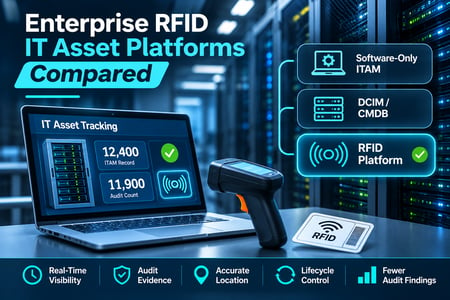
Hardware-first RFID and barcode platforms (AssetVue) start from the physical device. Tags and scan points record location and custody as a side effect of the work, so the record stays close to the rack and the shelf. AssetVue's IT asset management platform maps assets to buildings, floors, rooms, and custodians in one hierarchy, combines RFID and barcode, and integrates with the ITSM and finance systems that own the other slices of the record. The trade-off is that physical-first tracking only pays off where you actually place capture points.
|
Platform type
|
Hardware lifecycle tracking
|
Inventory accuracy at campus scale
|
Best fit
|
|
General ITSM / ITAM suites
|
Strong on software and network, light on physical
|
Accurate for networked devices, blind to off-network assets
|
Institutions centering asset data on the service desk and CMDB
|
|
Software / SAM-first tools
|
Software estate only
|
High for licenses, not applicable to physical location
|
License optimization and software audit defense
|
|
Higher-ed device / lab management
|
Strong for managed endpoints
|
Accurate for networked machines, limited for other assets
|
Lab usage analytics and Apple or endpoint fleets
|
|
Hardware-first RFID / barcode
|
Full physical lifecycle with custody chain
|
Real-time across buildings, including off-network assets
|
Campus-wide physical inventory accuracy
|
No single category wins every criterion. The right answer depends on which problem is costing the institution the most. If the pain is license spend, a SAM tool leads. If it is lab utilization, a device-management tool leads. If the pain is the three-numbers problem from the opening, where nobody can confirm what is physically on campus, a hardware-first platform is the one built to solve it, usually alongside the ITSM and finance systems rather than replacing them.
What to confirm before you buy
Not every product fits a university's operational model. Before shortlisting vendors, confirm the platform handles the things a campus actually needs:
Multi-site hierarchy. Buildings, floors, rooms, and outdoor spaces in one structure, not separate databases that need manual reconciliation.
Multi-dimensional ownership. One asset carrying a funding source, a department, a custodian, and a maintenance owner at the same time.
Mixed tagging. RFID for high-value and high-movement items, barcode for the rest, both feeding the same dashboard.
Verification age. A "last verified" date on every record, so stale data and fresh data don't look identical.
Role-based access. Department admins see their own gear, central IT sees all of it, finance sees depreciation and grant allocation.
Integration, not replacement. Clean connections to the ITSM platform, the CMDB, and the finance register, with clear rules about which system owns which field.
Audit support. Exportable reports that satisfy institutional auditors, state regulators, and federal grant agencies without custom formatting every cycle.
AssetVue helps universities track IT and physical assets across buildings, departments, and funding sources with RFID and barcode technology, so the record matches what is actually on campus. Schedule a call to compare it against your current tracking setup.


 Contact Us


 FAQ