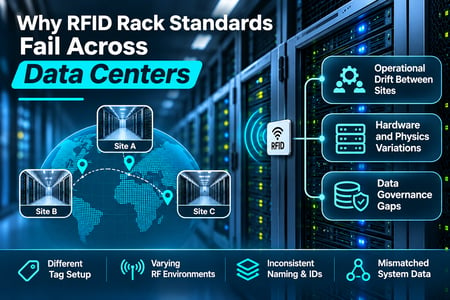
An enterprise runs RFID in six data centers. Every site passed its own acceptance test, and every site reads its own racks cleanly. Roll all six into one dashboard and the enterprise asset count is still an estimate. Site 2 tags the chassis, site 5 tags the rail kit. Site 1 names cabinets by row, site 4 by grid coordinate. Site 3 never syncs its reads to anything but a spreadsheet nobody reconciles.
The radios all speak the same protocol. The deployments do not agree.
That gap is the RFID rack standardization problem, and it is the reason a technology that works in one building so often falls apart across a portfolio. The physics of reading a tag on a metal rack was solved years ago. What no vendor solves for you is the set of decisions around the radio: where the tag goes, how the asset is identified, how a location is named, where the reads happen, and which system owns which field. Make those decisions differently at each site and the records never roll up.
This guide separates the two layers of "RFID rack standards." First, the industry standard your hardware already shares. Second, the enterprise standards you have to define yourself and enforce everywhere. Then it lays out a deployment model that scales those standards from a pilot to an entire estate without rebuilding them at every site.
Key facts
- RFID rack hardware already shares one industry standard: passive UHF, branded RAIN RFID, built on the GS1 EPC UHF Gen2 protocol and the ISO/IEC 18000-63 air-interface standard, operating in the 860 to 960 MHz band. GS1 ratified the newest Gen2 release, version 3.0.1, in February 2026.
- That standard makes radios interoperable. It does not make two sites agree. Standardization breaks on the choices around the radio, not the radio itself.
- A passive UHF tag laid flat on a metal server often will not read at all. On-metal tags and fixed read points are what hold read rates steady from site to site.
- The fastest route to a consistent estate is a reference site, a "golden template," that every other site copies, under one owner and one reconciliation cadence.
- The Uptime Institute estimates that roughly 20% of servers in an average facility are obsolete or unused. A standardization program is the moment to retire them, so the enterprise count means something.
Two kinds of RFID rack standards
The word "standard" does two different jobs in this topic, and conflating them is where most programs go wrong.
The first kind is the technical standard your equipment is built to. Nearly every rack-tracking deployment today uses passive ultra-high-frequency RFID, which the RAIN Alliance brands as RAIN RFID. A tag or reader that carries that brand follows the GS1 EPC UHF Gen2 protocol and the equivalent ISO/IEC 18000-63 air-interface standard, and operates in the 860 to 960 MHz UHF band. GS1's Gen2 air interface is the foundation of the ISO standard, and the two track each other closely. The practical result is interoperability: a Gen2v2 tag from one vendor reads on a compliant reader from another.
The second kind is the enterprise standard, the set of rules you write for how your organization deploys that hardware. The industry standard guarantees the radios can talk. It says nothing about where you stick the tag, what number you encode on it, or how you name the rack it sits in. Those are your decisions, and they are exactly the decisions that have to match across sites for a multi-site count to add up.
So the industry standard is necessary and already handled. The enterprise standard is what you actually have to build. The rest of this guide is about the second one.
Why enterprises struggle to standardize
Multi-site RFID rarely fails on hardware. It fails on governance, and the pattern is consistent.
Each data center tends to get deployed as its own project, on its own timeline, by whoever owned that site. One site buys tags in 2024 and another in 2026, from different vendors, with different mounting habits. Acquisitions bring in facilities that were never part of any plan. Nobody writes down a reference design, so each team makes reasonable local choices that happen not to match the next team's reasonable local choices. There is no single owner holding every site to one rule, and no shared cadence for checking that the sites still agree.
None of these are technology faults. They are the absence of a standard and the absence of an owner. The companion guide on how to standardize RFID rack tracking across data centers walks through the operational side of closing those gaps. This post focuses on the standards themselves and the model that rolls them out.
The RFID rack standards stack
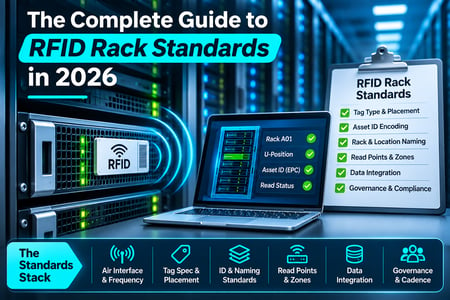
A standardized estate is one where seven decisions are made once, written down, and applied at every site. Think of them as a stack: each layer has to be the same everywhere, or the layers above it inherit the inconsistency.
Standard 1: Air interface and frequency. Fix the baseline your estate buys to. For most data centers that is RAIN RFID, meaning GS1 EPC UHF Gen2v2 and ISO/IEC 18000-63, with the regional frequency and power settings each site's regulator allows. This is the one layer the industry has already standardized for you. Your job is to write it into procurement so no site buys off-baseline hardware that cannot interoperate.
Standard 2: Tag spec and placement. Pick one on-metal tag family and one mounting rule, and apply both everywhere. On-metal tags carry a spacer or ground plane that lets them radiate off steel, where an ordinary label tag detunes and reads erratically. Mount the tag on the chassis, in a defined position and orientation, never on a bezel, rail kit, or faceplate that can leave with a removable part. Placement decides read consistency more than almost anything else, which is why reads drift from one sweep to the next when tags sit on the wrong surface or face the wrong way.
Standard 3: Identifier and data encoding. Decide what number identifies an asset and how it is written to the tag, then use that scheme at every site. You have two honest options. Encode a GS1 identifier under the GS1 Tag Data Standard, which governs how an identifier is written to the tag's EPC memory. Or encode your own documented asset-tag numbering scheme. Either works. What breaks an estate is one site keying on the chassis serial while another keys on an internal asset tag, so the same server shows up as two assets when the data rolls up. Pick one key and make it the primary identifier across every system.
Standard 4: Location and naming hierarchy. Name building, room, row, rack, and U-position the same way at every site. "Rack 14" has to mean one thing across the portfolio. A single naming hierarchy is what lets a central team compare a count in one facility against a count in another without a translation table in between.
Standard 5: Read-point coverage. Define where reads happen, not just that they happen. The standard should put a read point at every place custody changes, including the cabinet, the row, the cage door, and the loading dock, with handhelds filling only the gaps between fixed coverage. Rack-level and row-level antennas reading at a short, controlled range beat a far-field reader trying to punch through a full row of steel. Set the same coverage rule everywhere and a clean read in one aisle means the same thing as a clean read in the next.
Standard 6: Integration and field ownership. Write one contract for which system owns which field. The tracking platform owns location, the CMDB owns configuration, the DCIM owns power and space, and a sync only ever writes a field from its owning system. Without that rule, syncs overwrite verified reads with stale or planned data, and the record quietly drifts. Pointing every site at AssetVue as the single asset tracking platform, with field ownership defined, is what lets a central team pull one number for the whole estate and trust it.
Standard 7: Governance and reconciliation. Name one owner for the standard and one cadence for checking it. Every site compares its reads against the DCIM, the CMDB, and a physical count on the same schedule, and every mismatch above a small threshold goes to a named person with a deadline. A standard with no owner drifts back into six local variants within a year.
A scalable deployment model
Knowing the seven standards is not the same as rolling them out across twenty sites without the program collapsing under its own weight. The model that scales is a reference site that every other site copies, deployed in four phases.
Phase 0: Define the standard. Before any hardware ships, write the seven standards down as the enterprise default. This is a document, not a deployment. It names the tag family, the mounting rule, the identifier scheme, the naming hierarchy, the coverage rule, the field-ownership contract, and the governance owner. Everything downstream references it.
Phase 1: Build the reference site. Deploy the standard in full at one data center and prove it reconciles. This is the golden template. Its tag placement, its naming, its reader layout, and its integration become the pattern, photographed and documented so a later site copies a known-good build instead of reinventing one. Clean the baseline here first: run a full sweep, reconcile against the DCIM, CMDB, and finance register, and retire the obsolete hardware before you measure success.
Phase 2: Templated rollout. Bring the remaining sites online against the template, not from scratch. Each new site is a copy with local adjustments for its floor plan, its regional frequency rules, and its existing racks. Because the standard is fixed, the only open questions at each site are physical, which keeps rollout fast and keeps every site landing on the same model. Acquired facilities get retrofitted to the same template rather than left as exceptions.
Phase 3: Steady-state governance. Once the estate is live, the work shifts from deployment to holding the line. The governance owner runs the shared reconciliation cadence, reviews the exception queue, and checks that no site has drifted off the tag, naming, or integration standard. New hardware and new sites enter through the same template. This phase has no end date, because drift has no end date.
A quick way to place your estate on this path is a maturity ladder. At the bottom, tracking is ad hoc and every site is its own island. One step up, each site is internally consistent but sites do not match each other. One more, the estate shares one standard and one platform. At the top, that standard is actively governed and new sites inherit it by default. Most enterprises running RFID in more than one building sit on the second rung and mistake it for the third.
Why 2026 raises the stakes
Two shifts make a loose, site-by-site approach more expensive than it used to be.
Consolidation into colocation and hybrid footprints means more organizations are moving hardware between sites they do not fully control, which multiplies the handoffs where a record and a device part ways. At the same time, dense GPU and AI racks have pushed the value of a single chassis far above a general-purpose server, so one misplaced or unaccounted unit is a larger financial and security exposure than it was a few years ago.
Both trends reward a standard that produces a current, defensible count on the first day after any change, rather than a quarterly audit that rebuilds the inventory from scratch. A structured comparison of real-time asset management tools for data centers is the right place to match the capability to your situation. That article also cites the Uptime Institute estimate that about 20% of servers in an average facility are obsolete or unused, which is the hardware a standardization program should retire before it ever gets tagged, trucked, or counted twice.
A standardization go or no-go checklist
Before you call a multi-site deployment standardized, confirm every item:
- One air-interface baseline. Procurement only buys RAIN RFID hardware, Gen2v2 and ISO/IEC 18000-63, at every site.
- One tag spec. Every site uses the same on-metal tag family, mounted on the chassis in the same position.
- One identifier scheme. A single primary key, encoded the same way, references every asset across every system.
- One naming hierarchy. Building, room, row, rack, and U-position follow identical labels everywhere.
- One coverage standard. Fixed reads at every custody change point, with handhelds filling defined gaps.
- One integration contract. Each field has a single owning system, and syncs never overwrite verified reads.
- One governance owner and cadence. A named person owns the standard and the exception queue, and every site reconciles on the same schedule.
Each item you cannot check is a place where two sites will drift apart again.
Running RFID in more than one data center and still can't trust the enterprise total? AssetVue standardizes RFID rack asset tracking across sites with on-metal tagging, real-time rack-level reads, and DCIM and CMDB integration, so one report speaks for every facility. Schedule a call to plan your multi-site standard.


 Contact Us


 FAQ