Most enterprise ITAM tools are excellent at telling you what software runs on a laptop and nearly useless at telling you which rack the laptop is sitting in. That split matters, because the hardware lifecycle, from the purchase order to the certificate of destruction, is physical. A server gets de-racked, a loaner laptop changes hands, a GPU chassis moves between cages, and none of those events touch the network stack your discovery tool watches.
So when an enterprise IT asset management team goes shopping for the "best" tool, the honest answer depends on which problem they are actually trying to solve. A platform that wins on software license optimization can be blind to a storage room full of decommissioned hardware. A CMDB that maps every service dependency can still carry a server that was recycled 11 months ago.
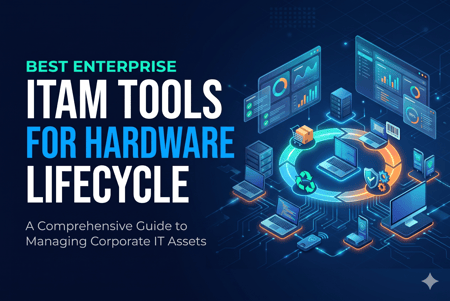
This comparison looks at enterprise ITAM tools through one lens: the hardware lifecycle. It groups the market into four categories, scores each on hardware lifecycle tracking, CMDB connectivity, and physical inventory control, and takes a position on where the gaps usually sit in a data center or a large institution.
Key facts
- Enterprise IT asset management runs on ISO/IEC 19770-1:2017, the ITAM management-system standard. It is built on a Plan-Do-Check-Act cycle and names "Trustworthy Data" as the first implementation tier, ahead of lifecycle integration and optimization (ISO/IEC JTC 1/SC 7).
- Up to 33% of IT assets are not captured or managed by ITAM systems (Forrester, Tame the Asset Management Beast).
- Gartner has reported that through 2024, 99% of organizations running CMDB tooling without addressing configuration-item data-quality gaps would face visible business disruption (3 Steps to Improve IT Service View CMDB Data Quality, 2022).
- The CIS Controls list inventory and control of enterprise assets as Control 1, the first of 18 (Center for Internet Security).
- The Uptime Institute has estimated that roughly 20% of servers in an average facility are obsolete or unused.
- Hardware moves through five lifecycle stages: plan and procure, deploy, operate and maintain, refresh, and retire and dispose. End-of-life sanitization is governed by NIST SP 800-88.
What "best" means for hardware lifecycle
Before comparing categories, pin down the three capabilities that decide whether a tool keeps hardware records accurate over an asset's life.
Hardware lifecycle tracking follows a device through five stages: plan and procure, deploy, operate and maintain, refresh, and retire and dispose. ISO/IEC 19770-1:2017 frames ITAM as managing assets across every one of those stages, and it puts trustworthy data first, before any optimization. A tool that tracks deployment but loses the thread at disposal leaves ghost assets on the books.
CMDB connectivity decides whether hardware records agree with the configuration and service data the rest of IT relies on. A CMDB is only as good as its inputs. Gartner has reported that through 2024, 99% of organizations running CMDB tooling without confronting data-quality gaps would see visible business disruption. Integration alone does not fix that.
Physical inventory control is the ability to confirm that a specific device is physically present in a specific place right now. This is the capability most software-first tools skip, and it is where up to 33% of IT assets go uncaptured, according to Forrester's Tame the Asset Management Beast.
A tool can be strong on one or two of these and weak on the third. The best setup covers all three, usually by combining categories rather than betting on a single product.
The four categories of enterprise ITAM tools
Enterprise buyers rarely compare products one to one, because the products are built for different jobs. It is more useful to compare the four categories the market actually splits into.
Category 1: ITSM and CMDB platforms
ITSM-centric platforms treat the CMDB as the center of gravity. They model configuration items, service dependencies, and change records, and they are the system of record most of IT already works from. For hardware, they track status and ownership as attributes on a configuration item.
Their strength is the service view: what depends on what, and what breaks if a device goes down. Their weakness is physical truth. A CMDB cannot see a device; it reflects whatever its upstream sources tell it. Lifecycle status often gets updated by hand, which is exactly where it goes stale. These platforms answer "what is this asset connected to," not "is this asset still in the building."
Category 2: Discovery and software asset management suites
Network discovery and SAM suites scan the environment, agent-based or agentless, and populate records for everything they can reach. They are built around software license position and security hygiene, and they are good at it.
The limit is in the name: discovery finds what is on the network. A powered-off server in a staging room, a spare in a closet, a decommissioned switch in a disposal bin, none of these answer a ping. For the hardware lifecycle, that means discovery is strong during the operate stage and nearly silent at procurement, storage, refresh staging, and disposal, the stages where hardware most often drifts out of the record.
Category 3: DCIM tools
Data Center Infrastructure Management tools track the physical layer of the data center: power draw, cooling, rack space, cabling, and rack-unit position. For a server inside a cabinet, a DCIM knows more about its physical context than any other category.
That precision stops at the data center door. A DCIM manages the infrastructure an asset sits in, not the asset's full custody chain across buildings, campuses, or field sites. And DCIM records model space and power, not procurement or disposal, so the lifecycle view is partial. DCIM is the right tool for capacity and power planning; it is not a complete hardware lifecycle system.
Category 4: Dedicated physical asset tracking
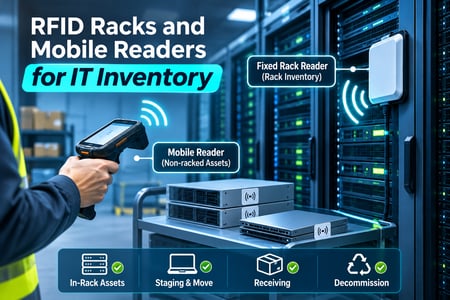
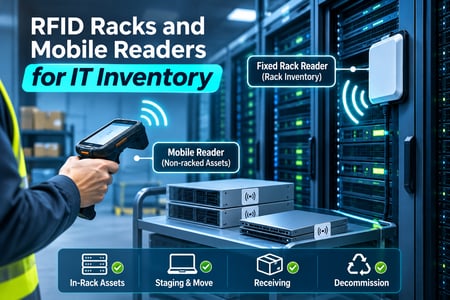
Dedicated hardware tracking platforms start from the physical object. RFID tags and barcode labels make the device itself the primary identifier, and fixed or handheld readers record location and custody as a side effect of normal work. AssetVue's dedicated hardware asset tracking platform uses passive and active RFID, barcodes, smart cabinets, and rack sensors so a scan, not a manual edit, updates the record.
The strength is physical accuracy across the whole life and across every location, including the stages discovery and DCIM miss. The trade-off is that this category is a verification and location layer, not a license-management or service-mapping engine. It is strongest when it feeds the CMDB and DCIM rather than replacing them.
How the categories compare
|
Tool category
|
Hardware lifecycle tracking
|
CMDB connectivity
|
Physical inventory control
|
Best fit
|
|
ITSM / CMDB platform
|
Status and ownership as CI attributes, often manual
|
Native (it is the CMDB)
|
None natively; trusts upstream data
|
Service mapping, change management
|
|
Discovery / SAM suite
|
Strong at operate stage; license-focused
|
Feeds the CMDB
|
Network-visible assets only
|
Software licensing, on-network discovery
|
|
DCIM
|
Rack, power, and space over the asset's data center life
|
Integrates with the CMDB
|
Rack-level, inside the data center only
|
Capacity and power planning
|
|
Dedicated physical tracking
|
Full custody and location across all five stages
|
Integrates with CMDB and DCIM
|
Native RFID and barcode verification
|
Physical accuracy across sites
|
Hardware lifecycle tracking: where each category fits
Map the categories onto the five lifecycle stages and the coverage gaps become obvious.
At plan and procure, the asset does not exist on the network yet, so discovery contributes nothing. Procurement data lives in finance or the ITSM platform. At deploy, discovery and DCIM both pick the asset up, and this is the stage every category handles. At operate and maintain, all four can contribute, though status accuracy depends on whether repair and RMA events write back to the record.
The gaps open at the end. At refresh, hardware moves into staging, gets swapped, and shuffles between sites, which is movement discovery cannot see and a CMDB only hears about if someone types it in. At retire and dispose, a device gets wiped and recycled under NIST SP 800-88, but the record often survives the hardware. That surviving record is a ghost asset: it still carries a depreciation schedule, still inflates insurance, and still shows up in audits. Physical tracking is the category that closes the record at the moment the device physically leaves, because the tag stops reading.
CMDB connectivity: integration is not accuracy
Every category above claims CMDB integration, and the claim is usually true. The catch is that integration moves data; it does not verify it. A sync between two systems can quietly degrade the data it carries through field mapping losses, duplicate records, timing gaps, and unmapped status values. We covered this failure mode in detail in why CMDB and DCIM syncs corrupt hardware inventory.
This is why "connects to the CMDB" is a weak evaluation criterion on its own. The stronger question is which system owns which field, and whether any part of the stack can confirm the physical facts the CMDB stores. Completeness, a filled-in record, is not the same as accuracy, a correct record. A hardware record can be complete and wrong at the same time.
The practical fix is a physical verification layer that validates the CMDB rather than just feeding it. When an RFID sweep or barcode audit confirms that a device is where the CMDB says, the CMDB earns its trust. When the sweep disagrees, you have found drift before it reaches a change decision or an audit.
Physical inventory control: the layer most stacks skip
Physical inventory control is the capability that separates a current inventory from a historical one. It is also the one most enterprise stacks are missing, because ITSM, discovery, and SAM tools all operate in the digital layer.
The cost of skipping it shows up as the Forrester figure: up to a third of IT assets uncaptured. It shows up again in security. The CIS Controls put inventory and control of enterprise assets first, as Control 1, because a device nobody knows about cannot be patched, monitored, or wiped. And it shows up in the data center, where the Uptime Institute has estimated that roughly 20% of servers in an average facility are obsolete or unused, hardware that a physical audit finds and a network scan walks right past.
RFID and barcode tracking close this gap by recording movement and custody physically. The device carries its own identity, readers log transitions as assets pass through chokepoints, and the record reflects the floor instead of the last manual edit.
Data centers vs. universities
Two kinds of large institution feel the hardware lifecycle problem most, and their shapes differ.
In a data center, the hardware is dense, expensive, and concentrated, and the worst accuracy damage happens during migrations and consolidations, when thousands of physical changes land in a few days and custody passes to movers who never log into the asset system. A platform that keeps rack-level accuracy through that event is worth more than one that only shines in steady state. The mechanics of that are in our guide on how data center moves break inventory accuracy.
In a university or large campus, the hardware is cheaper per unit but spread across dozens of buildings, departments, and funding sources, and it drifts constantly as loaner laptops, AV carts, and lab instruments cross boundaries. The accuracy problem is breadth, not density, and it calls for multi-site hierarchy and role-based access more than rack sensors. We break down that environment in our work on university IT asset inventories. The common thread across both: the tool has to confirm physical reality, not just record intent.
How to evaluate enterprise ITAM tools for hardware lifecycle
Before shortlisting vendors, confirm the platform, or the combination of platforms, covers these points. AssetVue builds IT asset management around physical hardware for exactly this reason.
- Physical verification. The tool can confirm a device is present through RFID, barcode, or both, not just infer it from a network signal.
- Full lifecycle coverage. Records open at procurement and close at disposal, with status that updates through refresh and retirement, not only during the operate stage.
- Multi-site hierarchy. Buildings, floors, rooms, racks, and sites map in one structure, so data centers and distributed campuses live in the same model.
- CMDB and DCIM integration with field ownership. The platform syncs both ways but with explicit rules about which system owns location, configuration, and power, so syncs stop overwriting good data.
- Custody chain. Every checkout, transfer, and return logs a name, time, and place, going back as far as compliance requires.
- Audit and compliance reporting. Exportable records satisfy internal auditors, regulators, and grant agencies without rebuilding the report each cycle.
The best enterprise ITAM tool is usually more than one
There is no single winner, and any comparison that crowns one is selling something. ITSM and CMDB platforms own the service view. Discovery and SAM suites own software license position. DCIM owns data center power and space. Dedicated physical tracking owns location and custody across the whole life.
For the hardware lifecycle specifically, the physical verification layer is the one most enterprise stacks are missing, and it is the one that keeps the other three honest. The strongest setup runs the CMDB or ITSM platform as the system of record, the DCIM for data center physical context, and a physical tracking layer that confirms reality, with clear field ownership deciding who writes what. Pick the categories your environment actually needs, then make sure something in the stack can walk the floor.
AssetVue gives enterprise IT teams the physical verification layer their CMDB, DCIM, and discovery tools are missing, with RFID and barcode tracking across data centers, campuses, and distributed sites. Schedule a call to see how it fits your stack.


 Contact Us


 FAQ