A misplaced infusion pump is rarely gone for good. It sits in a soiled-utility room two floors up, rides out on a discharge bed, or waits in a closet nobody opens until the next biomed sweep. The hospital pays for it either way: in the nurse time spent hunting for a replacement, in the rental unit brought in to cover the gap, and in capital spent on spares that paper over equipment which was never actually lost.
For a healthcare IT asset manager, equipment loss is three problems wearing one coat. It is a budget line. It is a care-delivery risk when the device a clinician needs isn't where it should be. And on any device that stores patient data, it is a compliance exposure. The question worth asking before you sign a contract is simple: which IT asset management system reduces that loss, and which one just records it after the fact?
Most systems can tell you what you own. Far fewer can tell you where a specific device is right now and raise a flag before it leaves the building. That gap is the whole game for loss prevention, and it's the lens this comparison uses.
Key facts
- Searching for misplaced equipment costs U.S. hospitals an estimated $14 billion a year in lost staff productivity, according to figures cited by GE Healthcare.
- Industry estimates put the share of a hospital's mobile assets lost or stolen over their useful life at 10% to 20%, at an average of roughly $3,000 per item.
- Nurses can lose up to an hour per shift looking for equipment, time that comes straight out of patient care.
- Santa Clara Valley Medical Center reported 383 medical items missing between 2010 and 2014, including incubators, heart monitors, and mammography machines, which it traced to weak inventory monitoring.
- Healthcare has recorded the highest average data breach cost of any industry for 13 straight years, reaching $6.6 million in the 2026 IBM Cost of a Data Breach Report. Lost or stolen devices are among the factors that push that cost up.
What loss prevention asks of an ITAM system
Asset inventory management and loss prevention are not the same job. An inventory system answers "what do we have and what is it worth." A loss-prevention system has to answer "where is it, who has it, and has it moved somewhere it shouldn't." The first is an accounting function. The second is an operational one, and it needs different machinery underneath.
This is where buyers get caught. A spreadsheet or a basic IT asset management platform can hold an accurate list on the day you build it. Neither keeps that list true as equipment moves through a 400-bed hospital with three shifts, dozens of departments, and a steady flow of rentals and loaners. The controls below are what close that distance. Compare systems on these, not on how many fields their asset record holds.
The controls that prevent loss
Real-time location
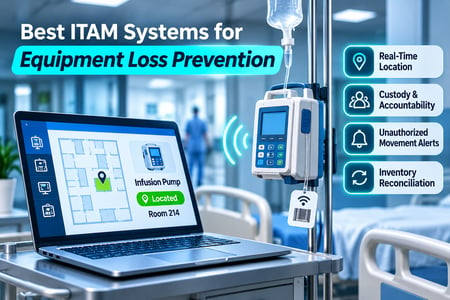
The single largest lever on recovery is time. Equipment that gets flagged the same day it goes missing is far more likely to come back than equipment first noticed during a quarterly count. A system that records every location change as it happens shortens the search from "walk the building" to "check Room 214, last read at 3:15 PM."
Barcode and RFID feed this differently. Barcode confirms location at each manual scan. Fixed and handheld RFID readers log movement as tagged equipment passes a zone, with no one scanning anything. For high-value asset tracking on items that move constantly, like portable ultrasound units or telemetry packs, RFID carries the load because it does not depend on a busy clinician remembering to scan. The same recovery-window logic, worked through in detail, is covered in how continuous tracking cuts equipment loss.
When you evaluate equipment tracking systems, ask what "real-time" means in the demo. Some products refresh on a nightly batch and call the result current. That is a historical snapshot with a shorter delay, and it will not catch a device walking out a side door this afternoon.
Custody and accountability
Equipment goes missing faster when no name is attached to it. A system that logs every checkout, transfer, and return with a person, a timestamp, and a location builds a custody chain that makes someone accountable at every step. That record does two things. It tells you who last held a missing device, and it changes behavior before anything goes missing, because people handle tracked equipment more carefully when they know the handoff is logged.
Look for custody history that goes back as far as your compliance requirements demand, and for role-based access so a department admin manages their own equipment while central IT keeps oversight across the institution.
Alerts on unauthorized movement
Visibility without alerting still leaves someone watching a screen. The control that matters is the automatic flag: a tagged asset crosses a boundary it shouldn't, and the system notifies an owner the same day. Geofencing at exits, loading docks, and department thresholds turns a silent departure into a task that lands in someone's queue while recovery is still realistic.
Compare how configurable these rules are. A system that only alerts when a device leaves the whole campus misses the floor-to-floor drift that accounts for most "lost" equipment. The useful version lets you define zones at the department or room level.
Reconciliation against the record
Even a well-run inventory separates from reality between audits. A device gets disposed of without an update, a loaner changes hands twice, a status never propagates from the repair queue. That slow gap between the record and the floor is inventory drift, and it is how ghost assets accumulate: items that sit on the books, inflate insurance and depreciation, and read as "we have it" long after they're gone.
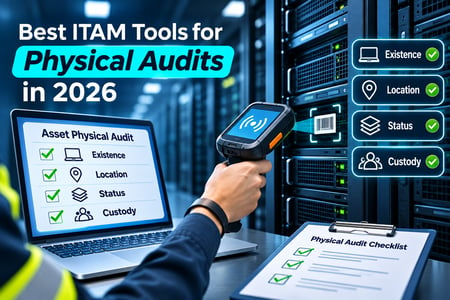
A loss-prevention system fights drift by keeping records in sync with physical events as they happen, and by surfacing a "last verified" timestamp on every asset so stale data and fresh data stop looking identical. When you compare systems, ask how an RFID sweep reconciles against the system of record, and how long a full physical audit takes. The difference between an audit that confirms the inventory and one that rebuilds it from scratch is a real operating cost.
Security controls for data-bearing devices
In a regulated facility, a missing laptop, tablet, or imaging workstation is not only a replacement cost. If it holds protected health information, it's a potential breach. Healthcare has carried the highest average breach cost of any industry for 13 consecutive years, and lost or stolen devices sit among the factors that raise that figure. The HHS Office for Civil Rights has settled cases on exactly this pattern, including a $1.04 million resolution after an unencrypted laptop was stolen from an employee's car, exposing the data of more than 20,000 patients.
Physical custody tracking is part of the defense. A system that logs where a data-bearing device is, who holds it, and when it was decommissioned and wiped gives you the audit trail a breach investigation demands. That overlap between physical tracking and data protection is the point of pairing asset management with IT asset security controls: the device record and the security record describe the same object.
Audit and compliance reporting
The last control is the one finance and auditors feel. A loss-prevention system should export reports that satisfy institutional auditors, state regulators, and federal grant agencies without a custom formatting project every cycle. For grant-funded instruments, a clean chain of custody and an accurate disposition record are what keep a ghost asset from becoming an audit finding. Compare systems on whether their reporting maps to the frameworks you're actually held to, not on how many chart types the dashboard offers.
What healthcare and regulated facilities need that generic ITAM misses
Corporate ITAM products assume a single-owner model: one laptop, one employee, one cost center. A hospital breaks that assumption. One infusion pump can be owned by central biomed, assigned to a unit, checked out to a float nurse, and funded by a capital grant, all at once. A system purpose-built for healthcare has to carry that multi-dimensional ownership without forcing every department into an identical workflow.
Two more requirements separate clinical-grade systems from office-grade ones. The first is EMR cross-reference: tying a tracked device to the patient record or room context so a lost telemetry pack can be matched against where the patient actually was. The second is tolerance for the clinical floor itself, where metal carts, dense equipment, and constant movement interfere with reads, and where a tag on a removable bezel can separate from the device it's meant to identify. Regulated enterprise environments outside healthcare, from labs to data centers, hit the same wall: the asset model has to survive real operating conditions, not the tidy ones in a product demo.
AssetVue helps hospitals and regulated facilities track high-value equipment with RFID and barcode technology, across departments, custodians, and funding sources. Schedule a call to see how it fits your facility.


 Contact Us


 FAQ