An auditor pulls 40 asset tags from your ITAM system and asks your team to walk to each device and confirm it. The system knows every laptop's hostname, its last login, its patch level, and the user it's assigned to. What it can't tell you is which floor the laptop is on, whether it's in a drawer or a decommission bin, or whether it walked out the door in March. Your team finds 37. The other three become an audit finding.
That gap is the one most IT asset management (ITAM) tools leave open. They were built to discover devices on a network, not to verify objects on a floor. For regulated enterprises that get audited on both, the distinction decides whether an audit is a formality or a three-week scramble through storage rooms.
The best ITAM tools for physical audits close the distance between the record and the room. This guide covers why most tools can't, what a physical audit actually tests, the criteria that separate audit-ready platforms, and how the main categories of ITAM software compare for a regulated team.
Key facts
- CIS Control 1, "Inventory and Control of Enterprise Assets," is the first of the 18 CIS Controls. Safeguard 1.1 calls for reviewing the enterprise asset inventory at least twice a year, covering physical, virtual, remote, and cloud assets. (Source: Center for Internet Security)
- ISO/IEC 19770-1:2017, the ITAM management system standard, runs on a Plan-Do-Check-Act cycle and lists three implementation tiers in order: Trustworthy Data, lifecycle integration, and optimization. Trustworthy data comes first. (Source: ISO/IEC)
- Network discovery tools see only devices that are powered on and connected. A physical audit tests devices whether or not they are on the network, which is where discovery-based ITAM tools leave a gap.
- A physical asset audit verifies four things about the physical object: that it exists, where it is, what state it's in, and who holds it.
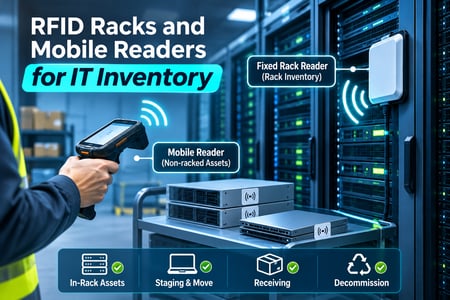
- AssetVue reports that RFID reduces manual inventory time from about an hour per rack to under a minute, which is what makes auditing a large footprint practical rather than a quarterly project.
Why most ITAM tools fail a physical audit
Most ITAM platforms earn their keep through network discovery. Agents and scanners find devices on the network, read their configuration, and populate the record. That approach is good at answering "what is running and how is it configured." It is poor at answering "where is this specific object, right now."
The blind spot is everything off the network. A laptop in a decommission bin, a spare switch in a storage closet, a loaner tablet in a drawer, a server pulled for repair: none of them respond to a scan, so discovery can't confirm they exist or where they sit. The record keeps showing the last state anyone captured, which may be months stale.
The gap widens on its own. Every unlogged move, repair, and disposal pushes the record a little further from reality, a process covered in the complete guide to IT asset inventory drift. By audit day, the accumulated drift is exactly what the auditor samples for.
Regulators assume you can account for the physical object, not just the network endpoint. CIS Control 1, the first of the 18 CIS Controls, requires an inventory of all enterprise assets and a review at least twice a year that covers physical, virtual, remote, and cloud assets. A tool that can only see what's on the network satisfies part of that requirement and leaves the physical half to a spreadsheet and a clipboard.
What a physical audit actually tests
A physical audit checks the object, not the database. For each sampled asset, an auditor confirms four things, and an ITAM tool is only audit-ready if it holds current data on all four.
Existence. The asset the record describes is a real device someone can put a hand on, not a ghost asset that was disposed of without updating the system.
Location. The device is where the record says, down to the building, floor, room, or rack, not "somewhere in the East campus."
Status. The record's lifecycle state matches reality. A device marked "deployed" is deployed, not sitting in a returns bin or already shredded.
Custody. The person or team named as custodian is the one who actually holds it, not an employee who left in March.
These four map directly to the controls auditors test under frameworks regulated teams already live with. ISO/IEC 19770-1, the ITAM management system standard, puts "trustworthy data" as the first implementation tier, ahead of lifecycle integration and optimization, because every downstream control depends on the record matching the object. SOX fixed-asset testing, grant-funded equipment rules, and security frameworks all rest on the same foundation. The practice of tying each of these checks to a physical scan is the subject of physical hardware control for IT asset audits.
The criteria that separate audit-ready ITAM tools
Feature lists blur together in a demo. For physical audits specifically, these are the capabilities that decide whether a tool holds up. The broader set is in the features that matter in asset management software; the ones below are the audit-critical cut.
A physical verification layer. The tool captures data from RFID tags and barcode scans, not only network discovery. RFID confirms many assets through a chokepoint without line of sight; barcode confirms a specific device at a specific spot. A platform without either can't verify an off-network object.
The physical tag as the primary identifier. When every system references the same RFID or barcode tag ID, the serial-versus-asset-tag mismatches that create duplicate records go away. The tag on the device becomes the single source of truth that ties the digital record to the physical object.
A full lifecycle and custody trail. Every receipt, deployment, transfer, repair, and disposal is logged with a name, timestamp, and location, so the audit trail reconstructs who had what, where, and when. AssetVue's IT asset management solution is built around this link between lifecycle records and physical verification, which is the pairing a physical audit tests.
A multi-site location hierarchy. Buildings, floors, rooms, racks, and outdoor zones map in one structure, not as separate databases someone reconciles by hand. Auditors sample across sites, so the hierarchy has to be one system.
Exportable audit evidence. The tool produces reports that satisfy internal auditors, external auditors, and regulators without custom formatting every cycle. If pulling audit evidence is a data-export project, the tool is adding work instead of removing it.
Role-based access. Departmental admins manage their own equipment, central IT sees everything, and finance sees depreciation and funding allocation. Access scoped to role keeps the record current because the people closest to each asset can maintain it.
Enterprise reach and integration. A regulated ITAM tool has to work across every department and site, and feed the CMDB, DCIM, and ITSM systems the rest of the organization runs on. Integrating IT asset management across the enterprise is what turns a departmental tool into a system of record the whole organization audits against.
How the main categories of ITAM tools compare
ITAM tools fall into four broad categories, and each handles physical audits differently. Capabilities shift between releases, so confirm the details against current vendor documentation before you shortlist.
|
Tool category
|
What it does well
|
Where it falls short on physical audits
|
Best fit
|
|
ITSM suites with a CMDB (e.g., ServiceNow)
|
Configuration, change, and service relationships, with mature workflow
|
Tracks the digital record, not physical presence; location is often free-text and stale
|
Large enterprises standardizing on one ITSM platform
|
|
Network discovery and SAM tools (e.g., Lansweeper)
|
Finding and classifying what's on the network; software license inventory
|
Blind to powered-off, stored, or off-network hardware
|
Software license control and network visibility
|
|
Lightweight and open-source trackers (e.g., Snipe-IT, Asset Panda)
|
Barcode check-in and check-out, assignments, low cost
|
Manual scanning, with limited audit reporting and multi-site scale
|
Small teams and single-site checkout tracking
|
|
RFID and barcode physical-first platforms (e.g., AssetVue)
|
Verifying existence, location, and custody of the physical object
|
Needs tag and reader deployment up front
|
Regulated enterprises audited on physical assets
|
The pattern across the table is consistent. CMDB-centric and discovery tools are strong on the digital layer and weak on physical presence. Lightweight trackers add basic physical tracking but rarely scale to a multi-site audit. Physical-first platforms are built for the exact thing an audit tests, at the cost of tagging and reader setup, which the first audit usually pays back in recovered hours.
Most regulated enterprises don't replace one with another. They keep the CMDB and discovery tools for configuration and license data, and add a physical verification layer underneath so the records tie back to real objects. The question is less "which single tool" and more "which tool owns the physical truth."
Where AssetVue fits
AssetVue sits in the physical-first category. It combines passive and active RFID, barcode labels, fixed and handheld readers, smart cabinets, and rack sensors, and maps every asset to a building, floor, room, and custodian in one hierarchy. It integrates with CMDB, DCIM, and ticketing tools so the physical layer reconciles with the systems the rest of the enterprise runs. The result is a record that can be verified against the object, which is the one thing a physical audit checks and the one thing discovery-based tools can't do on their own.
Evaluating ITAM tools for an upcoming audit? AssetVue ties IT asset lifecycle records to physical verification with RFID and barcode tracking, so your records match your hardware when the auditor arrives. Schedule a call to see how it works in your environment.


 Contact Us


 FAQ