An auditor asks a simple question: show me every server that touches customer financial data, where it sits right now, and who is responsible for it. In a regulated bank or a data center handling cardholder data, that question has to be answered with evidence, not confidence. The team pulls the asset spreadsheet. It lists 3,000 devices. Nobody can swear it matches the floor, because the last count was in March and hardware has moved since.
That gap between the record and the rack is where compliance findings come from. A control is only as strong as the inventory behind it, and most inventories are built from periodic counts that start drifting the day they close. RFID asset management attacks the problem at its source by recording where equipment is, who holds it, and when it moves, continuously, so the inventory an auditor sees is the inventory that actually exists.
For regulated IT and data center teams, that shift changes asset tracking from a reporting chore into an audit control.
Key facts
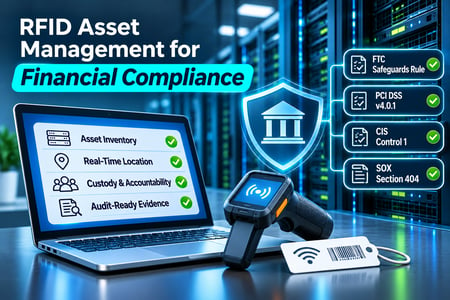
- The FTC Safeguards Rule (16 CFR Part 314) requires covered financial institutions to maintain an inventory of data, devices, and systems as one of its required safeguards. Compliance has been mandatory since June 9, 2023.
- PCI DSS v4.0.1 Requirement 12.5.1 requires a current inventory of every in-scope system component, with a description of its function. Requirement 12.5.2 requires scope to be reconfirmed at least every 12 months, and 12.5.2.1 tightens that to every six months for service providers.
- CIS Control 1, Inventory and Control of Enterprise Assets, is the first of the 18 CIS Controls and calls for reviewing the asset inventory at least twice a year.
- Sarbanes-Oxley Section 404 holds public companies accountable for IT general controls over the systems that produce financial reports, which puts the hardware running those systems inside audit scope.
- RFID asset management records location and custody as assets move, which replaces periodic counts with continuous visibility an auditor can verify on demand.
What regulators actually require
Financial compliance frameworks don't ask for perfect tracking in the abstract. They ask for a current, complete inventory of the assets inside scope, and they ask you to prove it.
The FTC Safeguards Rule under GLBA names a data, device, and systems inventory as one of the required elements of a financial institution's information security program. PCI DSS makes it explicit: Requirement 12.5.1 says the inventory of in-scope system components must be "maintained and kept current," and the surrounding requirements force a formal scope review every 12 months, or every six for service providers. The Center for Internet Security goes further still, ranking asset inventory as the first of its 18 Controls, on the logic that you cannot protect, patch, or wipe a device you don't know you own. Add SOX Section 404 for public companies, which pulls the hardware running financial systems into the scope of IT general controls.
The common thread across all of them is the word current. A snapshot from last quarter satisfies none of these on its own. The requirement is a live record, and a live record is exactly what periodic counting cannot produce.
Why spreadsheets fail an audit
A spreadsheet or a quarterly count gives you a defensible number on one day of the year. The rest of the year, it decays. Equipment gets borrowed between cages, a server gets decommissioned without the record being updated, a drive gets pulled for secure disposal and the asset stays flagged as active. None of these is a mistake anyone would notice until an auditor does.
This is the accuracy problem that quietly undermines every control built on top of the inventory. The reasons records separate from reality are well catalogued in what breaks IT asset inventory accuracy: unlogged moves, missed scans, duplicate records, and status changes stranded in other systems. Every one of them produces a line on the asset list that an auditor can challenge and you cannot defend.
The failure mode that costs the most is the ghost asset: a device that was wiped and recycled but still counts as active on the books. It inflates insurance, distorts depreciation, and in a federal examination it becomes a finding, because you are claiming to control hardware that no longer exists.
What RFID changes
RFID asset management records movement as a side effect of the work, rather than depending on someone to update a field after the fact. A tagged asset passing a fixed reader logs its own location change. A handheld scan at a checkout counter writes the custody transfer. The inventory updates because the hardware moved, not because a technician remembered to type it in.
That is the difference between a historical count and real-time asset management tools that keep the record current between audits. Location, status, and custody stay in sync with the floor, so the inventory you report is the inventory you have. For a compliance team, continuous capture turns the annual scramble to reconcile the asset list into a confirmation that it was right all along.
The accuracy gain is measurable where it matters most. AssetVue reports that an RFID sweep cuts manual inventory time from roughly an hour per rack to under a minute, which is what makes a full facility reconciliation practical on demand instead of once a year.
Audit readiness is the payoff
Compliance isn't the state of having accurate data. It's the state of being able to prove it to someone who is paid to doubt you. RFID asset management produces that proof as a byproduct of normal operations.
Every scan, transfer, and status change lands in a timestamped custody chain, which gives an examiner a defensible answer to "who had this device, where, and when." Reports export against the asset list the auditor is testing, without reformatting work each cycle. Audit-ready asset visibility means the evidence exists before the request arrives, so an examination becomes a lookup rather than a three-week floor walk.
That readiness also narrows the scope-confirmation burden PCI DSS and the Safeguards Rule impose. When the inventory is already current and already shows function, location, and custodian per asset, the periodic scope review confirms a known state instead of rebuilding it.
Regulated data centers and bank facilities
Compliance pressure concentrates in the data center, where the hardware running financial systems lives. Banks and regulated operators also manage assets across branches, cages, and colocation space they don't fully control, which widens the surface an inventory has to cover.
Rack-level tracking closes the gap. AssetVue's data center asset tracking uses Real-Time Racks and Smart Cabinets to report installed equipment and open U-space continuously, combined with passive RFID and barcode scanning, and integrates with DCIM, CMDB, and ticketing so the records stay current as hardware settles. For bank asset tracking specifically, the same hierarchy maps devices to buildings, rooms, racks, and custodians, so a device holding regulated data can be located and attributed without a floor search.
The point is not more tags for their own sake. It is confirmation that a specific regulated asset is physically present in a specific place at the moment an auditor asks.
AssetVue helps regulated IT and data center teams keep an audit-ready asset inventory with RFID and barcode tracking, rack-level visibility, and DCIM/CMDB integration. Schedule a call to see how it supports your next compliance audit.


 Contact Us


 FAQ